An outdoor camera is the one piece of home security that a stranger can see from the pavement, and that turns out to be the entire point. The research on this is better than the research on almost anything else in home security, and it says something specific: cameras that are visible and clearly connected to a response change behaviour, while cameras that quietly record do not. That distinction should decide which of these fifteen you buy. We ranked them on image quality, night performance, weather sealing, what the subscription really costs, and what happens to your footage.
Every major subscription in this category was renamed, repriced or both in the last year, so much of what you will read online quotes plans that no longer exist. Nest Aware became Google Home Premium in October 2025 at higher prices. Ring Home became Ring Protect on 14 January 2026 with new tier names. Arlo restructured its plans, and its most-quoted price is routinely described as per-camera when it is not.
The deterrence literature also supports outdoor cameras far better than it supports video doorbells — but with a condition attached that should change what you buy.
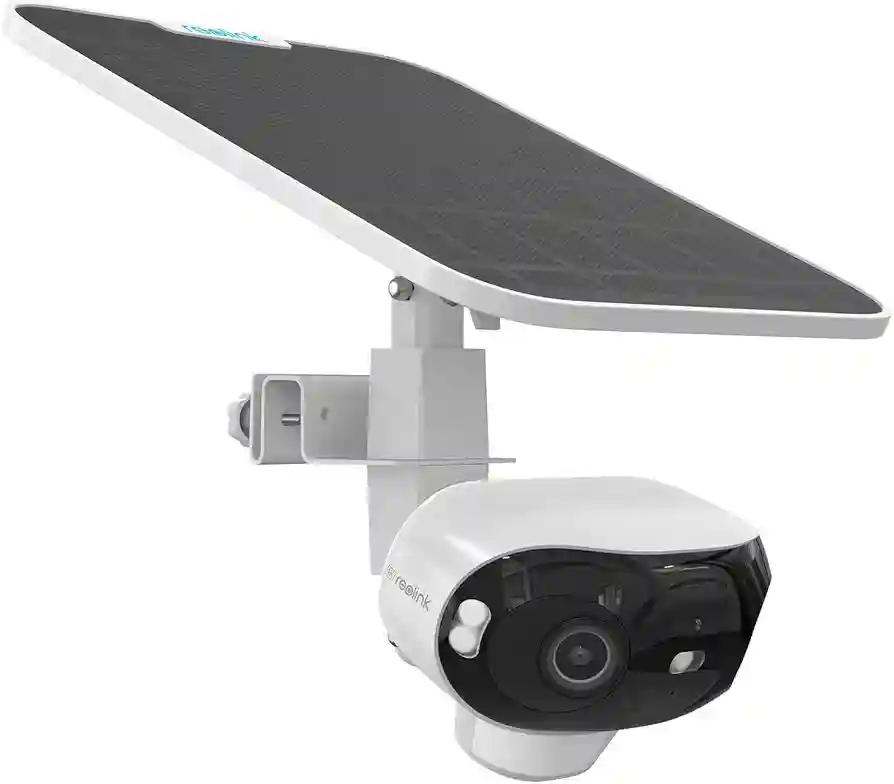
4K across a 180° stitched view, colour night vision without a spotlight, local storage, and nothing to pay monthly. The rare case where the value pick is also the best pick.
- 4K at a mid-range price
- 180° view with no fisheye distortion
- Genuine colour night vision, no spotlight needed
- All AI detection free and on-device
- Local storage — no cloud, no account risk
- Solar option means you may never touch it again
- Wi-Fi only, 2.4GHz for range
- Small and discreet — poor deterrent shape
- Reolink app is functional rather than pleasant
- No professional monitoring option
Dual-lens stitching is the trick here. Most wide cameras use one very wide lens and accept the barrel distortion, which stretches faces at the edges into something useless for identification. The Argus 4 Pro uses two lenses and joins the images, so you get 180° of coverage that stays rectilinear across the frame. At 4K, that means a face at the edge of your driveway is still a face.
Everything runs locally. Person, vehicle and animal detection happen on the camera, footage lands on a microSD card in your hand, and there is no account holding your video. Read the privacy record further down and you will see why that architecture matters more than any feature list.
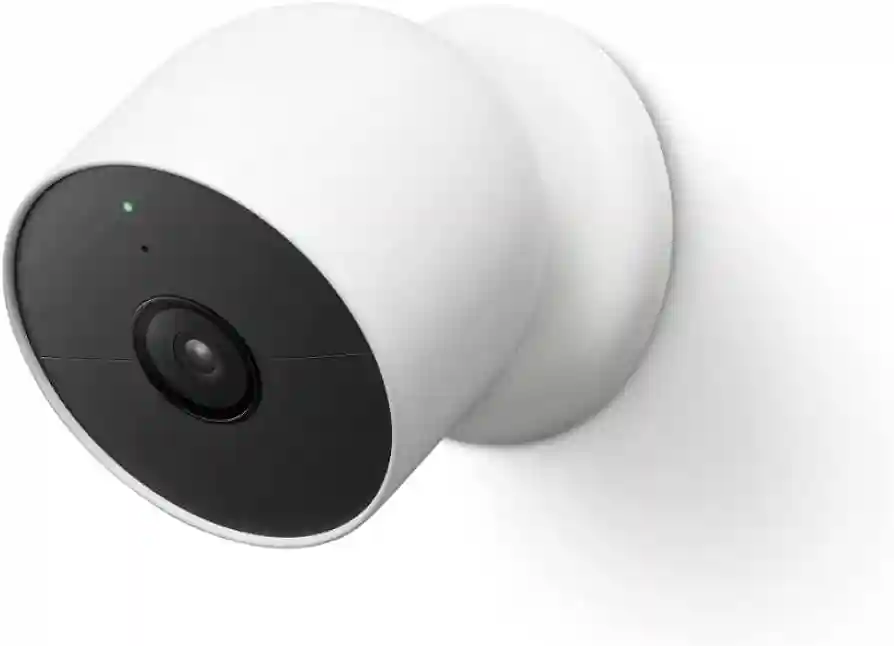
The camera you set up for your parents. Charge it, scan a code, stick it to the magnetic mount, done. Person, vehicle and animal detection work free — the history does not.
- Genuinely the simplest setup of any camera here
- Free on-device person, vehicle and animal detection
- Magnetic mount makes repositioning trivial
- Keeps recording briefly if the internet drops
- Excellent Google Home integration
- No local storage of any kind, ever
- Subscription prices rose in 2025, second rise since 2023
- Battery drains fast in a busy location
- Small, dark and unobtrusive — weak as a deterrent
Google deserves credit for the thing most brands paywall: person, vehicle and animal detection run on the camera itself and cost nothing. That is genuinely unusual, and it means a free Nest Cam still filters out the neighbour's cat.
Price the subscription properly before you commit, because the plan most sites still quote no longer exists. Nest Aware was retired in October 2025 and replaced by Google Home Premium: Standard at $10 a month or $100 a year for 30 days of event history, Advanced at $20 or $200 for 60 days plus continuous recording and the Gemini features. Google raised those prices in 2025 — Standard was $8, Advanced was $15 — the second increase since 2023. And no Nest camera has a card slot. Without a plan there is no archive; with one, you are renting your own footage.
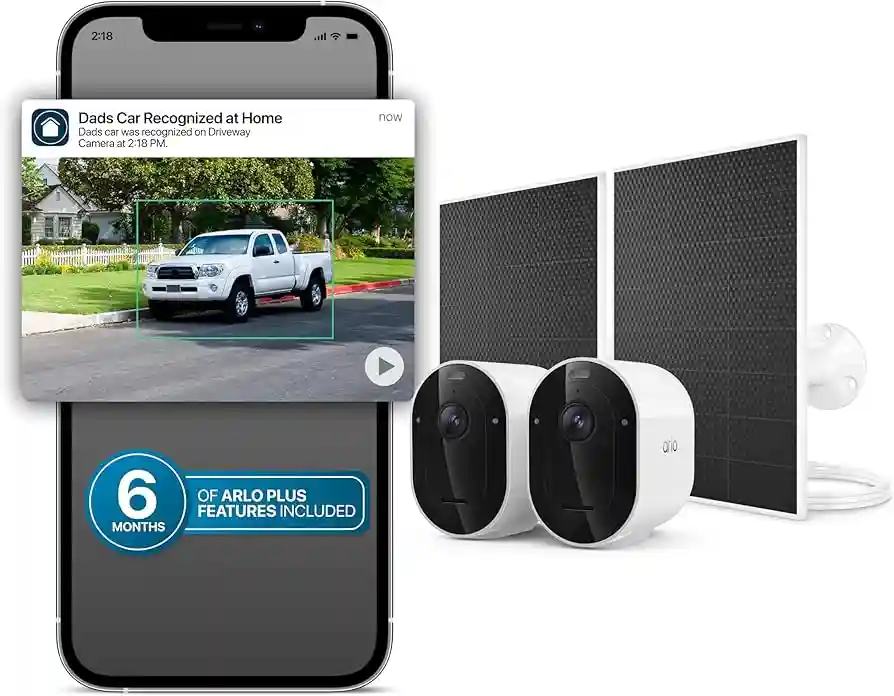
Excellent hardware on a platform that talks to everything — and charges for the privilege of keeping any of the footage.
- Broadest smart home support of the premium brands
- Dual-band Wi-Fi — rare and genuinely useful outdoors
- Colour night video from the built-in spotlight
- Unlimited plan covers every camera, not per-camera
- Premium tier adds real professional monitoring
- No cloud clips at all without a plan
- Arlo has raised subscription prices repeatedly
- Subscription-free route requires buying a Smart Hub
- Expensive before you have paid a penny in fees
Arlo is widely quoted at "$8–18 per month per camera," which makes it look considerably more expensive than it is. The $17.99 tier is Secure Plus Unlimited, covering every camera on the account, not $17.99 each. In full: Secure Plus Single is $7.99 a month billed annually or $9.99 monthly; Secure Plus Unlimited is $17.99 annually or $19.99 monthly; Secure Premium is $24.99 annually and adds 24/7 professional monitoring, event captions and cellular backup. With one camera the single plan makes sense; with three or more the unlimited plan is the cheapest premium-brand option on this page.
What has not changed is that newer Arlo cameras save nothing to the cloud without a plan. Live view works; the clip you wanted does not exist. The only subscription-free path is local recording to an Arlo Smart Hub, which is another purchase.
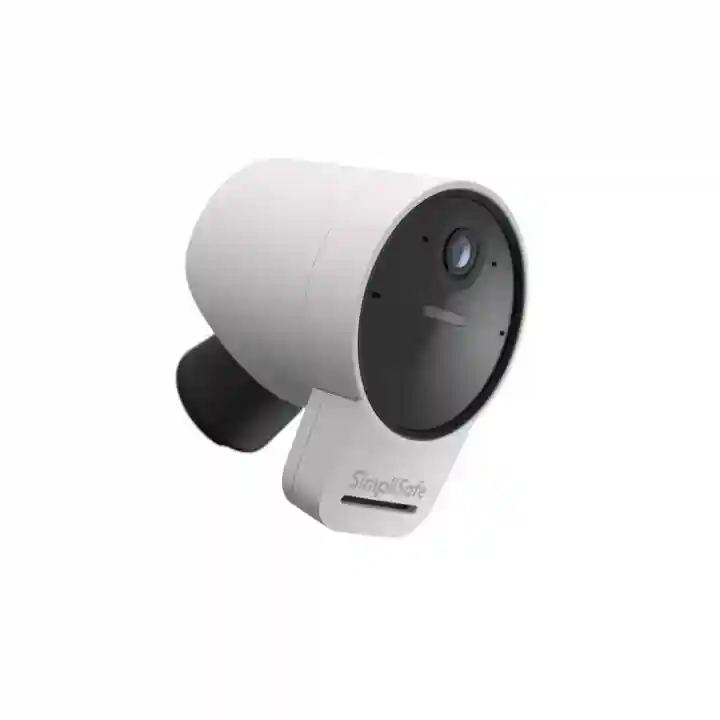
The only camera here that does what the deterrence research actually says works: a real person watching, who can turn on a light, sound a siren and speak to whoever is in your garden.
- Matches the one intervention with strong evidence behind it
- Agent talk-down works when you are asleep or abroad
- Spotlight and siren are visible and audible from the street
- Integrates with a genuine alarm system
- The feature that matters requires a monitoring plan
- Highest ongoing cost here
- Pointless unless you buy into the wider system
- Image quality is good, not class-leading
This camera exists at number four because of a single research finding, covered in full below: in a large systematic review of CCTV studies, actively monitored systems were associated with a meaningful crime reduction while passive, record-only systems showed no statistically significant effect. Almost every camera on this page is passive. This one is not.
Whether that is worth the monthly cost depends on what you are buying a camera for. If you want a record of what happened, buy the Reolink and put the difference in your pocket. If you want fewer things to happen, the evidence points here — and to a monitored alarm system more generally.
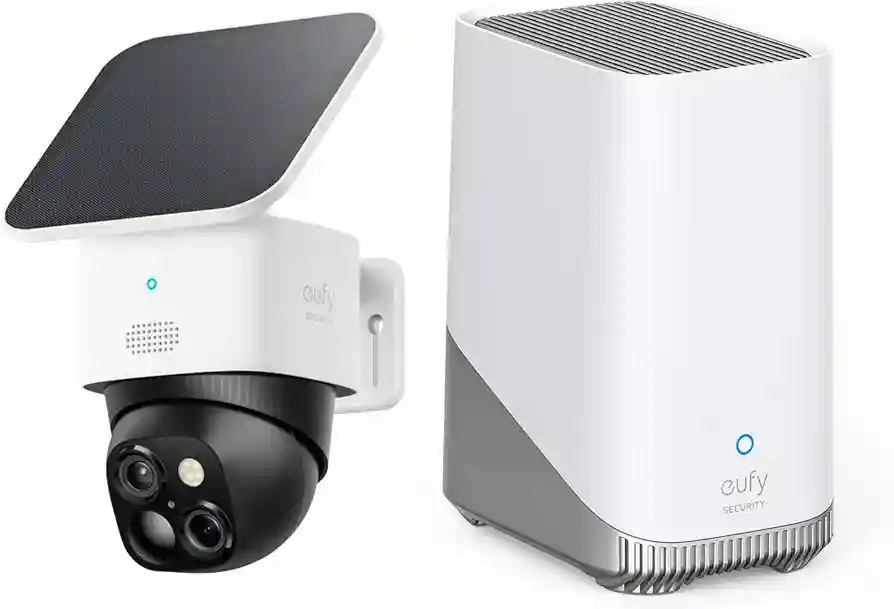
Solar panel built in, dual lenses with 3× zoom, pan and tilt across 360°, and 8GB on board. Install it once and forget it exists — from the company that was caught being wrong about local storage.
- Built-in solar — realistically never needs charging
- Telephoto lens actually resolves faces at distance
- Tracks movement across a full 360°
- Local storage, no fees
- Large enough to be noticed, which matters
- Anker's documented privacy failure was about exactly this promise
- 8GB fills quickly on a busy frontage
- Needs genuine direct sun for the solar to keep up
- Moving parts are the first thing to fail outdoors
The dual-lens arrangement is the standout. A single wide lens gives you a nice picture of a person-shaped blur at thirty feet; the S340 pairs a wide lens with a 3× telephoto and can track a subject and zoom on it, which is the difference between "someone was here" and "that person was here."
The caveat is the company. In late 2022 researcher Paul Moore showed eufy devices sold on the promise of "No Clouds or Costs" uploading name-tagged thumbnails and facial recognition results to Amazon Web Services with cloud storage switched off; The Verge streamed footage from a eufy camera across the country unencrypted. Anker's admissions came in stages, ending in early 2023 with the acknowledgement that the cameras were never end-to-end encrypted. Current firmware is much better. If you buy it, set notification content to text-only — that stops images leaving the house and makes the marketing true.
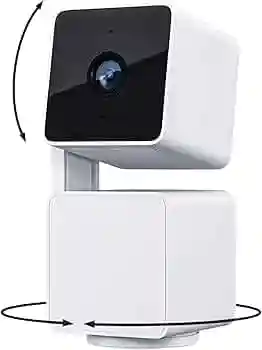
2K, colour night vision and continuous local recording for the price of two months of somebody else's cloud plan. The hardware is a bargain; the company's history is the price.
- Cheapest credible outdoor camera by a distance
- 2K with real colour night vision
- Continuous microSD recording with no plan at all
- Cam Plus is the cheapest paid tier on this page
- Took nearly three years to fully patch a 2019 disclosure
- Showed roughly 13,000 users other people's feeds in 2024
- Cam Plus rose 50% in March 2026
- Wired only — you need an outdoor outlet
- Free tier caps clips at 12 seconds
Set it to record continuously to a microSD card and this becomes a genuinely capable camera that costs nothing to run. The free cloud tier caps clips at twelve seconds, which is close to useless, but the card sidesteps that entirely.
The history is the reason it sits at six rather than two. Bitdefender disclosed vulnerabilities in March 2019 that Wyze did not fully patch until January 2022; the Cam v1 was unfixable and retired. In February 2024, around 13,000 users were shown other people's camera feeds after a caching library mismapped device and user identifiers — the second such incident in five months. Running it on a card, with no cloud plan, avoids the class of failure that has actually bitten Wyze customers.
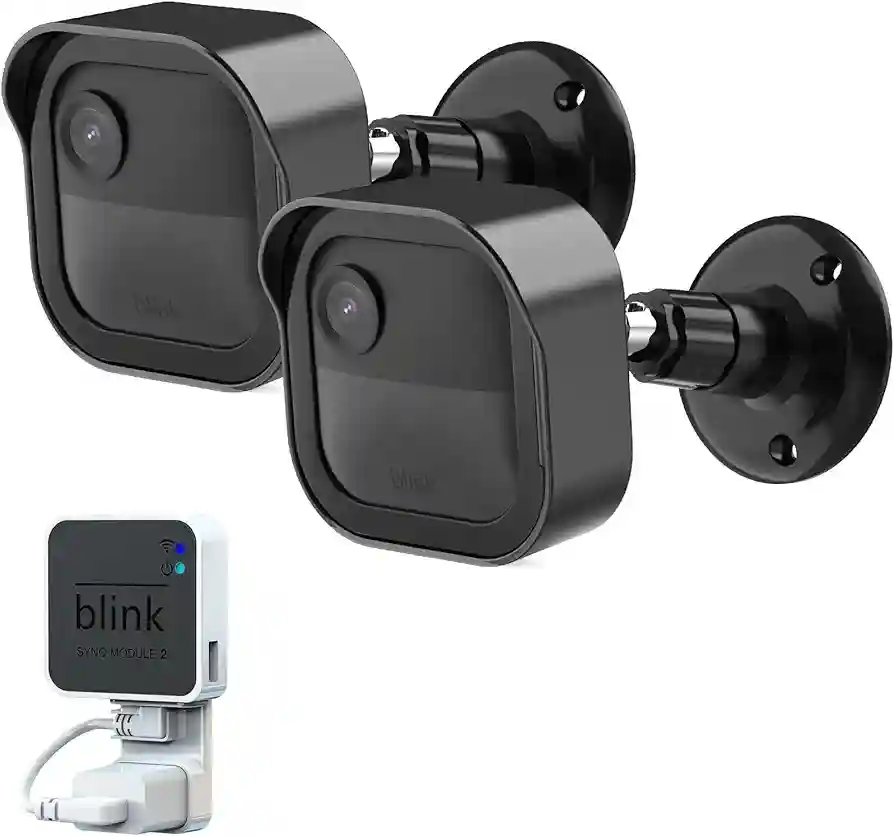
Two AA lithium cells, two years of life, and a local backup option if you buy the Sync Module. Modest resolution, near-zero maintenance.
- Two-year battery life is unmatched here
- Cheapest per-camera plan of the big brands at $3
- Sync Module 2 gives a genuine local backup path
- Plus plan includes hardware replacement cover
- Deep Alexa integration
- 1080p is the lowest resolution on this list
- Local storage needs an extra purchase
- No colour night vision
- Amazon-owned, so the Ring privacy questions are adjacent
Two years on a pair of AA cells is not a marketing figure you should dismiss — it is the difference between a camera you maintain and a camera you install. For a garage, a side gate or a shed where you want coverage and never want to think about it, this is the sensible choice.
The corrected plan detail: Blink Basic is $3 a month per camera with 60 days of clip history, and Blink Plus is $10 a month or $100 a year covering every camera on the account and adding replacement cover for hardware failures. Buy the Sync Module 2 and you can skip both.
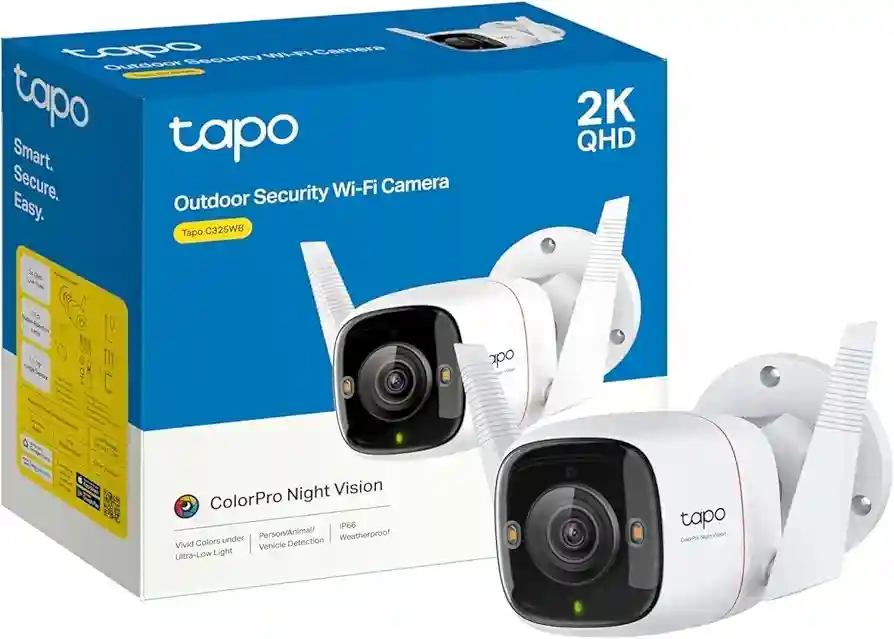
Colour night video with no spotlight, half a terabyte of local storage and free AI detection, for fifty dollars. The best pure value on the page, with an asterisk about data handling.
- Starlight sensor gives colour at night without a light
- 512GB of local storage — months of footage
- Free person, vehicle and pet detection
- Around $50
- Consumer Reports rates TP-Link poorly on data privacy
- Wired only
- Small and easy to miss — weak deterrent
- App is basic next to Arlo or Nest
The starlight sensor is the reason this punches so far above its price. Most budget cameras go monochrome infrared after dark, which loses the single most useful identifying detail — the colour of a coat or a car. This one holds colour in ambient light without switching on a spotlight, which also means it does not announce itself every time a fox walks past.
The caveat is a privacy rating rather than a documented incident: Consumer Reports scores TP-Link poorly on data handling. That is a different category of concern from the Ring, eufy and Wyze entries in the privacy record, and we are not going to inflate it into one — but it is the relevant known fact, and running it on a card rather than the cloud plan is the obvious mitigation.
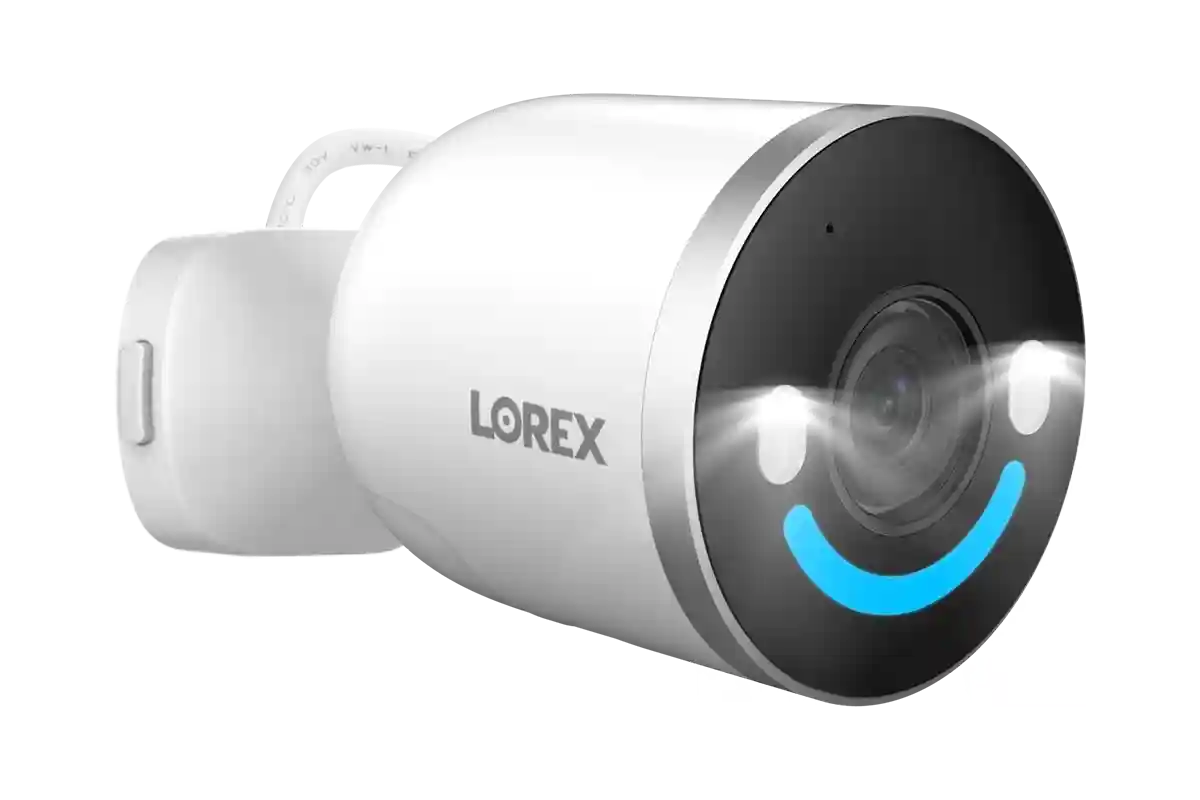
4K, a real spotlight and siren, local recording, and a system that scales to a whole property without a single monthly fee. The closest thing here to proper commercial kit.
- 4K with genuine local recording and no fees
- Scales to many cameras on one recorder
- Visible housing plus spotlight — actually deters
- Wired reliability, no batteries anywhere
- Installation is real work — cable runs, drilling
- Higher up-front cost once you add a recorder
- App and smart home support lag the consumer brands
- Overkill for a flat or a small terrace
If you have a driveway, outbuildings, side access and a garden to cover, buying five consumer cameras and five cloud subscriptions is the expensive way to do it. A Lorex system records everything locally to a recorder you own, at 4K, with no per-camera fees, and it does not stop working because a company reorganised its subscription tiers.
It is also, by some distance, the most visible option here — a chunky white housing with a spotlight reads as surveillance from the pavement in a way that a small black puck does not. Given what the deterrence research actually says, that is a feature and not a compromise.
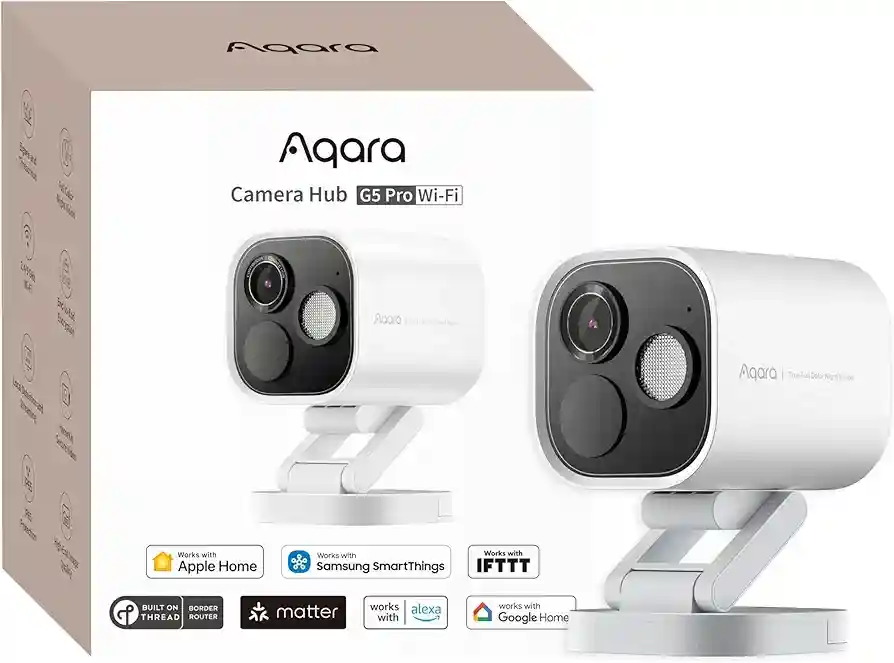
A weatherproof 2K camera that is also a Thread border router and Zigbee hub, running its detection on-device. Two products in one housing.
- Camera and smart home hub in one weatherproof box
- Thread border router — useful for Matter locks
- Detection runs locally, not in a company's cloud
- One of very few outdoor cameras with HomeKit Secure Video
- Only makes sense inside the Aqara ecosystem
- 2K rather than 4K at this price
- Wired
- Smaller support community than the big brands
The hub function is the reason to buy it. If you are running Matter over Thread devices — the Aqara U200 or U400 locks, for instance — you need a Thread border router somewhere in the house. This is a camera that supplies one, mounted outside, which is a tidy piece of consolidation.
HomeKit Secure Video support matters for Apple households: footage is analysed on your home hub and stored encrypted in iCloud against your storage allowance, which is a meaningfully different privacy posture from a manufacturer's own cloud.
Honorable Mentions
These did not crack our top ten but are the right answer for specific situations — a particular ecosystem, a particular budget, or a particular shaped problem. Same full breakdown, narrower audience.
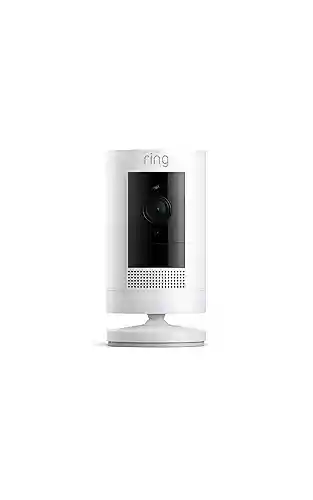
Indoors, outdoors, battery, plug-in or solar — the most placeable camera Ring makes, and the tidiest fit if your house already runs on Alexa.
- Works indoors and out, on battery, mains or solar
- Radar-based 3D motion mapping is genuinely accurate
- Dual-band Wi-Fi
- Best-in-class Alexa and Echo integration
- Ties into Ring Alarm and Ring doorbells
- 1080p at $180 is poor value on paper
- No local storage, no free recording
- No Google Home or Apple Home, ever
- Ring's $5.8m privacy settlement is on the record
Worth getting the plan names right, because they changed recently: Ring renamed Ring Home to Ring Protect on 14 January 2026. The tiers are Solo at $4.99 a month or $49.99 a year for one device, Multi at $9.99 or $99.99 covering every Ring device at one address, and Pro at $19.99 or $199.99 adding professional monitoring. Advanced AI — Video Descriptions, Familiar Faces, Active Warnings — is a separate Pro Intelligence add-on at roughly $5 a month for a single camera. The "$4–20/mo" range quoted elsewhere implies a per-camera scale that does not exist.
The flexibility is the selling point. One product that mounts inside or outside and takes battery, mains or a solar panel means you can move it when your problem moves, which is more useful than it sounds after your first winter.
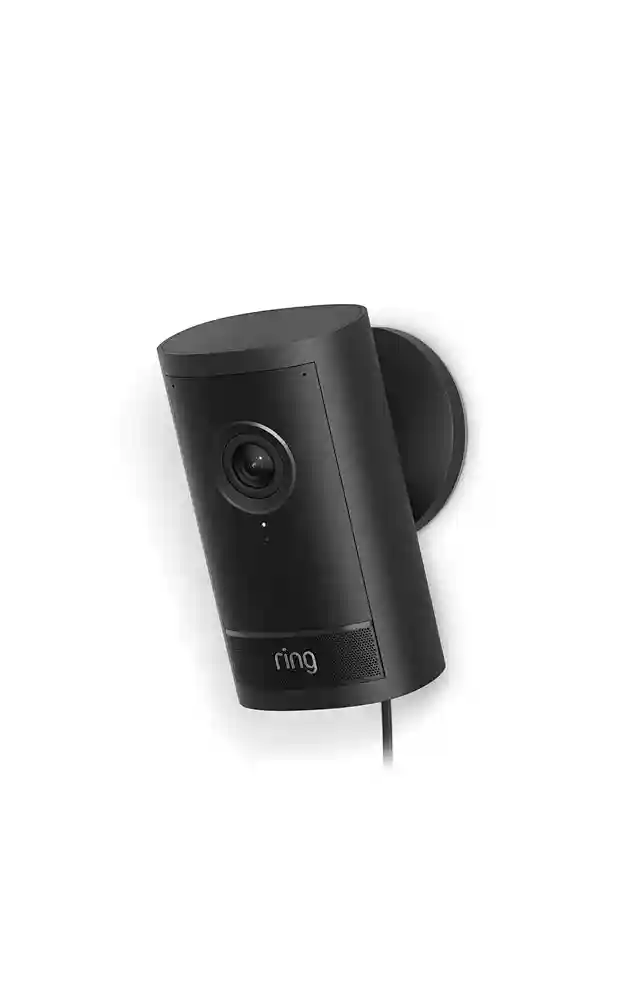
Ring's sharpest outdoor camera, with the same 4K sensor family as its flagship doorbell — and the same appetite for upload bandwidth that nobody warns you about.
- Best image quality Ring sells
- 10× zoom that stays legible — plates and faces
- True colour in near-darkness
- Full Ring ecosystem integration
- Needs upload speed many homes do not have
- Serious data consumption on a metered connection
- Nothing recorded without a plan
- Expensive before subscription
Two practical warnings that belong on the box and are not. First, Ring recommends at least 15 Mbps of upload for full-quality 4K, and ideally 20 or more. Plenty of cable and DSL homes run 5 to 10 Mbps up, in which case the camera quietly reduces its own stream and you never see the resolution you paid for. Test your upload speed, not your download.
Second, bandwidth is not the same as data. A cloud camera at 1080p typically consumes several gigabytes per camera per day; a 4K camera recording continuously can approach thirty gigabytes a day. On a metered or satellite connection that is a genuine problem, and it is the strongest practical argument for the local-storage cameras above.
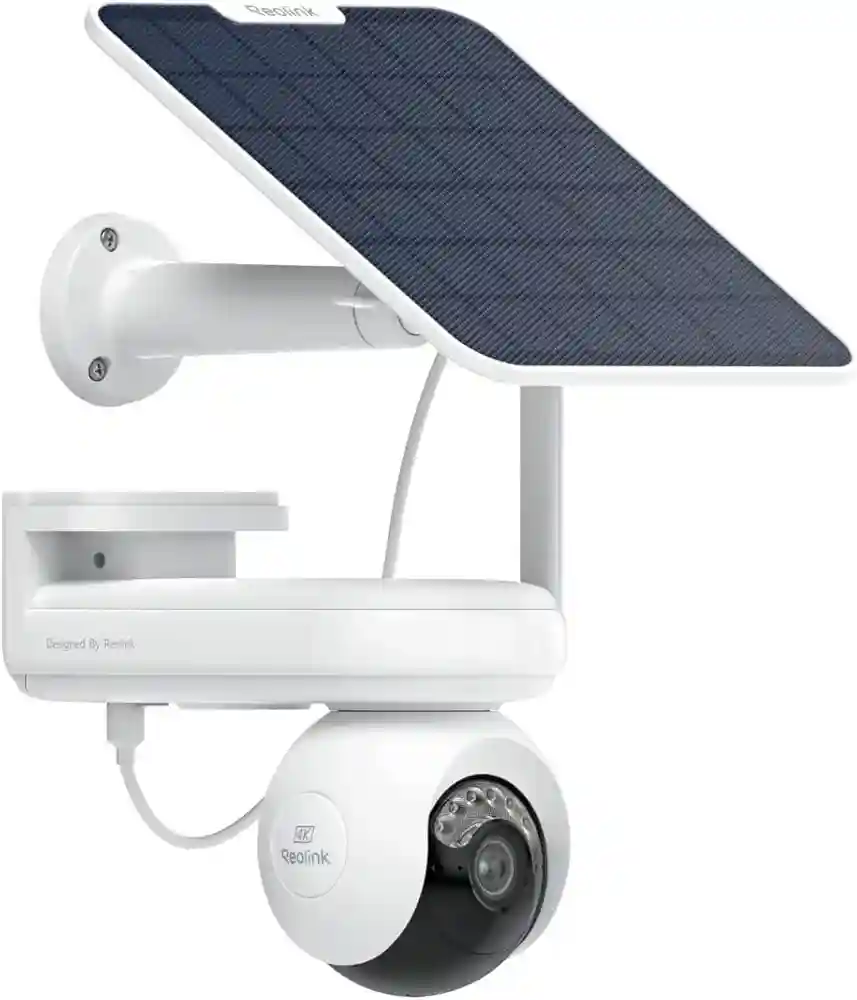
4K on a motorised head, solar powered, recording locally, with a buffer that captures the seconds before the trigger. Built for land rather than doorsteps.
- Pre-roll buffer catches the approach, not just the arrival
- Covers a wide area from one mounting point
- Solar means no mains run to a far fence line
- 4K local recording with no fees
- Motors are the part that fails first outdoors
- Tracking can be fooled by wind-blown foliage
- Needs decent Wi-Fi at distance from the house
- Overkill for a suburban front garden
Pre-recording is the feature worth understanding. Most battery cameras sleep to save power, wake on motion, and start recording — by which point your subject is already halfway across the frame and often facing away. A pre-roll buffer holds the preceding few seconds and prepends them, so you get the approach rather than the departure. On a long driveway that is frequently the difference between a usable clip and a useless one.
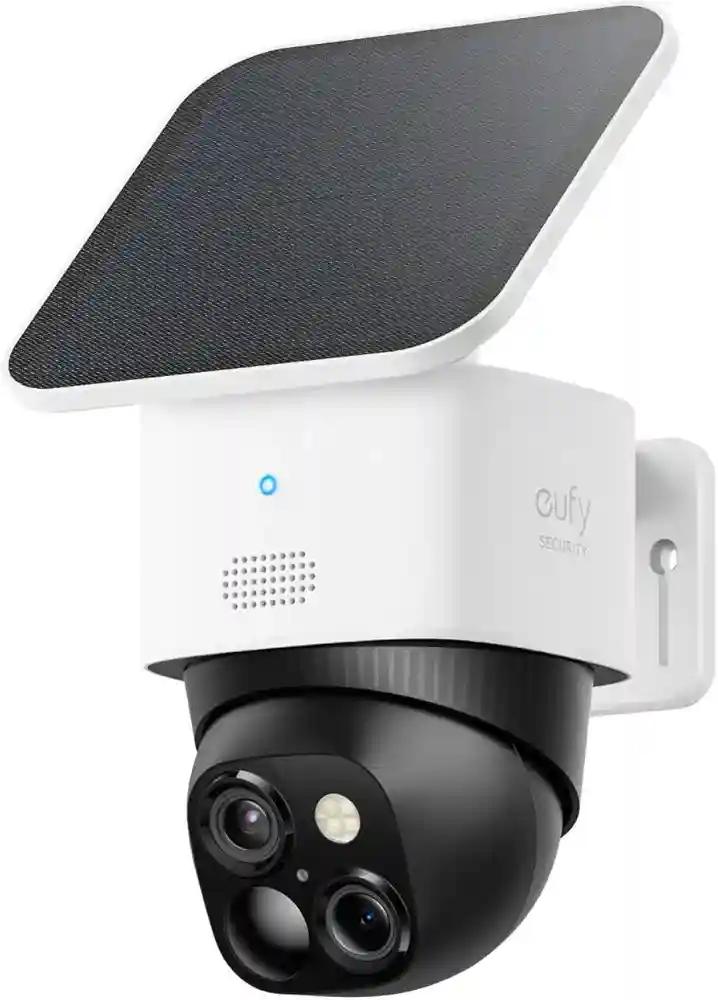
A fixed 4K wide lens and a separate motorised zoom lens in one housing — watch everything and follow one thing at the same time. The most capable camera here, at the highest price.
- Wide coverage and close detail simultaneously
- 4K with no ongoing cost
- Solar keeps it topped up
- Large, obvious housing — reads as surveillance
- Most expensive camera on this page
- Requires a eufy HomeBase
- Anker's privacy record applies
- Motorised lens is another moving part
The two-lens approach solves the fundamental compromise of a single camera: wide enough to cover the whole driveway means too wide to identify anyone on it. The S4 keeps a fixed 4K wide view recording while a second, motorised lens zooms and follows. You end up with both the context and the close-up of the same event.
At $350 plus a HomeBase it needs to be replacing two or three cameras to make sense. If it is, the maths works — and with no subscription attached, three years closes most of the gap against a cheaper camera on a cloud plan. The Anker privacy history described in the SoloCam entry applies equally here.
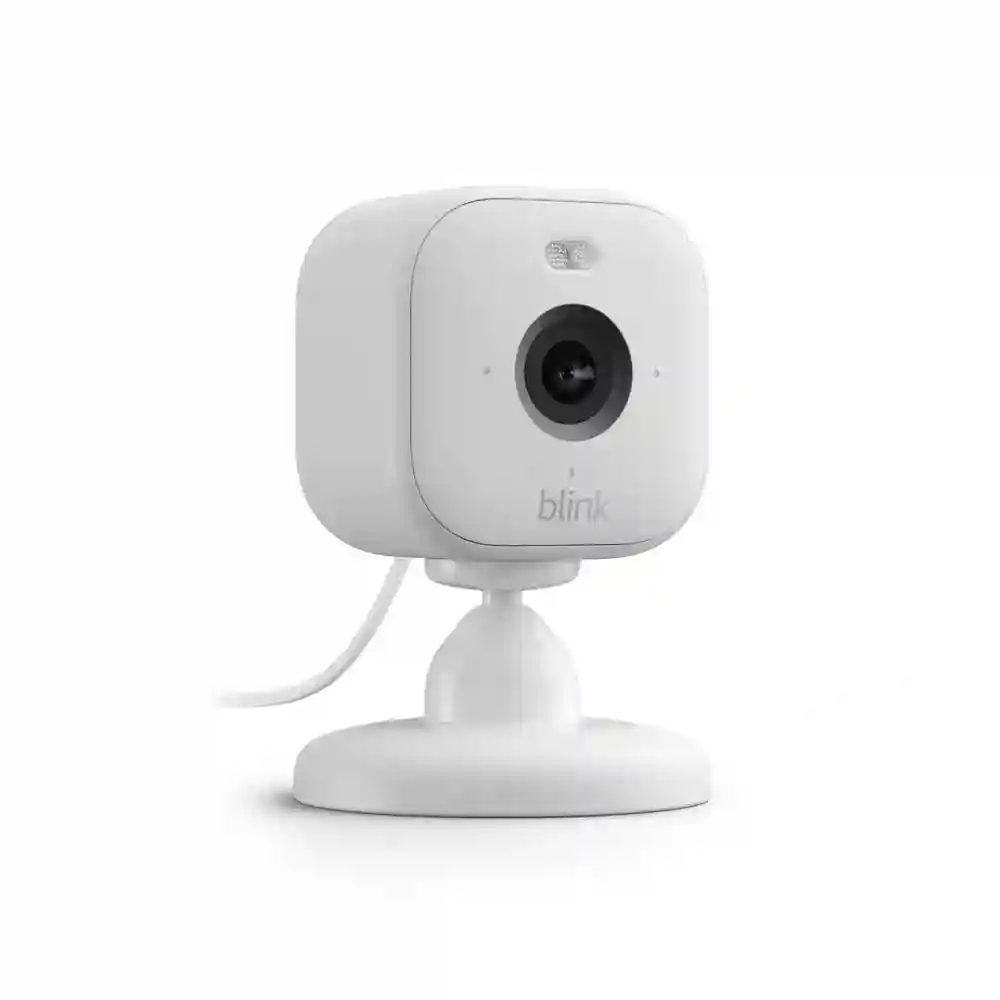
Thirty dollars for a small wired camera with a spotlight and person detection. Read the fine print though — it only goes outside if you buy the weather-resistant adapter.
- Cheapest camera here by a wide margin
- Spotlight gives colour night video at $30
- Person detection included
- Fine for a porch, shed or garage interior
- Not weatherproof out of the box — adapter required
- 1080p and a small sensor
- Wired only, so you need an outlet
- Local storage needs a Sync Module
The important detail, and the reason this sits last: the Mini 2 is fundamentally an indoor camera that Blink permits outdoors with the weather-resistant power adapter. Buy it without that, mount it under an eave and expect it to survive a winter, and you will be disappointed. Budget for the adapter and it is a perfectly reasonable thirty-dollar camera for a covered porch or a garage.
The Reolink Argus 4 Pro keeps the top spot, and the value case is stronger than the price suggests: 4K across a genuinely rectilinear 180° view, colour night vision, all detection running on the camera, footage on a card you own, and a three-year cost of roughly $150 against $600 for a Nest on the Advanced plan.
But read the deterrence section before you buy anything. If your goal is fewer incidents rather than better recordings, the evidence points at the SimpliSafe Outdoor Camera with live agent response, or a visibly bulky Lorex with a spotlight, over any small discreet camera regardless of resolution.
Do Outdoor Security Cameras Actually Deter Burglars?
Yes — more convincingly than video doorbells, which is a distinction worth making because the two devices are usually discussed as though they were the same thing. But the evidence comes with a condition attached, and the condition should change what you buy.
The most-cited work is Understanding Decisions to Burglarize from the Offender's Perspective, led by Joseph Kuhns at the University of North Carolina at Charlotte, which surveyed 422 incarcerated burglars across North Carolina, Kentucky and Ohio. Its findings on deterrence are specific: around 83% said they would try to determine whether an alarm was present before attempting a burglary, and about 60% said an alarm would send them to a different target. On cameras specifically, roughly 60% said they would consider cameras or surveillance equipment when choosing a target, and more than 40% said it would prompt them to pick somewhere else. Of those who discovered an alarm mid-attempt, about half said they would stop entirely and a further third said they would sometimes retreat; only around 13% said they would always continue regardless.
The UNC Charlotte research was funded by the Alarm Industry Research and Educational Foundation, which is supported by the Electronic Security Association — the main trade body for the alarm industry. In other words, the most widely quoted evidence that alarms and cameras deter burglars was paid for by the people who sell alarms and cameras.
That does not make it wrong. It was conducted by academic criminologists across three state prison systems and its findings are broadly consistent with other offender-interview research. But you will not find that disclosure on a single security company's website, and a self-reported survey funded by an interested party deserves to be weighed accordingly.
The stronger evidence is a systematic review by Piza and colleagues published in 2019, examining forty years of CCTV studies. Its central finding is the one that should decide your purchase: actively monitored camera systems were associated with a significant crime reduction of roughly 15%, while passive, record-only systems showed no statistically significant effect at all.
Read those two bodies of evidence together and a coherent picture appears. Offenders do look for signs of surveillance, and they do avoid targets that look watched. But "looking watched" is doing the work — not "being recorded." A camera reduces crime when it signals that something will happen, not merely that a file is being written somewhere.
Recording is not deterrence. Deterrence is the belief that someone is going to respond — and almost every camera sold to consumers is an excellent witness that promises nothing at all.
— NoPryZonePractically, that means three things. Mount for visibility, not concealment. A camera hidden under an eave where nobody sees it has traded away its deterrent value for a marginally better angle. Put it where someone approaching notices it from the pavement. Prefer the ones that do something. A spotlight that snaps on, a siren, or a live agent who speaks through the camera are what convert recording into response — which is why the SimpliSafe sits at number four despite unremarkable image quality. And pair it with what actually gets checked for. In that same survey, 83% looked for an alarm. A camera plus a monitored alarm system and motion lighting is a different proposition from a camera on its own.
One last finding from the same survey that belongs on a lock site: about one in eight burglars reported picking locks or using a previously acquired key. The overwhelming majority simply forced or walked through a door or window. That is the argument for reinforcing the frame before worrying about the cylinder — and for reading how burglars actually choose targets.
What to Look for in an Outdoor Security Camera
Resolution
2K is the practical floor outdoors. The distances are longer than indoors, so pixels get spent on empty driveway before they ever reach a face. 4K (Reolink, Lorex, Ring Outdoor Cam Pro, EufyCam S4) genuinely helps if you need to identify a person or read a plate beyond about fifteen feet, and it is the only resolution where digital zoom stays useful. 1080p (Blink) answers "was anyone there" and struggles with "who." Watch lens distortion too: a single very wide lens stretches faces at the frame edges, which is why the dual-lens stitched approach on the Argus 4 Pro is worth more than its megapixel count suggests.
Night Vision
Most incidents involving a camera happen in the dark, so this matters more than daytime resolution. Infrared gives usable monochrome and loses the single most useful identifying detail — colour. Spotlight colour (Arlo, Lorex, Blink Mini 2) floods the scene with white light for full colour, and doubles as active deterrence. Starlight or low-light sensors (Tapo C325WB, Reolink) produce colour from ambient light with no spotlight at all, which is kinder to neighbours and does not announce every passing cat. If you can only have one: the spotlight version deters more, the starlight version records more discreetly.
Weather Rating
Treat IP65 as the minimum for anything genuinely exposed — dust-tight and protected against water jets. IP66 and IP67 are better. The digit people misread is the second one: IP54 protects against splashing, which is not the same as driving rain. Check the operating temperature range if you get real winters, because battery cameras lose capacity sharply below freezing and a camera rated to −4°F will simply stop in a cold snap. And note the Blink Mini 2 case — some cameras are only rated for outdoor use with a specific weather-resistant accessory.
Storage: Cloud vs. Local
Local (Reolink, eufy, Lorex, Tapo, Wyze on a card) means a microSD card or base station in your house. No fees, no company holding your footage, and — as the privacy record below shows — immunity to the exact class of failure that has actually harmed camera owners. The trade is that a thief can take the storage along with everything else, and capacity is finite. Cloud (Ring, Nest, Arlo, Blink, SimpliSafe) survives the hardware being stolen and generally comes with better AI, at a monthly cost and a privacy exposure.
One number nobody quotes: bandwidth. A cloud camera at 1080p typically uses several gigabytes per camera per day, and a 4K camera recording continuously can approach thirty gigabytes a day. Event-only uploads are far lighter, in the region of tens to hundreds of megabytes. On a metered, satellite or rural connection that is a decisive argument for local storage before you even reach the monthly fee.
Power: Wired vs. Battery vs. Solar
Wired never fails for power reasons, supports continuous recording, and ties you to an outlet or a cable run. Battery mounts anywhere in ten minutes and needs recharging — every few months typically, far more often on a busy frontage, and faster in cold weather. Solar (Reolink Argus and Altas, eufy SoloCam and S4) is the best of both where you have genuine direct sun for a few hours a day; in a north-facing or heavily shaded spot it will not keep up and you are back to recharging. Battery cameras also sleep between events, which is why the pre-roll buffer on the Altas is worth looking for.
Smart Home Compatibility
Alexa: everything here except the pure local-storage systems. Google Home: Nest natively, plus Arlo, eufy, Tapo and Reolink. Apple Home: thin, as always — the Aqara G5 Pro with HomeKit Secure Video is the standout, and one of very few outdoor cameras that supports it. Matter and Thread: barely present in cameras yet, though the Aqara doubles as a Thread border router, which is useful if you also run Matter smart locks. Ring will never work with Google or Apple; Nest will never work with Apple. Assume the lock-in is permanent, because so far it has been.
Wired vs. Wireless — Which Is Better?
Wired, for anything you actually depend on. It is not close on reliability: no battery to die in a cold snap, no gap in coverage while it charges, continuous recording rather than event clips, and no sleep-wake delay that clips the first seconds off an event. If you have an outlet or can run a cable, run the cable.
Wireless earns its place on placement rather than performance. A battery or solar camera goes on a fence line, a detached garage or a rented wall where no cable can reach, and that is a real category of problem. It also comes off the wall when you move, which matters if you rent.
The honest answer for most homes is a mix: wired on the front elevation and the main approach where you want continuous, reliable coverage, and battery or solar on the outbuilding and the back gate where running power is not worth the effort. Where you do go wireless, mind the Wi-Fi — outdoor cameras sit at the furthest point from the router, usually through a masonry wall, and most are 2.4GHz only. Signal, not the camera, is the most common reason people describe a camera as unreliable.
The Subscription Question — Hidden Costs Explained
The sticker price is frequently the smaller number. Here is the state of play as of August 2026. Check it against anything else you read, because this category reprices constantly and most published figures are a year behind.
Reolink / Lorex / Tapo / eufy: $0 in fees — hardware price only
Wyze Cam Plus: $2.99/mo per camera → $108, or $99/yr unlimited → $297 for any number
Blink Basic: $3/mo per camera → $108; Blink Plus $10/mo all cameras → $360
Ring Protect Solo: $49.99/yr → $150; Multi $99.99/yr all devices → $300
Arlo Secure Plus Single: $7.99/mo annual → $288; Unlimited $17.99/mo → $648 for any number
Google Home Premium Standard: $100/yr → $300; Advanced $200/yr → $600
The one most often misreported: Arlo's $17.99 tier covers unlimited cameras, not one. It is frequently quoted as a per-camera price, which overstates a four-camera Arlo setup by several hundred dollars over three years — in reality it works out cheaper per camera than Ring Multi.
Two structural points worth internalising. First, per-camera plans punish you for expanding and whole-account plans do not, so the right plan depends on how many cameras you will own in two years rather than how many you own today. Wyze breaks even on its $99 annual unlimited tier at three cameras; Blink Plus beats Blink Basic at four; Ring Multi beats two Solo plans immediately.
Second, and more important: on Ring, Arlo and Nest, no plan means no recording. Not reduced quality or shorter history — nothing saved at all. Live view and alerts still work, which produces the specific frustration of receiving a notification about an event you can never watch. On Reolink, Lorex, Tapo, eufy and Wyze-with-a-card, the camera does its whole job for free, permanently.
The Privacy Record
An outdoor camera records your home, your family, your neighbours and part of a public street, continuously, for years. Where that footage goes is a specification, not a footnote. Here is what is documented.
Ring — $5.8 million, Federal Trade Commission (FTC), May 2023. The findings included unrestricted employee and contractor access to customer video, two documented instances of staff viewing women's private recordings — one continuing for months — no multi-factor authentication until 2019, and roughly 55,000 accounts compromised between January 2019 and March 2020. Ring denied violating the law and accepted a twenty-year compliance obligation. Ring has also partnered with well over a thousand police departments, and in some subsidised city programmes residents were required to comply with footage requests police deemed reasonably necessary.
eufy — 2022 to 2023. Sold on "No Clouds or Costs," found uploading facial thumbnails to Amazon Web Services with cloud storage disabled. The Verge streamed footage from one across the country unencrypted. Anker conceded in stages, finally acknowledging the cameras had never been end-to-end encrypted.
Wyze — 2019 to 2024. A March 2019 Bitdefender disclosure went unpatched until January 2022. In February 2024 roughly 13,000 users saw other people's camera feeds after a caching library mismapped device and user identifiers, five months after a similar incident.
TP-Link — rated poorly on data privacy by Consumer Reports. A rating rather than a documented incident, and we are not going to present it as equivalent to the three above.
The pattern is the point. Not one of these was a camera being hacked. Every one was an account system, an access policy, a storage bucket or a caching layer — the cloud, not the lens. Which means the cameras with no entry on this list are largely the ones that never held your footage in the first place. Local storage is not only cheaper; it is the only architecture in which this entire category of failure cannot occur.
Frequently Asked Questions
Partly, and it depends on the camera. In a survey of 422 incarcerated burglars, around 60% said they consider cameras when choosing a target and more than 40% said cameras would send them elsewhere — though that study was funded by the alarm industry's own research foundation. The stronger evidence is a 2019 systematic review finding that actively monitored camera systems produced roughly a 15% crime reduction while passive record-only systems showed no statistically significant effect. Visibility and the promise of a response are what deter; recording alone does not.
No. Reolink, Lorex, TP-Link Tapo and eufy all record to local storage with AI detection included and no monthly fee, and Wyze cameras record continuously to a microSD card without a plan. Ring, Arlo and Nest are the opposite — without a plan they save nothing at all, so you get alerts about events you cannot watch. Over three years the difference ranges from zero to $648, which is more than most of these cameras cost.
Three to four covers most homes: front approach, back door, driveway or garage, and any side gate. Prioritise the front, since it is the most common point of entry. But placement matters more than count — one camera mounted where an approaching stranger can see it from the pavement does more deterrent work than three hidden under eaves, and a camera aimed across a wide empty lawn wastes most of its pixels on grass.
Not for reliability. Wired cameras never lose power, can record continuously rather than in event clips, and have no sleep-wake delay that clips the first seconds of an event. Battery and solar cameras win on placement — a fence line, a detached garage, a rented wall — and come down easily when you move. Most homes are best served by a mix: wired where it matters, wireless where a cable cannot reach.
It was retired in October 2025 and replaced by Google Home Premium. Standard is $10 a month or $100 a year for 30 days of event history; Advanced is $20 or $200 for 60 days plus continuous recording and the Gemini features. Google raised the prices in 2025 — Standard was $8 and Advanced was $15 — the second increase since 2023. No Nest camera has a memory card slot, so without a plan there is no archive at all.
Ring Home became Ring Protect on 14 January 2026. Solo is $4.99 a month or $49.99 a year for one device; Multi is $9.99 or $99.99 and covers every Ring device at one address; Pro is $19.99 or $199.99 and adds professional monitoring. Advanced AI features such as Familiar Faces are a separate Pro Intelligence add-on at about $5 a month for a single camera, and some are unavailable in Illinois, Texas and Portland, Oregon under state biometric privacy law.
IP65 is the sensible minimum for genuinely exposed positions — dust-tight and protected against water jets from any direction. IP66 and IP67 are better. The digit people misread is the second one: IP54 only protects against splashing, which is not the same as driving rain. Check the operating temperature range if you get hard winters, and watch for cameras only rated for outdoor use with a specific weather-resistant adapter.
More than most people expect. A cloud camera streaming 1080p typically uses several gigabytes per camera per day, and a 4K camera recording continuously can approach thirty gigabytes a day. Event-only uploading is far lighter, in the tens to hundreds of megabytes. Ring also recommends at least 15 Mbps of upload speed for full-quality 4K. On a metered, rural or satellite connection, local-storage cameras are the practical choice.
High enough to be out of easy reach, low enough to capture faces rather than the tops of heads — around eight to ten feet, angled down. Crucially, mount it where someone approaching can see it, because visibility is what produces the deterrent effect. Avoid pointing into direct sun or at a bright sky, which silhouettes everyone in frame, and keep it out of the direct path of rain where you can, even on a well-sealed camera.
Rules vary considerably by country and state, so treat this as orientation rather than legal advice — we are not lawyers. The general principle in most places is that recording your own property and incidental public space is permitted, while deliberately pointing a camera into a neighbour's private space, such as a window or an enclosed garden, is not. Audio recording is often regulated more strictly than video. Most camera apps let you mask privacy zones out of the frame, which is worth setting up, and it is sensible to check your local rules before mounting.
The Right Camera Depends on Your Setup
Decide first what you want the camera to do, because the two answers point at different products. If you want evidence — a clear record of who came to your house and when — buy resolution, night performance and local storage, and the Reolink Argus 4 Pro at around $150 all-in over three years is very hard to beat. If you want fewer incidents, buy visibility and response: a bulky, obvious Lorex with a spotlight, or the SimpliSafe with live agents who can speak to whoever is standing in your garden.
Then match it to the property. Renting or no outdoor power: eufy SoloCam S340, solar, no fees. Whole property with outbuildings: a Lorex system on its own recorder. Tight budget: Tapo C325WB at $50 with colour night vision, or the Wyze Cam v3 Pro on a card. Deep in Alexa: Ring Stick Up Cam Pro. Deep in Apple: Aqara G5 Pro with HomeKit Secure Video. Long driveway or rural land: Reolink Altas PT Ultra for the pre-roll buffer.
And keep the camera in proportion. The research says offenders check for alarms more than anything else, and that most of them come through a door or window by force rather than by any clever method. A camera records that happening. A reinforced door frame, a proper deadbolt, lighting that reacts and a monitored alarm are what make it less likely to happen at all. Buy the camera fourth, not first.
Testing status. Researched, not tested. Subscription pricing for Ring, Google, Arlo, Blink and Wyze was verified in August 2026. Hardware prices should be treated as approximate.
On the deterrence evidence. The most widely quoted burglary study — Kuhns et al. at the University of North Carolina at Charlotte — was funded by the Alarm Industry Research and Educational Foundation, which is supported by the Electronic Security Association. That is a self-reported survey paid for by the industry it vindicates. It is consistent with other offender-interview work and we cite it, but the funding belongs in view. The Piza systematic review is independent and is the stronger of the two.
Why some figures here differ from other sites. Subscription pricing in this category changes faster than articles get updated. Nest Aware was replaced by Google Home Premium in October 2025 at higher prices. Ring's tiers were renamed in January 2026. And Arlo's $17.99 plan is routinely described as per-camera when it covers unlimited cameras, which overstates a multi-camera Arlo setup by hundreds of dollars.
Primary sources. Kuhns et al., "Understanding Decisions to Burglarize from the Offender's Perspective," University of North Carolina at Charlotte; Piza et al., 2019 systematic review of CCTV and crime; Google's October 2025 Google Home Premium announcement and Nest support pages; Ring's own plans page and its 14 January 2026 change notice; Arlo's published plan pricing; the FTC for the Ring settlement; Bitdefender for the Wyze timeline; The Verge and Anker's own statements for eufy; Consumer Reports for the TP-Link privacy rating.