The standard that measures how secure a door is doesn't measure the door. It measures the door, the frame, the anchors, and three feet of wall on either side — and it grades the whole thing at the level of its worst part. Your deadbolt's grade covers none of that.
By Johnny T.·March 2026·14 min read
Some links on this page are affiliate links — we may earn a commission.
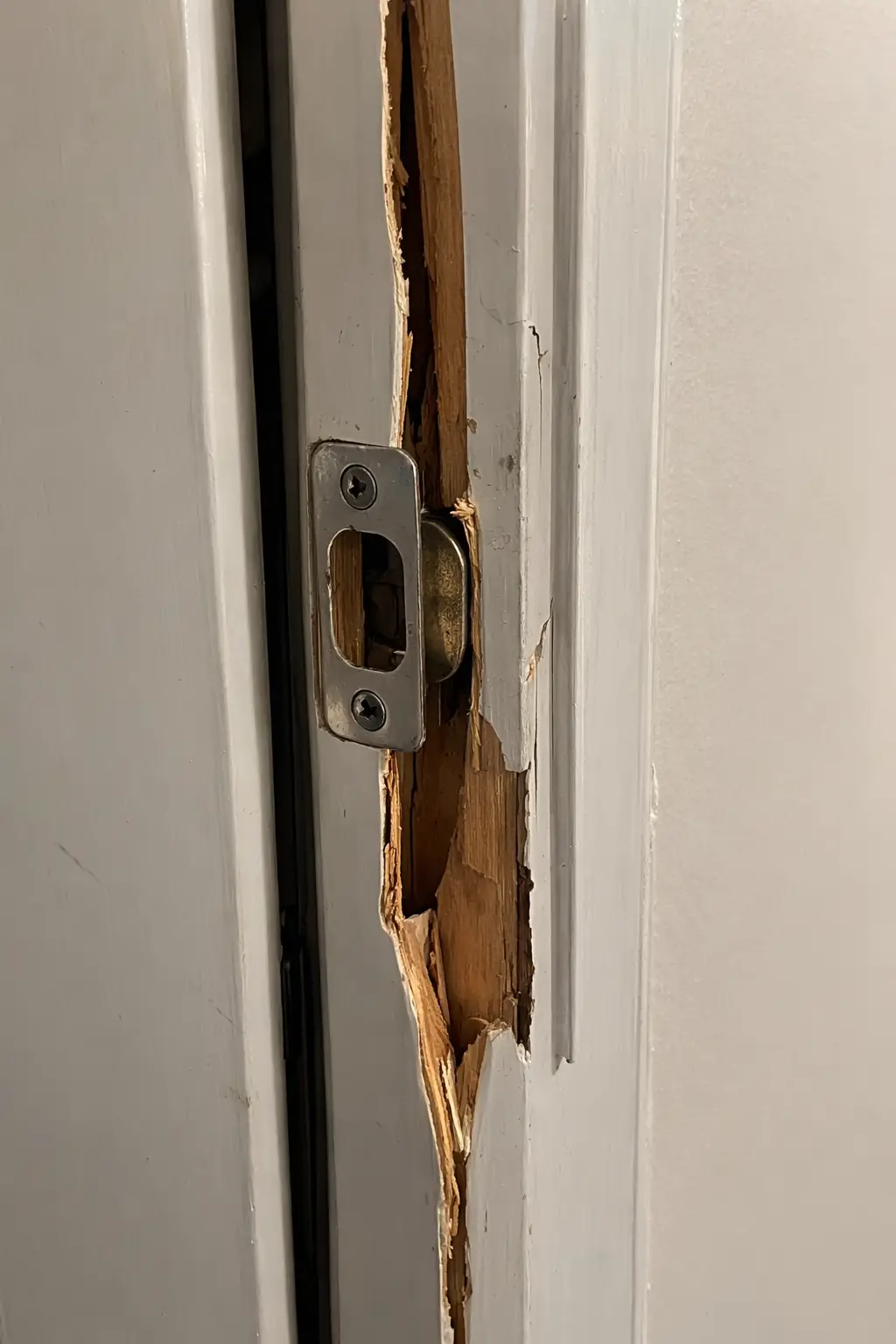
The split runs with the grain, through the strike screw holes. The lock is undamaged.
There is an American standard for how much abuse a residential entry door can take. It's ASTM F476, it was written in 1984 off the back of two government-funded burglary studies, and it is currently incorporated by reference into US federal regulation. Documented
Read its definitions section and you find something the entire home security industry manages not to mention. F476 does not test a door. It tests a door assembly — and it defines that assembly as the slab, the hinges, the locks, the handles, the frame, the anchors holding the frame to the building, plus 36 inches of surrounding wall on each side of the jambs and 16 inches above the head.Documented
Three feet of wall, either side. That's the unit of measurement. The people who wrote the test method decided, forty years ago, that you cannot say anything meaningful about a door's security without including the wall it's nailed into.
Then, a few pages later, they say the part that should end the argument: when an assembly is built from separately graded components, it takes the grade of its worst component.Documented Not the average. The floor.
So: a Grade 1 deadbolt in a jamb that fails at the lowest tested level is a lowest-tested-level door. The standard says so in plain language. And the lock you bought was never graded on the jamb at all — ANSI/BHMA grades are lab tests of the lock, run on a test fixture, and the jamb isn't in scope.
36″
Of wall each side of the jamb that ASTM F476 counts as part of the door ASTM
3.6×
More jamb-spreading force required to pass the top grade than the bottom one ASTM
$4
Cost of the box of screws that does most of the work on this page
How to read this article
Every claim on this page carries a tag saying where it came from. If something is opinion, it says so.
TestedI physically had it in hand and tried it myself.
DocumentedVerified in a published standard, report, or primary dataset. Linked at the bottom.
ManufacturerThe maker's own claim. Treated as a claim, not a fact.
CommunityConsensus among locksmiths, builders and locksport people. Informed opinion.
VerifyA widely repeated figure I could not trace to a primary source. Flagged, not used.
The short version
The lock is graded. The frame is not. Change the screws in the strike plate and the top hinge, and you have changed the failure mode of the entire assembly for about four dollars.
Chapter 1
Six Parts, One Grade
Where a door assembly actually fails — threat-rated and explained
The standard names the components it tests: door, lock, hinges, jamb/strike, and jamb/wall. Below is each one as it exists in a normal house, rated by how often it's the thing that gives. Threat level here means likelihood this is your weakest link, not how scary it sounds.
Strike Plate Screws
Threat Level
The default failure. F476's own definition of a jamb/strike failure lists pull-out of the strike attachment screws before it lists anything else. Documented Builder-standard screws are around 3/4 inch, which means every bit of their holding power lives in one thin board of softwood. Nothing they grip is structural.
The Shim Gap
Threat Level
Behind your jamb board there is a deliberate void — the space a carpenter needs to shim the frame plumb in a rough opening that's never square. It's usually a quarter to half an inch of air with a couple of cedar wedges in it. Under load the jamb has somewhere to go. This is the part nobody tells you exists.
Hinge-Side Screws
Threat Level
Half the people who reinforce a door do the strike and stop. F476 runs a separate impact test at the bottom hinge, and defines jamb failure there the same way — splitting, fracture, or screws pulling out. Documented A door that holds at the latch and tears off at the hinges is still an open door.
The Slab Itself
Threat Level
Genuinely less of a problem than the internet thinks, on a real exterior door — most are solid-core, fibreglass, or steel-skinned. It becomes a live issue on the garage passage door, which builders treat as interior and hang hollow-core, and where the lock edge can split out around the bore.
Jamb Spreading
Threat Level
Quiet, and the one a bolt length actually defends against. Force the two jambs apart at latch height and the bolt clears its pocket without anything breaking. F476 has a dedicated hydraulic test for it, and the California Crime Technological Research Foundation data behind the standard put prying and jimmying at roughly a quarter of house entries. Documented
Sidelites & Door Glazing
Threat Level
Reinforcing the frame does nothing if there's glass within arm's reach of the thumbturn. F476 handles this explicitly: glazing impacts are required unless the panel starts 30 inches or more from the lock. Documented That 30-inch figure is a usable rule for walking your own front door.
Five of those six are the frame or the fasteners. One is the door. None of them is the lock cylinder — which is where nearly all the money in this category gets spent, and where nearly all the writing in this category is pointed. If you want the long version of why picking isn't on this list at all, we did the timings: how long picking actually takes.
Chapter 2
The Gap Behind Your Jamb
Why a longer screw is not a small improvement but a different failure mode
Nobody framed your door tight
A rough opening is cut oversized on purpose. It has to be — the framing is nailed up fast, nothing in a wall is truly plumb, and the door unit has to be adjusted square inside it after the fact. So the carpenter sets the frame in the hole, drives cedar shims between the jamb and the stud until a level says stop, and nails through.
What that leaves behind, permanently, is a void. Usually a quarter to half an inch of air running the full height of the jamb, with a couple of tapered wedges in it. It's covered by casing on one side and drywall on the other, so you will never see it, and it is the single most important fact about your front door.
Because it means the strike plate isn't attached to your house. It's attached to a 3/4-inch board that is near your house.
Fig. 02
Jamb at the strike — plan section
SECTION · NOT TO SCALE
1Strike plate. Steel, and almost never the part that fails.
2Jamb board — nominally 3/4 in. of softwood. The only material a builder-length screw ever touches.
3The shim gap. The void left so the frame can be set plumb. Air, and two cedar wedges.
4King stud. The first structural member in the wall, and the first thing tied to the rest of the house.
5A 3/4 in. screw stops here. Every pound of resistance is thread held in item 2.
6A 3 in. screw crosses item 3 and lands in item 4. Same lock, same door, different failure mode.
Section drawn from the wall assembly specified in ASTM F476 for component testing: 2×4 studs at 16 in. on centre, 1/2 in. sheathing, 1/2 in. gypsum board. Shim gap exaggerated for legibility.
The standard admits it
Here is the detail that made me stop reading and go back over it twice. In the notes attached to F476's test-wall drawing — the specification for how you build the wall you're going to bolt the sample door into — there is an instruction saying that blocking may be necessary behind the jamb to pass the jamb stiffness test, and that if you use blocking you have to declare it in the test report. Documented
Read that again. The people writing the test method anticipated that a correctly built, code-compliant wall might not pass the frame test without extra wood packed in behind the jamb. Filling the gap isn't an aftermarket upgrade someone invented to sell you a kit. It is a known requirement, written into the standard, in 1984.
And the conclusion the standard cites from the California research that fed it is blunter still: standard exterior single-door systems Documented"will not withstand man's capability for forced entry without additional local reinforcement" — at both the door and the jamb, at the latch.
That is a fifty-year-old finding, sitting inside a federally-referenced standard, saying exactly what this page says. It has simply never made it into consumer advice, because consumer advice in this category is written by people selling locks.
How we found this
Every page on this topic says the frame is the weak point. Almost none of them cite anything, and the first version of this page didn't either — it asserted the problem confidently and moved straight to the shopping list. So the job this time was to go and find a load test.
What turned up wasn't a study. It was the test method itself, sitting in a public archive because it's incorporated by reference into federal regulation, which means it can't be paywalled. The jamb-spreading figures in Chapter 3 have been published since 1984. The admission that you may need blocking behind the jamb to pass is a footnote on a construction drawing in an appendix.
That's the whole method here, and it isn't clever. Nobody in this category reads the primary document, so a footnote in a forty-year-old standard counts as a scoop.
The related point, which does generalise: this is the same principle as everything else on this site. A lock is a system, and systems fail at their interfaces, not at their strongest component. It's why a well-made deadbolt and a bad one perform identically in a kick-in, and why the worst locks on the shelf are usually bad for reasons that have nothing to do with the cylinder.
Chapter 3
What a Kick Actually Is
Real numbers, from the only standard that tests the whole assembly
The number you have probably read
Nearly every page on this topic puts a figure on a kick: 800 pounds of force, 1,200 pounds, 1,500 pounds. Those figures are worth tracing, because they come from product packaging rather than from any test. Unsourced Search any retailer for door reinforcement hardware and you will find bars rated to 300 lbs, latches rated to 800 lbs and strikes rated to 1,500 lbs, none of which name a test method, a standard or a laboratory. The figures moved from marketing copy into articles and hardened into folklore.
More useful than knowing they are unsourced is knowing why a pounds figure cannot answer the question in the first place. The unit is wrong.
A kick is not a static load. It is an impact — a short, sharp transfer of energy — and energy is measured in joules.
Prying and spreading are static loads, and those are measured in pounds-force.
F476 tests both, separately, with different apparatus, precisely because they are not interchangeable. A product rated to resist 800 lbs of steady pull tells you nothing about how it behaves under a boot.
So there is no honest pounds-per-kick figure and this page does not print one. What exists instead is a published, graded table of what a door assembly has to survive — and it is considerably more useful, because you can act on it.
What the standard actually does
F476 doesn't ask a person to kick anything. It swings a 99-pound steel cylinder on a five-and-a-half-foot pendulum into the face of the door, with a six-inch hemispherical nose and a foam buffer to spread the contact patch. Documented Energy is set by how far back you pull it. That's the apparatus.
Then it hits the assembly in three separate places — the centre of the door, eight inches from the bottom hinge, and eight inches from the lock edge — because those load paths fail differently and a door that survives one can fail another.
Four grades, 10 through 40, 40 being the highest:
Test
Grade 10
Grade 20
Grade 30
Grade 40
Impact at door, hinge and bolt Two blows at each level, cumulative
80 J
+120 J
+160 J
+200 J
Jamb spreading force To open the lock-front-to-strike gap
1,350 lbf
1,800 lbf
3,600 lbf
4,950 lbf
Gap allowed while spreading
3/8 in.
3/8 in.
1/2 in.
1/2 in.
Minimum bolt throw
9/16 in.
9/16 in.
11/16 in.
11/16 in.
Hinge pin pull-out Outswing doors with exposed pins
50 lbf
50 lbf
200 lbf
200 lbf
Figures from the recommended acceptance criteria published as an appendix to ASTM F476. Documented The standard itself sets no pass mark — it explicitly leaves acceptance to whichever authority is using it.
Three things worth pulling out of that table
The impact requirements are cumulative. A Grade 40 assembly doesn't take two 200-joule blows; it takes the Grade 10, 20 and 30 blows and then two at 200 J, at each of three locations. Real forced entry works the same way. It's rarely one heroic kick — it's repeated loading on a joint that loosens a little each time. Which is exactly the loading a screw in end-grain softwood is worst at resisting.
The jamb spreading numbers are the ones to care about. Going from Grade 10 to Grade 30 means the frame has to take 2.7 times the spreading load, and hold the bolt engaged while opening half an inch instead of three-eighths. That is not a lock specification. There is nothing you can buy in a blister pack that changes it. It is a property of the wood, the fasteners, and whether there's a void behind the jamb.
The bolt throw minimums are lower than you'd guess. F476 asks for 9/16 inch at the bottom two grades and 11/16 at the top. The one-inch throw sold as the mark of a serious deadbolt exceeds the top grade of the assembly standard by five sixteenths of an inch. Throw is real and it matters against spreading — but it's already ahead of what the assembly is graded to, which tells you where the slack in the system is.
Put it plainly
You cannot buy your way to Grade 40 through the lock aisle. Every one of those tests is passed or failed by the frame.
Chapter 4
The Fix Ladder
Everything that works, ordered by what it costs you
Door Assembly Fix Ladder
Start at the top. Most people never need to reach the bottom.
$0
Free
Back out one strike screw and one top-hinge screw and measure them. This is the whole diagnosis. Under an inch and a half means everything below applies to you.
Throw the deadbolt with the door open and look at the bolt. If it doesn't project fully when the door is shut, the strike is misaligned and you are running a partially engaged bolt.
Look into the bolt pocket with a torch. If you can see past the jamb board into a void, that's your shim gap.
Measure from the edge of any glass to the thumbturn. Under 30 inches and the frame isn't your first problem — the glass is.
Count the hinges. Two hinges on an exterior door is a builder cost-saving, not a specification.
<$15
Cheap
#9 × 3 in. screws in the deadbolt strike, the latch strike, and the top hinge of every exterior door. Including the garage passage door and the back door nobody uses.
Pilot-drill every hole. 1/8 in. bit, thirty seconds each. Skipping this splits the jamb or the stud and undoes the point of the exercise.
Do the top hinge first if you only do one thing — it carries the most load and it's the one everybody forgets.
Drive them snug, then stop. Over-driving crushes the jamb inward and the door stops latching cleanly.
<$60
Worth it
A heavy box strike — one that wraps the bolt pocket rather than sitting flat on the jamb face. Spreads load over a much larger area of wood. Only worth buying if you fit it with 3 in. screws; on short screws it's a costlier version of the same failure.
Fill the shim gap at the strike. A hardwood block cut to the gap, tapped in behind the jamb through the bolt pocket, removes the void the standard's own test notes warn about. Free if you have offcuts.
Hinge reinforcement plates where the hinge screws have already chewed out their holes.
A door edge wrap if the slab is splitting around the lock bore — a real problem on hollow-core garage passage doors, mostly irrelevant on a solid exterior door.
$100+
Overkill
Full-length steel jamb reinforcement down both sides plus the hinge side. Genuinely effective, genuinely a two-hour job, and mostly redundant if you've done the tiers above.
Replacing a hollow-core garage passage door with a solid-core slab. Worth it on that one door.
Multipoint locking hardware. Excellent engineering, and it still bolts into the same jamb — do the screws first or you've spent several hundred dollars to relocate the failure.
Laminated glazing in sidelites within reach of the thumbturn. Expensive, and the only real answer to that specific problem.
Advertisement
The three things worth buying
In cost order, and the first one does most of the work. Prices are what we've seen in the US, and none of this is exotic — every item is stocked by any hardware store.
Tier 1 — Best value on the page
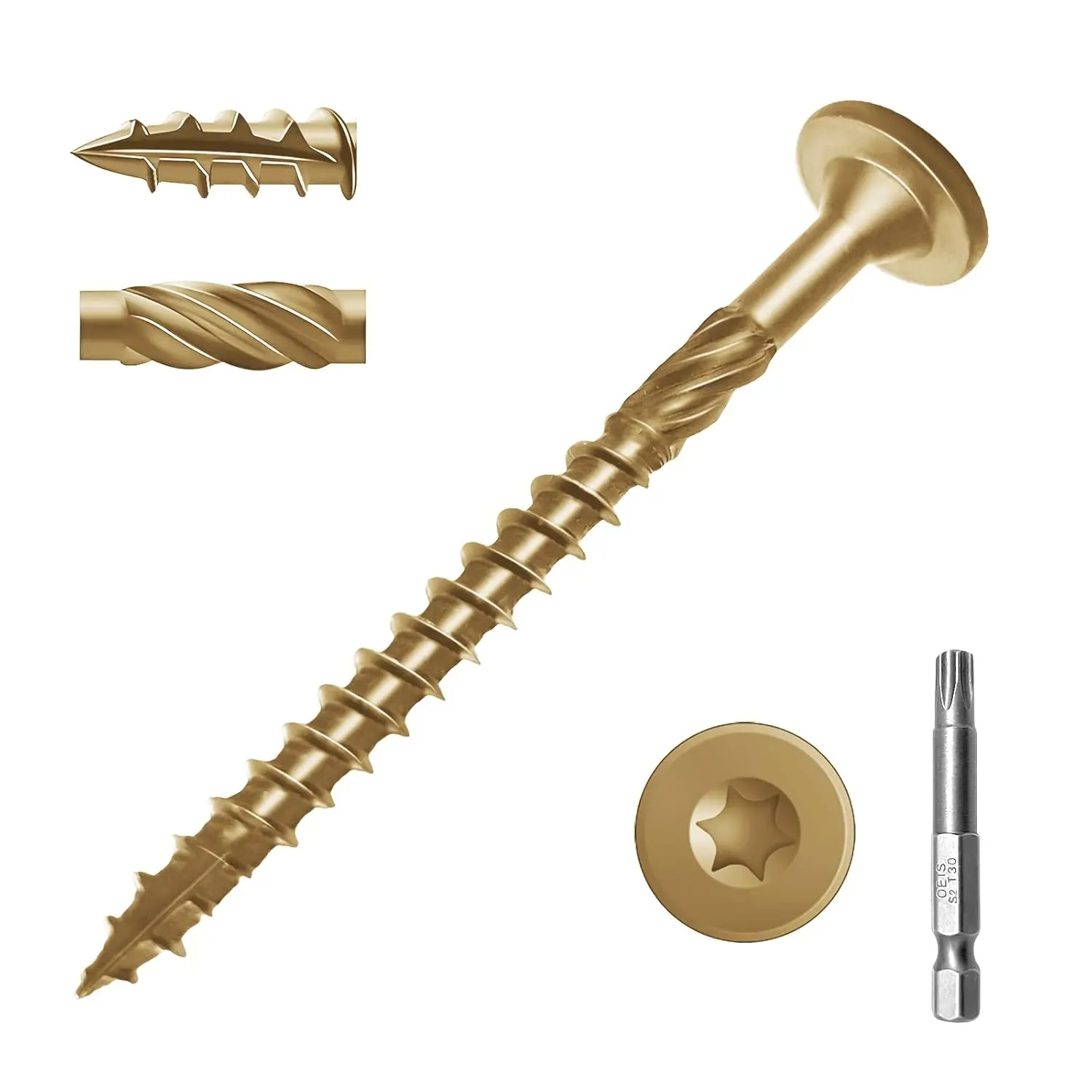
#9 × 3″ Hardened Wood Screws
~$8–14 USD
The best security-per-dollar item in residential physical security, and it isn't close. Replace the short screws in the deadbolt strike, the latch strike and the top hinge with #8 or #9 × 3-inch hardened screws. Nothing else changes.
What changes is the load path. The short screw's entire holding capacity is thread in one softwood board. The long screw crosses the shim gap and lands in the king stud, so the attack now has to move framing lumber that's nailed to a top plate, a sole plate and a header. Community
Pilot-drill first. A 1/8 in. pilot the full depth. Without it you can split the stud, and a split stud holds worse than an unmodified one.
Amazon USAny hardware store. Do not buy drywall screws — they snap.
Tier 2 — Only with long screws
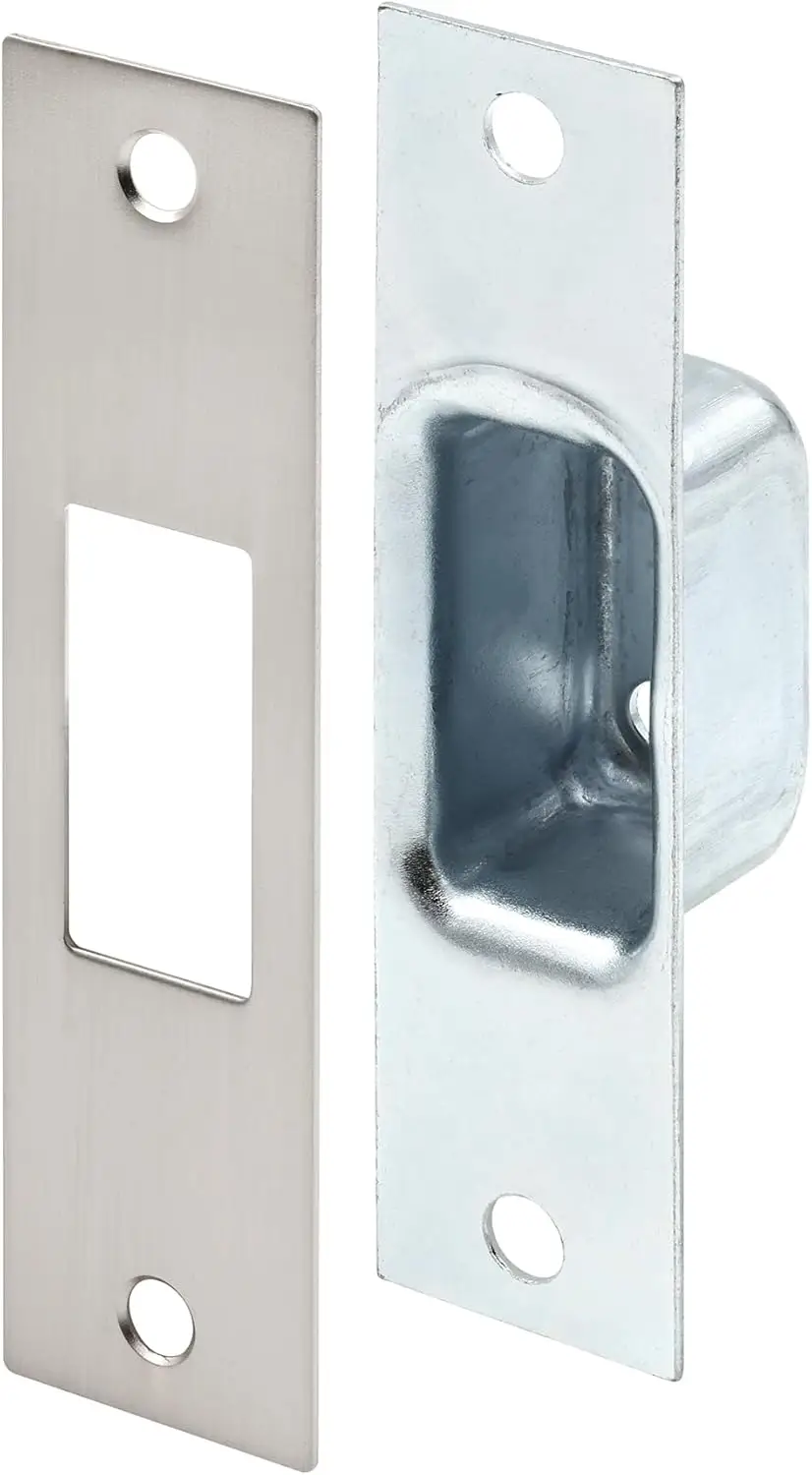
Security Box Strike Plate
~$12–25 USD
A longer plate with more fixings, ideally one that boxes the bolt pocket instead of sitting flat against the jamb face. The gain is load distribution: instead of two screw holes taking everything, you have four to six spread over several inches of grain.
The honest caveat, which the packaging never carries: a box strike on 3/4-inch screws is a more expensive version of the same failure. The plate is not what pulls out. If the box in the kit ships with short screws, bin them.
Fit it to the existing mortise where you can. Chiselling a deeper pocket removes jamb material at exactly the point you're trying to strengthen. Community
Amazon USCheck the screw length in the box before you fit it
Tier 3 — Situational
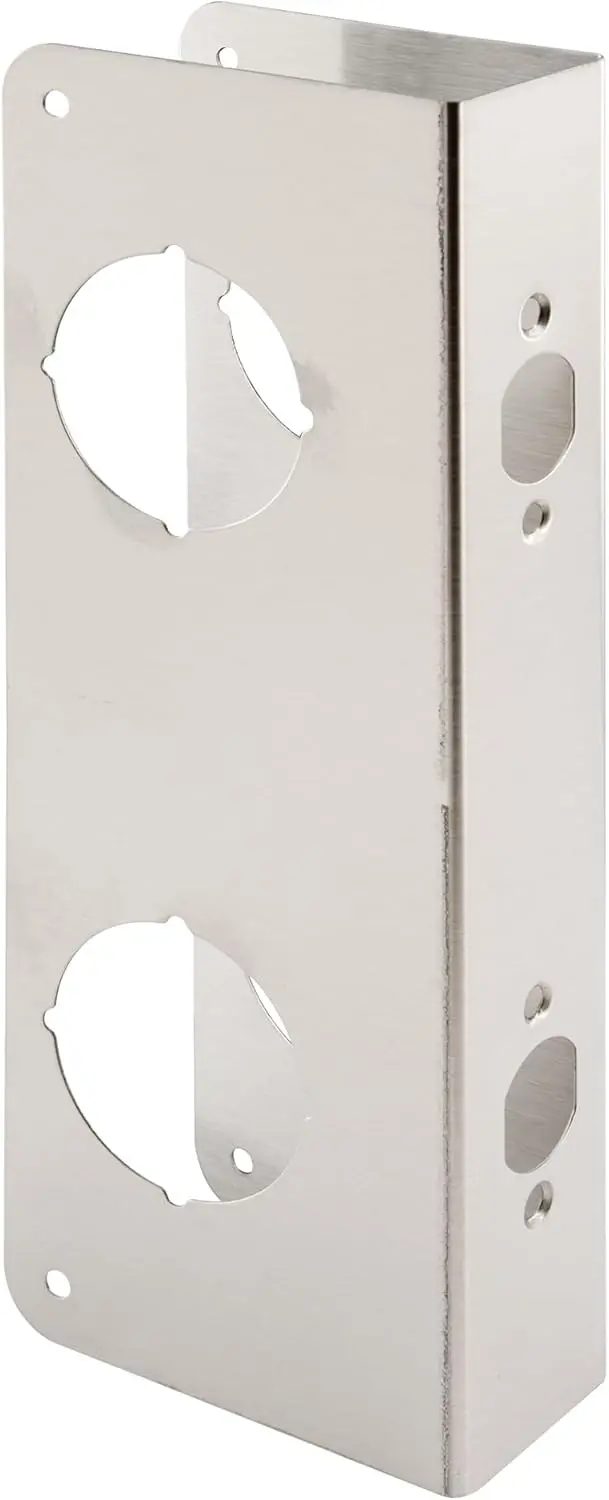
Door Edge / Lock Wrap
~$15–30 USD
A steel sleeve that wraps the lock edge of the slab. This one solves a different problem from the two above — it stops the door splitting out around the bore, rather than stopping the jamb failing.
Buy it if the lock edge is already cracked, if the slab is hollow-core, or if the bore has been drilled twice for different hardware. On an intact solid-core exterior door it's the least necessary item here, and we'd rather you spent the money on the screws and a box strike.
Do not fit one to a fire-rated door. See the next chapter — it matters more than it sounds. Documented
Amazon USMeasure your slab thickness first — 1-3/8″ and 1-3/4″ are different parts
Short version on how we chose these: none of the three items above were tested by us in a lab, we've said so in the tags, and the cheapest one is the one we'd push hardest.
Chapter 5
Before You Drill
Four ways this job goes wrong, two of them serious
There is wiring in that wall
The National Electrical Code requires cable through bored holes in framing to sit at least 1-1/4 inches back from the edge of the member, or be shielded by a 1/16-inch steel plate. Documented That number is not arbitrary: it's set so that ordinary wall fasteners — drywall screws and trim nails, 1-1/4 to 1-5/8 inches — stop short of the wire.
You are about to drive a screw roughly twice that deep, on a path the code was not written to anticipate. Doorways are also exactly where switches sit, so there is usually a cable run somewhere near the hinge-side stud.
If a screw suddenly stops or feels wrong, back it out. Do not drive through it. Wood offers steady resistance; anything sharp, sudden or springy is not wood. A stud finder with live-AC detection costs about the same as the screws. If you have any doubt, this is a twenty-minute job for a locksmith or an electrician.
If you rent, or live in a condo or apartment
Corridor and stairwell doors in multi-family buildings are very often fire-rated assemblies, and they are regulated as assemblies, not as doors. Under NFPA 80, fitting non-listed hardware to a rated assembly is not permitted, and field modifications need approval from the listing laboratory in advance. Documented A door edge wrap or a full jamb armour kit is precisely the kind of unlisted surface hardware that voids a label — and a voided fire door is a life-safety problem for the whole building, not a paperwork problem for you.
Look for a metal label on the hinge edge of the slab or the frame rebate. If there is one, talk to the building before you fit anything. Swapping existing screws for longer ones in existing holes is a much smaller question than adding hardware, but it is still your landlord's frame. Get it in writing. Our apartment security guide covers what's available when you can't modify the door at all.
Two smaller ways to waste an afternoon
No pilot hole. A 3-inch screw driven dry into a stud can split it along the grain. A split stud holds a screw worse than an intact one, so you will have made the door measurably weaker while believing you improved it. Pilot every hole, full depth.
Over-tightening. Drive the screws snug and stop. Keep going and you pull the jamb toward the stud, close up the clearance, and the door starts sticking or won't latch without a shove. A door that's annoying to lock is a door that ends up unlocked — and per BJS, entries through something already unlocked are the single largest category. Documented Check the door swings and latches cleanly before you move to the next one.
Chapter 6
What Doesn't Work
Advice that fails on inspection
"Buy a Grade 1 deadbolt and you're done."
ANSI/BHMA grading is a laboratory test of a lock, run on a test fixture. Deadbolts are covered by their own standards — A156.36 for auxiliary locks, A156.40 for residential deadbolts and deadlatches — and none of them put your jamb, your screws or your shim gap in scope. Documented The assembly standard that does include those things says an assembly takes the grade of its worst component.
VerdictFalse as stated. The grade is necessary and nowhere near sufficient.
"A smart lock is more secure than a deadbolt."
A smart lock changes the credential — how you prove you're allowed in. It does not change the bolt, the strike, the jamb or the screws, and a kick-in does not care what unlocked the door. Some are excellent, some are worse mechanically than the dumb lock they replaced, and none of them are an answer to this article.
VerdictCategory error. Convenience and audit trail are real benefits. Kick resistance isn't one of them.
"Burglars pick locks, so buy a pick-resistant cylinder."
The California dataset the assembly standard was built on classed entries by method. For single-family homes, prying or jimmying and outright forcing together accounted for roughly half of entries, while everything in the pass-key, picking and slipping category came to under seven per cent. Documented The data is from 1972–73 and should be read as period evidence, not current statistics — but the ordering has never reversed in any dataset since. Interestingly, that same category was more than twice as common in apartments and duplexes, which fits: corridor doors with spring latches can be slipped in a way a properly deadbolted house door cannot.
VerdictBackwards for houses. High-security cylinders are a great buy for other reasons — this isn't one of them.
"Long screws make a door kick-proof."
Nothing here makes a door kick-proof, and we're not going to pretend otherwise. Long screws move the failure point from the jamb board to the framing, which raises the effort, the noise and the number of attempts required. That's a delay, and delay is the actual product. The strike is also only one of three places F476 hits — the hinge side and the slab are separate tests with separate outcomes.
VerdictOverstated. Enormous improvement, not immunity.
"The front door is where your security budget goes."
Doors do lead forcible entries. But BJS found that around 40% of unlawful entries into unoccupied homes came through a door or window that was simply not locked. Documented Hardening a door that gets left open is spending money to solve a problem you don't have. The windows, the slider and the garage are where the rest of the perimeter is, and they're cheaper to fix.
VerdictHalf-right. Do the screws — they're four dollars — then go and walk the rest of the building.
Questions
The Ones People Actually Ask
Short answers
Do 3-inch screws really make that much difference?
They change what the attack has to break. Short screws are held entirely by a 3/4-inch softwood board; long screws reach the king stud, which is nailed into the wall framing. There's no published before-and-after load test we can point you at for that specific swap — if you know of one, tell us — but the mechanism is straightforward and the standard's own failure definitions name screw pull-out first.
Screws in the strike, or in the hinges?
Both, and if you're only doing one, the top hinge. F476 runs impact tests at the hinge and at the bolt as separate tests with separate pass criteria, because they're separate failure paths. Hinge-side reinforcement is the half everybody skips.
Will this work on a steel door in a steel frame?
Differently. A steel frame is usually grouted or anchored to the structure, so the shim-gap problem mostly disappears and the wood-screw fix doesn't apply. Check what's behind it before you drill anything, and treat the anchors rather than the plate as the thing to inspect.
I rent. Is any of this possible?
Swapping screws in existing holes is reversible and usually the easiest thing to get permission for — ask in writing anyway. Anything that adds hardware is not, and if the door is fire-rated it may not be legal regardless of what your landlord says. The apartment guide covers the no-modification options.
What about the door between the garage and the house?
It's usually the worst door in the building — hollow-core, spring latch only, often no deadbolt — because builders classify it as interior. It's also the door an intruder gets to work on in complete privacy. Treat it as an exterior door: solid slab, deadbolt, 3-inch screws. More on that in the perimeter walkthrough.
Is a security bar or door jammer worth it?
As a supplement when you're home, yes — it adds a second load point low on the door, away from the strike. As your main defence, no: it only works while you're inside to set it, and the ratings printed on them are marketing figures with no stated test method. Fix the frame first.
The Bottom Line
Buy the Screws Today
The interesting thing about this whole topic isn't that the frame is weak. It's that this was established, measured and written down decades ago by people working for the National Bureau of Standards and the California Attorney General's office, published as a test method, incorporated into federal regulation — and then completely failed to reach the person standing in the hardware aisle choosing a deadbolt.
The industry knows. The standard says the assembly is graded at its worst part, and the worst part is almost always two short screws in a board that isn't attached to anything.
So: go and back one out. Measure it. If it's under an inch and a half, buy a box of 3-inch screws on the way home and spend twenty minutes with a drill this weekend. It's the cheapest meaningful thing you will ever do to your house, and when you're finished, go and try the window — because the door was only ever one part of the perimeter.
Sources & Method
Door assembly definition, component grading, test apparatus, and acceptance criteria — Documented
ASTM F476-84 (Reapproved 2002), Standard Test Methods for Security of Swinging Door Assemblies, ASTM Committee F12 / Subcommittee F12.50. Incorporated by reference into US federal regulation at 24 CFR 200.949(a)(1)(ix).
Source of the 36-inch wall definition (§3.8), the lowest-component grading rule (§X5.2.5.2), the pendulum apparatus (§5.1.1, X1.2.1), the jamb/strike and hinge failure definitions (§19.3, §21.3), the test-wall blocking note (Fig. 2, Note 8), and every figure in the Chapter 3 table (Table X5.1).
Full text posted by Public.Resource.Org: read the standard.
Current edition is F476-14, revised 2023; the standard was withdrawn in 2011 and reinstated.
The origin of the test method — Documented
NILECJ Standard 0306.00, Physical Security of Door Assemblies and Components, produced by the Law Enforcement Standards Laboratory at the National Bureau of Standards under National Institute of Justice sponsorship; and Building Security Standards, a report to the California Attorney General's Building Security Commission by the California Crime Technological Research Foundation, under Office of Criminal Justice Planning Grant No. 1243. Both are named as the basis of F476 in its own appendices.
Means-of-entry percentages, and the reinforcement conclusion — Documented
CTRF burglary data compiled April 1972 – March 1973, reproduced as Table X4.3 of ASTM F476. Read as period evidence: the dataset is over fifty years old and California-specific. The conclusion quoted in Chapter 2 is CTRF's, cited at §X5.1.3.
The "pounds of force" kick figure — Unsourced
Traced only to retail product copy, which states resistance ratings without naming a test method, standard or laboratory. Not used on this page. F476 measures impact in joules and static spreading in pounds-force as separate tests; the two are not interchangeable.
Deadbolt grading scope — Documented
ANSI/BHMA A156.36 (Auxiliary Locks — split out of A156.5 in 2008) and A156.40 (Residential Deadbolts and Deadlatches). Both describe laboratory tests of the lock. Neither includes the jamb or the surrounding wall. Published by the Builders Hardware Manufacturers Association.
Cable clearance and fastener depth — Documented
NFPA 70 (National Electrical Code) §300.4(A)(1): bored holes in wood framing must keep the hole edge at least 1-1/4 in. from the nearest edge of the member, or the cable must be protected by a steel plate of at least 1/16 in. IAEI summary of §300.4.
Fire door assemblies and field modification — Documented
NFPA 80, Standard for Fire Doors and Other Opening Protectives, which distinguishes permitted job-site preparations from field modifications requiring prior approval by the listing laboratory. Installing non-listed hardware on a rated assembly is not permitted. Alterations to fire door assemblies.
Unlocked entry to unoccupied homes — Documented
Bureau of Justice Statistics, Victimization During Household Burglary, NCJ 227379 (Catalano, 2010), National Crime Victimization Survey 2003–2007.
Full report (PDF)
Shim gap dimensions and framing practice — Community
Standard carpentry practice for setting a door unit in a rough opening. Widely consistent, not something we have measured across a sample of houses. The quarter-to-half-inch range is a working figure, not a specification.
We have not load-tested any of this ourselves and the page says so wherever that's true. What changed in this revision is that the jamb-failure claim — which this site previously carried as Community opinion with an open note asking for a citation — now has one. Corrections get credited: send them here.