Guide
Safes
Buying
Best Fireproof Home Safes Under $300 — Fire Ratings EXPLAINED + Top Picks
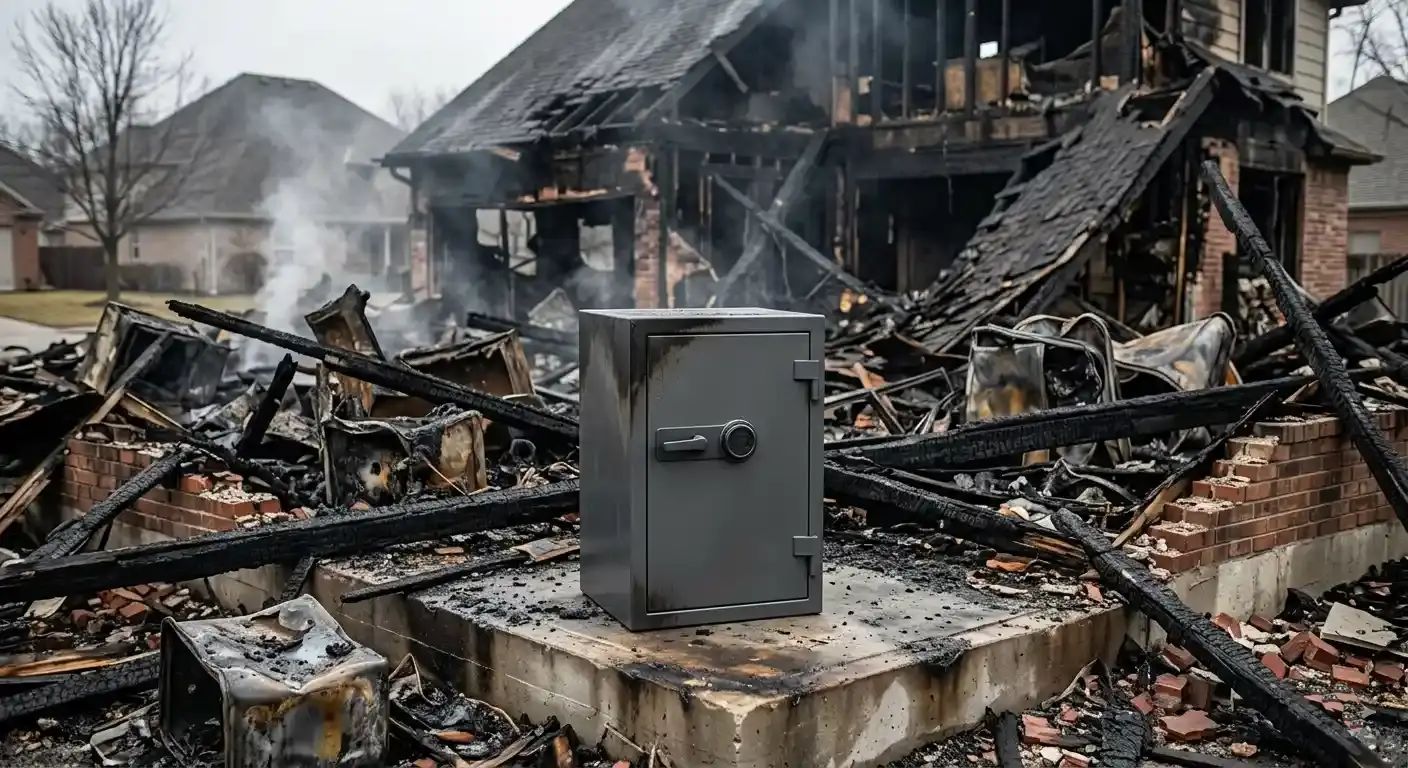
No safe is fireproof. Every rating on every box is a duration and a class, and the numbers manufacturers shout loudest are the ones that tell you least. Here's what the certifications actually certify, three safes under $300 that carry real ones — and the question about bolting them down that almost nobody thinks to ask before they drill.
By Johnny T.
·
March 2026
·
16 min read
Some links on this page are affiliate links — we may earn a commission.
Researched — not tested
We have not burned any of these safes. Nobody reviewing safes at this price has — the test costs more than the product. What follows is certification standards, manufacturer documentation, published test protocols and dealer records, tagged so you can see exactly what kind of claim each one is. Where our own earlier version of this page was wrong, we've said so and left the correction visible.
Two independent laboratories issue the marks that matter in this price band: Underwriters Laboratories, and Intertek, whose safe-testing mark is branded ETL. Both appear throughout. Neither is the same as a manufacturer testing its own product, which is the distinction the whole guide turns on.
The short version
Buy a third-party certification, not a temperature. Then ask one question nobody asks: does bolting this particular safe to the floor void its water rating? On some models the manufacturer says yes, on others no, and the answer is printed in the manual rather than the listing.
How to read this guide
Nothing here is hands-on. Where two credible sources disagree — and on this page they disagree more than you'd hope — we show you both rather than picking the tidier one.
TestedPhysically in hand. Nothing on this page carries this tag.
DocumentedPublished standard, laboratory protocol, manual or corporate filing.
ManufacturerThe maker's own claim. A claim, not a fact.
CommunitySafe-trade and locksmith consensus. Informed opinion.
CorrectedSomething we, or the industry, previously stated that the evidence doesn't support.
A fire rating is not a measure of toughness. It is the result of a specific laboratory procedure: the safe is loaded with test contents, sealed, and placed in a furnace that follows a controlled time-and-temperature curve while sensors inside record what happens. Documented
The rating that comes out of that has exactly two components:
- A class — the maximum temperature the interior was allowed to reach. That's the number that protects your contents.
- A duration — how long it held. Thirty minutes, one hour, two hours, up to four.
Everything else is packaging. The three classes under the American standard for record protection equipment, Underwriters Laboratories 72:
Note the humidity column, because almost nobody mentions it. Class 350 has no humidity requirement at all. Documented A safe can pass a paper-class test while the inside fills with steam. That is fine for a deed and fatal for a hard drive, which is precisely why the stricter classes exist and why they cost more. Class 150 was missing from our earlier version of this table entirely. Corrected
Why 1700°F is the least useful number printed on a safe
Fire testing follows a ramping curve rather than a fixed oven setting. Roughly 1700°F is simply where that curve sits at the sixty-minute mark — which is why every one-hour safe in existence quotes 1700°F, and why thirty-minute products quote around 1550°F. Documented It is a description of the test clock, not a claim about the safe.
"Withstands 1700°F!"
This tells you nothing that "one hour" doesn't already tell you, and it is doing rhetorical work that "one hour" wouldn't. Two safes both stamped 1700°F can differ by a factor of four in duration and by 225°F in what they let the interior reach. When you compare safes, compare class and duration. If a listing gives you a temperature and no class, it is quoting the furnace, not the product.
VerdictReal number, wrong end of the safe.
The 350°F threshold isn't about paper catching fire
Here's a correction to something we published and nearly everyone else still publishes. Our previous version said paper chars around 387°F and ignites at 451°F, stated as settled fact. It isn't. Corrected
The 451°F figure comes from a novel. Attempts to pin down a real number scatter badly: compiled fire-forensics references give a range of roughly 424–475°F, at least one technical write-up puts autoignition far higher at around 842°F with a flash point near 662°F, and ASTM's autoignition test method explicitly says it should not be applied to materials like wood, paper and plastics. Documented The honest position is that there is no single ignition temperature for paper — it depends on grade, thickness, coatings, moisture, oxygen and how long the heat is held.
Which makes the point better, not worse. 350°F was never chosen as an ignition threshold. It's a usability threshold. Long before paper burns it yellows, embrittles, curls and cooks the ink off itself. The standard certifies that what you take out is still readable and handleable — that's the actual promise, and it's a more demanding one than "didn't catch fire."
For context on the other side: trade sources put a typical residential fire in the region of 1,100–1,200°F, hotter at ceiling level and in flashover. Community Laboratory testing deliberately runs harsher than that, which is the reassuring part of all this.
Underwriters Laboratories has been testing since 1894 and its record-protection standard is the benchmark that insurers, specifiers and building codes reference. A Classified mark means an independent Underwriters Laboratories team ran the procedure and the product met it.
Intertek's ETL mark is not a lesser thing. ETL Verified testing for safes is conducted against the same Underwriters Laboratories 72 performance requirements, with unannounced follow-up factory audits, and the trade treats the marks as equivalent in rigour. Documented
Our earlier table implied ETL testing runs cooler — "1,200°F+ for rated time" against Underwriters Laboratories' 1,700°F. That was wrong and we've removed it. Corrected Both labs run the same curve. Anyone telling you ETL is the budget option is repeating a rumour.
The line that actually matters is third-party versus self-declared. A manufacturer testing its own safe, to its own interpretation, and printing the result is not certification. Watch for the tells:
- "Tested to UL standards" — tested by whom?
- "UL-style construction" — meaningless.
- "Meets or exceeds industry fire specifications" — which specification?
- "Fireproof" with no class, no duration and no laboratory named.
A genuine mark comes with a class, a duration and a lab. If any of the three is missing from the listing, ask for it before you buy — and if it isn't on the physical label when the box arrives, send it back.
The drop test, and the 30-foot / 15-foot confusion
Our previous version said that many certifications include dropping the safe from 30 feet and then returning it to a 2,000°F oven, and then, four hundred words later, described one of our own picks as drop-tested at 15 feet. Both numbers were in the same article. Corrected Here is what's actually going on, because the difference is real:
Three different tests people conflate
Fire endurance — the main event. Furnace, controlled curve, sensors inside, contents checked for usability afterwards.
Fire and impact (optional) — under Underwriters Laboratories 72, the safe comes straight out of the furnace, is hoisted 30 feet and dropped to simulate a fall through three storeys, then goes back into the furnace for up to another hour. Documented
Explosion hazard — a separate test in which a cold safe is dropped into a furnace already at roughly 2,000°F, to prove trapped moisture in the insulation won't flash to steam and rupture it. Documented This is where the 2,000°F figure belongs. It is not part of the drop test.
Separately, SentrySafe's consumer products carry an ETL Verified 15-foot drop claim, which is Intertek's own verification and a different, less severe article than the optional 30-foot impact test. Documented Both are real. They are not the same thing, and a listing quoting one does not entitle it to the other.
If you live in a single-storey house, none of this changes much. If your safe sits upstairs, drop performance is arguably the most under-considered spec in the category — the floor beneath it is one of the first things to fail.
This is new to the guide and it changed how we rank things, so it goes before the picks rather than after.
Buying a safe feels like buying a brand's reputation. In this category the brand on the door and the company that built the box are frequently unrelated, and the paper trail is all public:
All of that is documented. Documented And there's a detail in the second row that is genuinely funny once you see it. Resideo, which owns First Alert, is itself a 2018 spin-off of Honeywell International, and it holds a long-term exclusive licence to the "Honeywell Home" brand. Documented
So on a shelf of home safes you can have a Honeywell-branded chest made by a licensee in California that Honeywell disclaims, sitting next to a First Alert safe made by a company Honeywell spun off and licensed its other brand to. Neither is Honeywell. Both are, in a sense, Honeywell-adjacent. This is what brand equity looks like from the inside.
None of this makes any of these safes bad. Certification is independent of ownership — that's the entire point of a laboratory mark, and it's why we keep telling you to buy the label rather than the logo. But it does mean the name on the front is not evidence of anything, and it does affect the one thing certifications never cover: who answers the phone in eight years when the keypad dies. Our Gardall MS912 review goes through that trade-off in detail.
Every safe below carries an independent laboratory fire mark. No self-rated products. Prices move constantly at this end of the market — treat the figures as a bracket, not a quote.
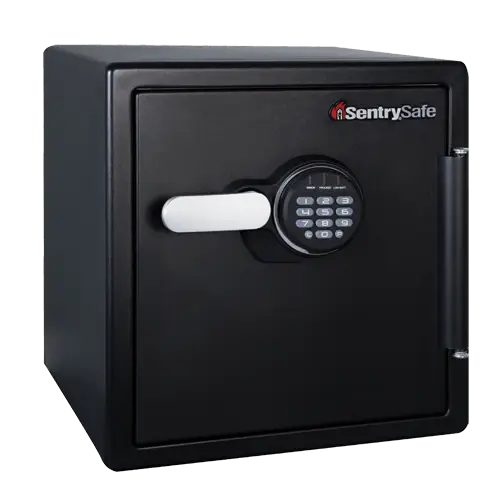
1. SentrySafe SFW123GDC — the default, and still the right default
Underwriters Laboratories Classified — 1 hour ETL Verified — water and impact
Fire
Underwriters Laboratories Classified, 1 hour at up to 1700°F Manufacturer
Water
ETL Verified, 24 hours in up to 8 inches of water
Impact
ETL Verified 15-foot drop during a fire
Digital media
Claimed via ETL verification, not an Underwriters Laboratories Class 125 rating Read carefully
Exterior
17.8" high × 16.3" wide × 19.3" deep — the door needs 14.75" of clearance to open fully
Weight
About 87 lb; some listings quote 90 lb shipping weight
Lock
Programmable digital keypad with secondary key
Security
Four 1-inch live-locking bolts, pry-resistant hinge bar, bolt-down hardware included
Inside
Locking drawer, door pocket, key rack, interior light
Warranty
1-year limited, with lifetime after-fire replacement
Price seen
Roughly $200–280
This is the most thoroughly certified safe you can buy under $300, and it has been for years because nothing has convincingly displaced it. The fire mark is a genuine Underwriters Laboratories Classification rather than a manufacturer claim, the water and impact verifications are Intertek's, and the hardware is better than the price suggests: four one-inch bolts, a hinge bar specifically designed to resist prying, and an interior that's actually organised rather than an empty steel cube.
Two things to know before you buy it, neither of which appears in most reviews.
The digital-media claim is not a Class 125 rating. SentrySafe and its retailers advertise protection for USB drives, discs and portable hard drives, verified by Intertek. That is a real verification, but it is not the Underwriters Laboratories 125 classification, and the two are not interchangeable. If your backup drive is genuinely irreplaceable, the correct answer is not a better safe — it's an off-site or cloud copy, which is cheaper and survives things no box does.
Bolting it down may affect the water rating, and SentrySafe's own manuals are the place to check. Some SentrySafe manuals state plainly that the resistance claim applies to the product prior to fitting a bolt-down kit; other SentrySafe models ship watertight bolt-down hardware and are verified when anchored. We could not confirm which applies to this exact model. Ask before you drill — details below.
Check the model code on the listing before ordering — SentrySafe's range uses near-identical part numbers for very different products, and the certifications differ between them.
The larger 2.05 cubic foot sibling is covered separately in our SFW205GQC review.
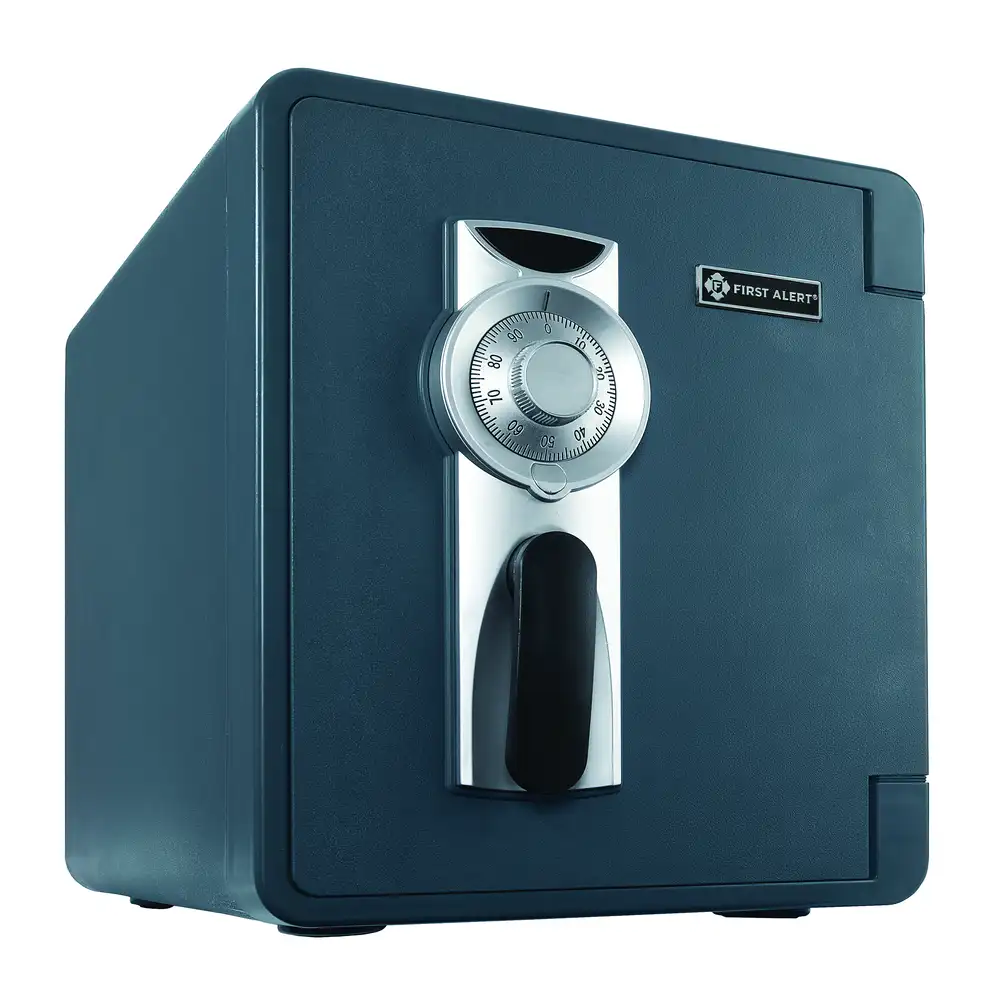
2. First Alert 2087F-BD — the budget pick, with a claim worth checking
Certifying lab: sources disagree 1 hour at 1700°F, interior below 350°F
Fire
1 hour at up to 1700°F with interior below 350°F. First Alert's own product page credits Underwriters Laboratories; our previous version of this page said Intertek. Sources disagree
Water
Waterproof seal, rated to remain sealed fully submerged — and the safe is designed to float
Bolt-down
Ready-Seal — First Alert states the safe stays fire-resistant and waterproof after anchoring. Ready-Seal is a registered trademark of BRK Brands; we found no patent behind it Manufacturer
Construction
Composite / resin body, not steel
Lock
Four-digit combination dial plus two override keys
Combination
Factory-preset and, per First Alert's own manual, cannot be changed Documented
Security
Four live-locking bolts, concealed pry-resistant hinges, adjustable shelf, key rack
Price seen
Roughly $130–160
We came into this update expecting to keep the First Alert as the budget also-ran. It doesn't deserve that, because of one patented feature the marketing undersells and every other listing ignores.
The bolt-down question, and what the manuals actually say
Waterproofing on a consumer safe comes from a gasket and a sealed shell, so drilling anchor holes through the floor of that shell is a reasonable thing to worry about. We put a strong version of this claim on an earlier draft of this page on the strength of a single review site, which was not good enough. Corrected Here is what the primary sources say.
Some SentrySafe manuals say the water claim applies before you bolt it down. The bolt-down page of a SentrySafe Fire-Safe manual carries the line that the resistance claim applies to the product prior to the application of a bolt-down kit, and a SentrySafe product-support representative answering a customer question stated that drilling the holes compromises the water protection, adding that you can seal around them afterwards. Documented
Other SentrySafe models are rated with the bolts in. The FPW082KSB is described as verified for water resistance in up to five inches of water for 24 hours even when bolted down, and ships watertight bolt-down hardware. One SentrySafe executive-series manual goes further and says water resistance requires the safe to be bolted down. Documented So this is a model-by-model question, not a brand-wide flaw, and we could not resolve it for the SFW123GDC specifically. Unresolved
First Alert markets Ready-Seal as the answer to exactly this. The company says the 2087F-BD stays fire-resistant and waterproof when fastened to the floor. Manufacturer Two caveats: Ready-Seal is a registered trademark of BRK Brands rather than a patent — retailer copy attributes the patent to the concealed hinges — and First Alert's claim to be "the only safe in the industry" that can be bolted down and stay waterproof is contradicted by SentrySafe's own bolt-down-rated models. Corrected
So the honest version is narrower than the one we published, and more useful: before you drill, find the bolt-down page of the manual for your exact model and read what it says about the water rating. It is a two-minute check that most buyers never make, and the answer genuinely differs between products sitting next to each other on the same shelf.
The trade-offs are real, though. The body is composite rather than steel, so it will not take an attack the way the SentrySafe's shell will. And the lock is the genuine annoyance: the four-number combination is factory-set and cannot be changed. That comes from First Alert's own product manual. Documented Several major retailers advertise it as a "user-settable combination lock" — that copy is wrong, and if a fixed combination is a dealbreaker for you, it is worth knowing before delivery rather than after. The two override keys are your only re-keying option, which is to say there isn't one.
One charming detail that is also a real feature: the 2087F-BD is designed to float, so it can be found after a flood rather than excavated. Manufacturer
Ask the seller which laboratory issued the fire mark, and check the label on arrival. The certifying body differs between First Alert's own materials and several retail listings.
If you plan to anchor it, read the separate Ready-Seal mounting instructions before you drill. The whole benefit depends on following them.
Amazon US
Also carried by Office Depot, Newegg and other general retailers
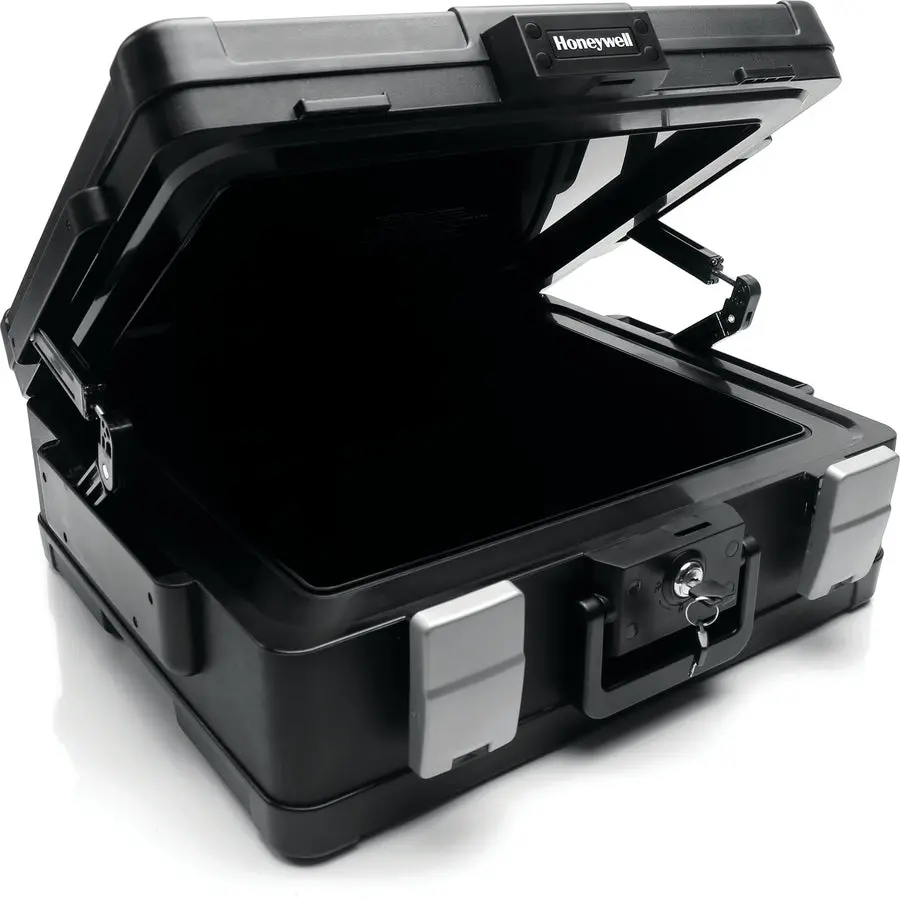
3. Honeywell 1114 — the document chest, and a weight correction
ETL Verified — 60 minutes 100 hours waterproof at 1 metre
Fire
ETL Verified, 60 minutes at up to 1700°F
Water
Certified 100 hours submerged at 1 metre — the strongest water figure here by a wide margin
Capacity
0.39 cubic feet; letter, A4 and legal documents lie flat
Exterior
7.32" high × 19.96" wide × 17.17" deep
Weight
41.9 lb per Honeywell's published specification — not the "about 10 lb" this page previously stated Corrected
Construction
Insulated double-wall moulded body with reinforced corners and compression latches
Lock
Privacy key lock, two keys. Not a security feature
Bolt-down
None. It has a carry handle instead
Warranty
5-year limited, with lifetime after-fire replacement guarantee
Start with the correction, because it was ours and it was significant. This page previously listed the 1114 at around 10 pounds and called it grab-and-go. Honeywell's own specification says 41.9 pounds. Corrected That also contradicted our own Honeywell 1114G review, which had the figure right at approximately 42 pounds. Two pages on this site disagreed by a factor of four, and the wrong one was the one telling you it was portable.
It has a carry handle and you can move it. You are not casually grabbing it on your way out of a burning house, and you should not plan around that.
What it is instead is the best pure fire-and-flood container here. A hundred hours submerged at a metre is four times the SentrySafe's water figure, and water is by a wide margin the likelier household disaster — burst pipes, failed appliances and roof leaks destroy far more paperwork than fires do. Documents lie flat, which matters more than it sounds over a decade of storage.
What it isn't is a security product, and Honeywell doesn't pretend otherwise. The key lock is privacy. At 42 pounds with no anchoring provision, a thief takes the whole chest. Use it for the papers whose loss is catastrophic and whose theft is pointless — birth certificates, deeds, policies, passports — and put anything a burglar would want somewhere bolted down.
Watch the model number here too: the similarly-named Honeywell 1104 is a 1550°F, 0.38 cubic foot chest, not the same product. Documented
Confirm the duration and water figure against the label on the unit. Honeywell's chest range spans 30 and 60 minute products with near-identical model numbers and packaging.
Full breakdown, including who actually manufactures Honeywell safes, in our 1114G review.
Amazon US
Widely stocked by office and general retailers
Side by side
"Fireproof" with no laboratory named. Anyone can print the word. Without a class, a duration and a lab, it means nothing. This is the single highest-yield filter you can apply.
Model numbers that differ by one character. This is the recurring theme across every safe we've researched. The Honeywell 1104 and 1114 are different products with different fire temperatures. Gardall's MS911 carries only a Korean fire label while the MS912 beside it also carries an Underwriters Laboratories one. SentrySafe's range reuses part-number patterns across wildly different products. Buy the model code, not the product photo.
Retailer copy that contradicts the manual. The First Alert combination is the case study on this page — sold as user-settable by several large retailers, described as unchangeable in the manufacturer's own manual. When they disagree, the manual wins.
Class 350 is not media protection. A paper-class safe has no humidity requirement and lets the interior reach 350°F. Drives, memory cards and photographs fail well below that. Class 125 products exist and typically cost more than everything on this page.
Weight only helps if the safe can't leave. An anchored 50-pound safe beats an unanchored 200-pound one, because once it's in a vehicle the attacker has unlimited time and better tools. Bolt-down hardware is included on the two floor safes here. Use it — and check the waterproofing consequence first.
Measure the door swing, not just the box. The SentrySafe needs 14.75 inches of clearance to open fully. Documented A closet that fits the safe but not the door is a common and expensive mistake.
Nothing here is a burglary rating. Fire and burglary are separate certifications under separate standards. A baseline Residential Security Container rating means a container resisted five minutes of attack by one person with common hand tools, and none of these safes carries one. Documented If theft is the actual threat, you are shopping in the wrong category — start with the gun safe guide or a burglary-rated box, and read how burglars pick targets first.
Before you pay, confirm all six:
☑ A named laboratory — Underwriters Laboratories or Intertek — not "tested to standards"
☑ A class stated: 350 for paper, 150 for film, 125 for digital media
☑ A duration stated: 30 minutes, 1 hour, 2 hours
☑ Water resistance certified separately, with a depth and a time
☑ Whether anchoring affects the water rating
☑ Door clearance measured, not just the safe's footprint
Is any home safe actually fireproof?
No, and the word appears in no standard. What exists is a class and a duration — how hot the interior was allowed to get, and for how long it held. Certification also demonstrates performance during a fire, not that the safe is reusable afterwards. Expect a fire-exposed safe to be a write-off you cut open, which is the correct outcome if the paperwork comes out readable.
Is ETL certification worse than UL?
No. Intertek's ETL Verified testing for safes is conducted against the same Underwriters Laboratories 72 performance requirements, with unannounced follow-up audits, and the trade treats the two marks as equivalent. The meaningful distinction is between any independent laboratory and a manufacturer testing its own product.
Does bolting a safe to the floor ruin its waterproofing?
It depends on the model, and the manual is where the answer lives. Some SentrySafe manuals state that the resistance claim applies before a bolt-down kit is fitted, and SentrySafe support has told a customer that drilling compromises the water protection. Other SentrySafe models ship watertight bolt-down hardware and are verified when anchored. First Alert says its Ready-Seal safes stay waterproof when bolted down. Check the bolt-down page of the manual for your exact model before you drill.
Can I keep a hard drive or photos in a Class 350 safe?
Not for fire protection. Class 350 lets the interior reach 350°F with no humidity limit, and drives, memory cards and photographs fail well below that. Digital media needs Class 125 and photographic media Class 150. Manufacturers often advertise separate media-protection verifications, which are real but are not the same as those classes. For data, an off-site or cloud copy beats any box.
Why does every safe say 1700°F?
Because fire testing follows a standard ramping curve, and roughly 1700°F is where that curve sits at the sixty-minute mark. It describes the test clock, not the product. Thirty-minute products quote around 1550°F for the same reason. Compare class and duration instead.
Will a safe under $300 stop a burglar?
Not meaningfully. None of these carries a burglary rating, because fire and burglary are certified under separate standards. Anchored to a floor, a steel-bodied fire safe defeats a casual grab-and-go. Against someone with time and tools it will not hold, and no product at this price claims otherwise.
Which of the three should I buy?
The SentrySafe SFW123GDC for most people — it is the most thoroughly certified safe in the price band, with a steel body and a keypad you can reprogram. The First Alert if you want to spend about $100 less and can live with a combination that cannot be changed. The Honeywell chest if what you are protecting is documents, or if you live somewhere that floods, because a hundred hours of submersion beats everything else here. Many households are best served buying the chest and a bolted-down burglary safe separately rather than one product attempting both.
That headline has been on this page since we published it, and the spirit of it survives the research: buy an independently certified safe. The price gap between a certified product and an uncertified one at the same size is small. The performance gap in a real fire can be total, and the uncertified one will still have its sticker on when they cut it open.
The amendment is that "get UL" is slightly too narrow. Intertek's ETL mark tests to the same standard, and treating it as second-tier would have you skip the best water-resistance figure on this page. The rule that actually holds is: a named laboratory, a class, and a duration. Three things. If a listing can't give you all three, it isn't a fire safe, it's a metal cupboard with a claim on it.
Beyond that: the SentrySafe SFW123GDC remains the sensible default, because it is the most thoroughly certified product in the band and the only one here with a steel body and a reprogrammable lock. The First Alert saves you about $100 and answers the bolt-down question more confidently, at the cost of a composite body and a combination you can never change. And if what you're actually protecting is a folder of documents you can't replace, the Honeywell chest does that job better than either for a third of the money — spend the difference on anchoring something else.
And whichever you buy: none of this is theft protection. Bolt it down, keep the backup drive somewhere else entirely, and don't put anything in a $200 box that you couldn't eventually survive losing.
Bottom line
A named laboratory, a class and a duration — everything else on the box is decoration. Then read the bolt-down page of the manual before you drill, because the water rating survives anchoring on some of these and not on others.
Sources & Method
- Underwriters Laboratories 72 classes, durations and the standard fire curve — Documented
Class 350 (paper, no humidity requirement), Class 150 (film and tape, 85%), Class 125 (digital media, 80%), across durations from 30 minutes to four hours. Testing follows a ramping time-temperature curve, which is why 1550°F pairs with 30 minutes and 1700°F with 60. The standard demonstrates performance during a fire and does not certify the container as reusable afterwards.
Standard summarised
- Fire endurance, impact and explosion-hazard tests — Documented
Underwriters Laboratories' own account: fire endurance monitors internal temperature and humidity against a controlled curve; the optional impact test removes the safe from the furnace immediately after the endurance run, hoists it 30 feet and drops it to simulate a three-storey fall, then returns it to the furnace for up to another hour. The explosion-hazard test is separate and places a cold safe into a furnace preheated to roughly 2,000°F.
UL Solutions — fire testing of safes
- ETL equivalence — Documented Corrected
Intertek's ETL Verified marks test to the same Underwriters Laboratories 72 requirements with unannounced follow-up audits and are treated as equivalent in rigour. Our previous table listed ETL testing at "1,200°F+", implying a less severe protocol. That was wrong and has been removed.
UL and ETL compared
- Paper ignition temperature — corrects a figure we stated as fact — Corrected Documented
We previously stated that paper chars at 387°F and ignites at 451°F. There is no settled value. Compiled fire-forensics references give a range of roughly 424–475°F while noting discrepancies in the literature; other technical write-ups place autoignition near 842°F with a flash point around 662°F; and ASTM's autoignition test method states it should not be used for materials such as wood, paper and plastics. The 350°F class threshold is a usability limit — documents must come out readable — not an ignition limit.
Ranges and test-method caveats
- SentrySafe SFW123GDC specification — Manufacturer Documented
Underwriters Laboratories Classified for 1 hour at up to 1700°F; ETL Verified for 24 hours in up to 8 inches of water; ETL Verified to withstand a 15-foot fall during a fire; ETL verification claimed for protection of drives and optical media. 1.23 cubic feet; exterior 17.8" × 16.3" × 19.3" with 14.75" of door clearance required; approximately 87 lb with 90 lb quoted as shipping weight; four 1-inch live-locking bolts, pry-resistant hinge bar, locking drawer, interior light, bolt-down hardware included; 1-year limited warranty with lifetime after-fire replacement.
SentrySafe — SFW123GDC
- Anchoring and water resistance — Documented Unresolved
An earlier version of this page asserted, on the strength of one review site, that anchoring a SentrySafe compromises its water resistance, and used that to reverse our ranking. That was not adequately sourced and the ranking has been restored. The primary sources say something narrower: the bolt-down section of a SentrySafe Fire-Safe manual states that the resistance claim applies to the product prior to the application of a bolt-down kit, and a SentrySafe product-support representative answering a customer question said the drilled holes compromise the water protection but can be sealed around. Against that, the SentrySafe FPW082KSB is described as verified for 24 hours in up to five inches of water even when bolted down, using watertight bolt-down hardware, and a SentrySafe executive-series manual states that water resistance requires the safe to be bolted down. It is a model-by-model question. We could not resolve it for the SFW123GDC.
SentrySafe manual — bolt-down page
- First Alert 2087F-BD specification and Ready-Seal — Manufacturer
0.94 cubic feet; composite body; four live-locking bolts; concealed pry-resistant hinges; adjustable shelf and key rack; rated 1 hour at up to 1700°F with interior below 350°F; waterproof seal maintained when submerged; designed to float. First Alert describes Ready-Seal as a lockdown mechanism that keeps the safe fire-resistant and waterproof when fastened to the floor, and markets it as the only safe in the industry able to do so. Two corrections to our earlier wording: READY-SEAL is a registered trademark of BRK Brands, Inc. rather than a patent — retailer copy attributes the patent to the concealed hinges — and the "only safe in the industry" claim is contradicted by SentrySafe models rated for water resistance when bolted down.
First Alert — 2087F-BD
- First Alert certifying laboratory — Sources disagree
First Alert's own product page credits independent verification by Underwriters Laboratories; a major retailer lists the safe as "UL listed"; Amazon's listing says only "an independent testing lab"; and our previous version of this page stated ETL Verified. We cannot resolve which mark the current production unit carries. Check the physical label.
- First Alert combination cannot be changed — Documented
The 2087F-BD / 2092F-BD owner's manual states that the combination is a pre-set four-number sequence unique to the safe and cannot be changed. Several large retailers advertise a "user-settable combination lock", which contradicts the manufacturer's own documentation.
First Alert 2087F-BD manual
- Honeywell 1114 specification — corrects our weight figure — Corrected Manufacturer
Honeywell's published specification: exterior 7.32" × 19.96" × 17.17"; interior 3.78" × 14.80" × 12.01"; 0.39 cubic feet; 41.9 lb; ETL 60-minute rating at up to 1700°F; certified 100 hours waterproof at 1 metre; insulated double-wall construction with reinforced corners and compression latches; privacy key lock; 5-year limited warranty with lifetime after-fire replacement. This page previously stated approximately 10 lb, contradicting our own 1114G review, which had it right at approximately 42 lb. One retailer's manual listing quotes 24 hours at 39 inches rather than 100 hours at 1 metre; Honeywell's own product page states 100 hours.
Honeywell Safes — 1114
- Brand ownership and manufacturing — Documented
SentrySafe: founded Rochester, New York 1930; acquired by The Master Lock Company, a unit of Fortune Brands, in July 2014 for $117.5 million; Rochester and Cannelton, Indiana facilities closed by June 2016 with functions relocated to Oak Creek, Wisconsin and Nogales, Mexico. First Alert: founded 1969, Aurora, Illinois; acquired by Resideo Technologies from Newell Brands in April 2022 for $593 million; manufacturing footprint includes Juarez, Mexico. Resideo was spun off from Honeywell International in October 2018 and holds a long-term exclusive licence to the Honeywell Home brand. Honeywell-branded safes are made by LH Licensed Products, Inc. of Carson, California under a separate trademark licence, and Honeywell states it makes no representations or warranties for them.
Resideo completes First Alert acquisition
- Claims removed or amended from the previous version — Corrected
Honeywell 1114 weight "~10 lbs" → 41.9 lb. "Many UL and ETL certifications" include a 30-foot drop followed by a 2,000°F oven → the 30-foot drop is Underwriters Laboratories' optional impact test with a return to the furnace; the 2,000°F figure belongs to the separate explosion test; SentrySafe's is an ETL 15-foot drop. ETL "1,200°F+ for rated time" → removed, ETL tests the same curve. First Alert "ETL Verified" → certifying lab disputed. Paper "chars at 387°F, ignites at 451°F" → no settled value, reframed. Underwriters Laboratories "over 125 years" → testing since 1894. Class 150 → added to the ratings table. An internal link labelled SFW123GDC pointed at our SFW205GQC review → relabelled, they are different safes. First Alert weight "82 lbs" → removed as unsourced. Retail availability claims → narrowed to retailers we could confirm. And in this revision: the claim that anchoring destroys the water rating was reduced from a brand-wide fact to a model-specific question, the ranking inversion built on it was reverted, "patented Ready-Seal" was corrected to a registered trademark, and the byline's second date was removed.
We have not fire-tested any of these products and nothing here is hands-on. If you have had any safe through an actual house fire or flood, that outcome is worth more than every specification above — tell us what happened and you'll be credited.