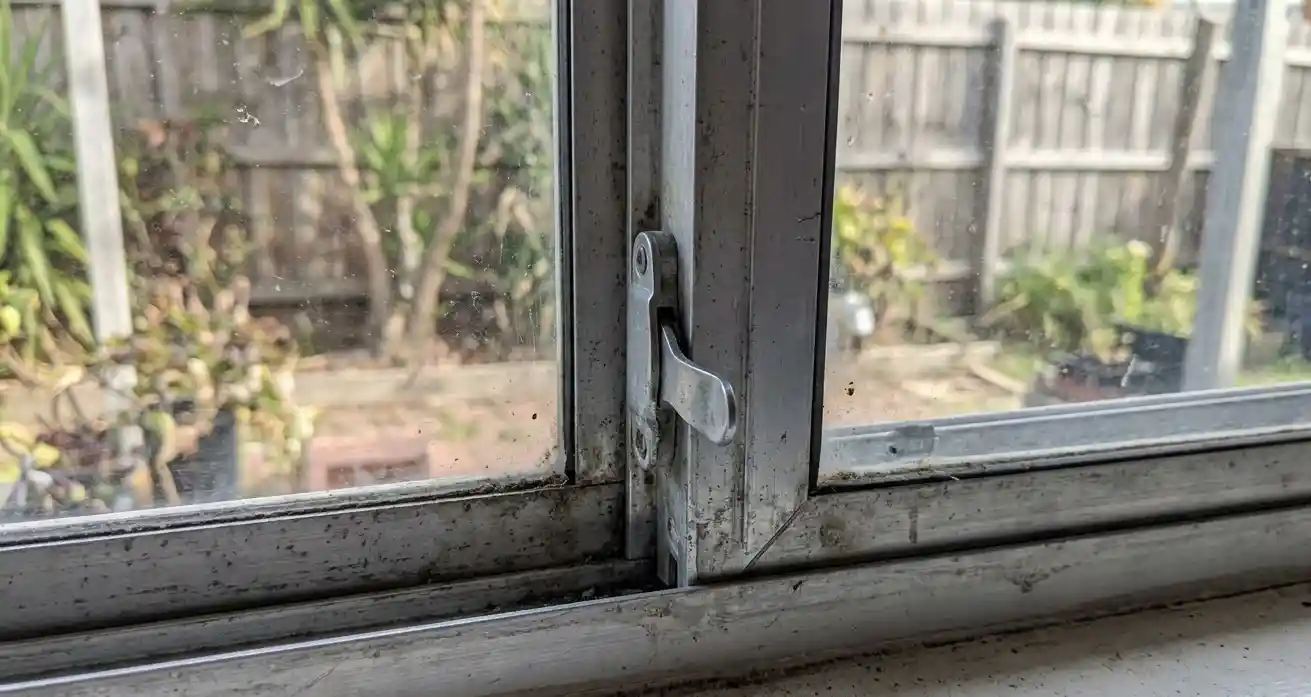
You spent real money on a good deadbolt. You read the reviews, you got the Grade 1, you drove the screws into the stud. Then you left a 1970s aluminum slider cracked open in the bedroom because it was warm. Here is the uncomfortable part: the lock you obsessed over was never the weak point, and the person who wants in already knows that.
By Johnny T.·Updated August 2026·18 min read
Security thinking has a front door problem. The research, the marketing, the reviews, the camera footage — all of it converges on the primary entry door as though it were the only thing between your household and a bad afternoon. And it isn't wrong, exactly. The front door is still the single most common entry point. But it is also the entry point people have been worrying about for forty years. It has a deadbolt. It has a reinforced frame. It has a doorbell camera pointed at it. In most homes, the front door is the most defended square foot on the property.
Meanwhile the windows have a latch. The sliding glass door has a dowel in the track, maybe. The garage passage door is a hollow-core interior slab that would fail to one kick. The basement hoppers sit two feet below grade, invisible from the street, and have not been thought about since the house was built.
Here is what I want you to take from this piece, and I'll say it before the 5,000 words rather than after: a perimeter is not a collection of locks. It is a single system, and it performs at the level of its worst component. Spending $180 on a high-grade deadbolt while a $4 crescent latch guards the window six feet to its left is not security. It's decoration with a receipt.
40%
Of unlawful entries to empty homes came through a door or window that was simply unlocked BJS
9–11%
Of forcible entries involved damaging or removing a window screen BJS
$4
Cost of the single highest-value fix in this guide
How to read this article
Most security sites present everything at the same confidence level, which means you can't tell a lab result from a guess. We tag ours. Every claim below carries one of these, and the numbered sources are at the foot of the page.
TestedI physically had it in hand and tried it myself.
DocumentedVerified in a published report, recorded demonstration, or manufacturer test data.
ManufacturerThe maker's own claim. Treated as a claim, not a fact.
CommunityConsensus among locksmiths and locksport people. Informed opinion.
VerifyA widely repeated figure I have not yet traced to a primary source. Flagged rather than deleted, because I'd rather show you the seam.
A note on the number we removed
An earlier version of this page led with a familiar figure: "23% of break-ins happen through a window." It appears on hundreds of security sites, insurance blogs and alarm-company landing pages. It is usually credited, when it's credited at all, to the Bureau of Justice Statistics.
We went and read the report — Victimization During Household Burglary, NCJ 227379, the BJS study everyone points at. That number is not in it. Not in the entry-method tables, not in the highlights, not anywhere. The figures BJS actually publishes on method of entry are different, and in one case they're considerably more useful:
Damaging or removing a door was the most common method in forcible and attempted forcible entries. Doors, not windows. BJS
Window screens were damaged or removed in roughly 9–11% of forcible entries, and 18–22% of attempted forcible entries — attempts being the ones that failed. BJS
And the one worth sitting with: in about 40% of unlawful entries to unoccupied homes, the offender came in through a door or window that was already unlocked. No force, no tools, no skill. BJS
We can't tell you where 23% came from. Possibly a single police department's local data that got repeated until it acquired the authority of a federal statistic. What we can tell you is that we couldn't source it, so it's gone — and that the 40% figure, which is sourced, makes the argument better anyway. The most common way into an empty house isn't a broken window or a picked lock. It's a door somebody forgot about.
This is the boring part of the job and it's the part almost nobody does. If a security site never shows you a number it removed, that isn't because it never had one wrong.
The thesis
Burglary is not a lockpicking problem. It is a weakest-link problem, and the weakest link is almost never the thing you paid the most for.
Chapter 1
The Full Perimeter
Every overlooked entry point — threat-rated and explained
Before you fix a weakness you have to know it exists. Below is the full map of the entry points that routinely get ignored, rated by how easily they're defeated without tools, noise, or skill — because that is the realistic threat, not a professional with a pick set. If you want the profile of who actually does this and how they choose a house, that's a separate read: how burglars choose targets. Five pips is worst.
Double-Hung Windows
Threat Level
The standard up-and-down residential window. The crescent-shaped cam it ships with is not a lock — it's a stay. Its job is holding the sash against rattle and draft. It's a zinc casting on two short screws into the sash rail, and a flat tool worked into the meeting rail will rotate it in seconds. On older frames with loose tolerances, the sash can be vibrated until the cam walks itself open. No manufacturer has ever claimed otherwise; people just assume.
Sliding Glass Doors
Threat Level
The worst offender in most houses, and it's not close. Three separate failure modes stack on one opening: a hook latch into thin aluminum, a panel that can often be lifted clear of its track, and a dowel-in-track "fix" that stops sliding but does nothing about lifting. Full breakdown in the sliding door guide.
Garage Passage Door
Threat Level
The door between the garage and the house. Builders treat it as interior: hollow-core slab, spring latch only, no deadbolt, short screws into a soft jamb. Once someone is inside the garage they are behind a closed door with total privacy and unlimited time — the two things that make everything else easy. This is the highest-value fifty dollars in the entire house.
Basement & Hopper Windows
Threat Level
Small, low, and hidden below grade in a well — which is exactly the problem. Concealment is worth more to an intruder than any amount of leverage. Hardware is typically a turn-latch or a friction catch older than the occupant. Nobody has looked at these since the inspection.
Pet Doors
Threat Level
The risk isn't a person squeezing through — it's a person reaching through. A pet door within arm's reach of a thumbturn, a chain, or an interior handle hands over the whole door. Measure it: if a shoulder-length reach from the opening lands on any hardware, that's a defect, not a feature.
Keyed Window & Track Locks
Threat Level
The upgrade that isn't. Most inexpensive keyed window locks and auxiliary track locks use a small wafer cylinder, not a pin-tumbler. Wafers are shallower, fewer, and far more tolerant of a badly fitting key — which is precisely why they're cheap and precisely why they're weak. More on why this matters below.
Chapter 2
The Lock Nobody Checks
Why window hardware fails on principles most guides never mention
This is the chapter that separates this guide from the other four hundred window-security articles online, and it's because of a bias in who writes them. General security writers evaluate window hardware by what it's called. Somebody who spends their evenings taking locks apart evaluates it by what's inside. Those produce very different answers.
A latch is not a lock, and the industry knows it
Start with vocabulary, because vocabulary is doing a lot of quiet work here. A latch holds a door or sash in position. A lock resists a person who is actively trying to defeat it. The crescent cam on your double-hung window is a latch. The hook on your slider is a latch. Neither is sold or rated as a security device, and if you read the packaging closely you'll notice the manufacturers are careful never to say they are. Manufacturer
The distinction isn't pedantic. It tells you where to spend. Reinforcing a latch is pointless — you can't make a stay into a barrier. What you can do is add a second, independent mechanical stop that has to be defeated separately. That's why every good fix in this article is an addition rather than an upgrade.
Wafer cylinders: the upgrade that isn't
Here's the one most homeowners get wrong, and it costs them money. You notice the flip latch is flimsy, so you buy a keyed window lock. It has a key. Keys mean security. Problem solved.
Except most low-cost keyed window locks, cam locks, and auxiliary track locks don't contain a pin-tumbler cylinder. They contain a wafer cylinder — a simpler mechanism using flat wafers instead of stacked pin pairs, usually four or five of them, with tolerances loose enough that a poorly cut key still turns. Community That tolerance is the entire point of the design: it makes the lock cheap to manufacture and forgiving to use. It also makes it trivially raked, jiggled, or opened with a tensioned blank. Wafer cylinders are what you find in filing cabinets, desk drawers, and vending machines — furniture-grade hardware. They exist to establish that a compartment is closed, not to resist attack.
So the keyed window lock you bought may genuinely be an improvement over the crescent cam — but not because of the key. It's an improvement because it adds a second physical stop. The cylinder is close to decorative. If you understand that, you'll stop paying extra for keyed versions and start buying whatever produces the strongest mechanical interference for the money, which is usually a plain pin or bolt.
Fig. 01Wafer cylinder vs. pin tumbler, in sectionSchematic · not to scale
1Four flat wafers, single-piece, riding in one slot. Fewer components, shallower travel, and manufacturing tolerances loose enough that an imprecise key still turns — which is the design intent, not a defect.
2The shear line. On both mechanisms this is the boundary the plug must rotate across. The wafer version simply has less standing in the way of it.
3Five stacked pin pairs — driver above, key pin below — each independently sprung. Every stack is a separate problem to solve, and the tolerances are tight enough that a wrong key jams rather than turns.
4The bitting cuts. Each depth lifts one stack to the shear line. This is the difference you are paying for at the front door, and the difference you are not getting in a $9 keyed window latch.
Both mechanisms are pickable. The distinction that matters here isn't pick resistance —
it's that a wafer cylinder is furniture hardware being sold as security hardware.
Community
From the bench
I'm not a master picker. I'm a yellow belt who has opened a couple of orange locks and exactly one green, and I want to be honest about that because it's the point I'm about to make. It took me somewhere around four to five weeks — an hour most days — before I first opened an ABUS 55/40, a $15 padlock. I bought a second one convinced the first was defective. It wasn't. I was just learning.
Wafer cylinders of the kind in cheap window hardware are on the opposite end of that spectrum entirely. They are not in the same conversation as a 55/40, and the 55/40 is not in the same conversation as a real lock. When somebody tells you a keyed window latch is secure, understand what tier of the tier list we're on.
Spring latches and the credit card problem
Any latch with an angled face — the sloped bolt that lets a door click shut without turning the handle — can potentially be pushed back by sliding something thin against that slope. The technique is called loiding, it's older than most of the houses it works on, and it's the reason a spring latch alone is not a lock. It applies to casement window latches, interior doors, and above all to the garage passage door we'll get to in Chapter 4.
A deadbolt is immune to this — the bolt is square-faced and doesn't retract under side pressure. That single mechanical difference is the whole argument for putting a deadbolt anywhere a spring latch is currently doing security work. Padlocks have their own version of this problem, which is shimming, and it's worth knowing about if you're using one on a gate or shed.
The screws are the lock
The most expensive lock in the world is fastened to something. On a typical American house, the strike plate is fastened to a jamb of finger-jointed pine roughly three-quarters of an inch thick, using the screws that came in the box — also three-quarters of an inch. Those screws terminate in the jamb. They never reach the stud behind it.
So when a door is kicked, the lock does not fail. The bolt does not shear. A quarter-inch strip of softwood splinters, and the whole assembly leaves with it. You can watch this in any bodycam footage of a forced entry: the hardware is usually still intact, dangling from a door that's now in the hallway. Documented
Three-inch screws through the strike plate and into the framing convert that failure mode into something entirely different, and the parts cost about four dollars. This is the single highest-leverage security purchase available to a homeowner, and almost nobody makes it. It's covered properly in the door frame reinforcement guide.
Chapter 2, condensed
Stop buying locks. Start buying mechanical interference that is fastened into structural wood.
Chapter 3
Sliding Glass Doors
Three failure modes stacked on one opening
If your house has one, this is your weakest opening, and the dowel you put in the track has probably given you false confidence for years. Three things fail here and they fail independently, which means fixing one leaves the other two untouched.
Failure mode 1 — the hook latch
Factory sliders use a hook that swings into a slot in the frame. It engages perhaps a quarter inch into thin extruded aluminum. Leverage at the meeting stile deforms the aluminum before the hook itself gives, and the hook clears the slot. On doors more than twenty years old the frame is often soft enough that this needs no tools at all — just body weight applied in the right direction.
Failure mode 2 — lift-off
This is the one people miss. Sliding panels are installed by lifting them into the upper channel and dropping them into the lower track. That process is reversible from outside. Lift the panel, swing the bottom clear, and set it aside — the latch is still perfectly engaged and completely irrelevant, because the door is no longer in the frame.
A dowel in the track does absolutely nothing about this. It prevents horizontal travel. Lifting is vertical. If the bar is the only thing you've done, you've addressed one of three failure modes and left the quietest one wide open.
The fix is embarrassingly cheap: drive two or three screws partway into the upper track above the sliding panel, leaving just enough clearance for the door to run. The panel can no longer be lifted high enough to clear the bottom track. Cost, roughly nothing. Time, ten minutes.
Failure mode 3 — the track bar itself
Cut-to-length track bars are usually sized generously so they'll fit a range of doors. That generosity leaves play — often an inch or two — and an inch of travel at the latch edge is frequently enough to work the hook free or get a tool into the gap. A bar should be cut so the door moves essentially not at all. If it rattles, it isn't finished.
Better than a bar: a foot bolt or auxiliary pin lock drilled through the sliding panel into the fixed panel or frame. That's a steel pin passing through both members. It defeats sliding and lifting simultaneously, and it doesn't care how the latch is doing. Deeper treatment in the dedicated sliding door guide.
Chapter 4
The Garage Problem
Where privacy becomes the vulnerability
Everything about the garage inverts normal security logic. Elsewhere in the house, being seen is the deterrent. In a garage with the door down, an intruder has walls, a roof, no sightlines, and as much time as they want. The garage isn't an entry point so much as a staging area.
The emergency release cord
Every automatic opener has a manual release — the red cord with the plastic handle, required so you can get your car out during a power failure. The bypass is not new and it is not obscure. A straightened coat hanger goes through the gap at the top of the door, hooks the release lever or its cord, and pulls. The trolley disengages and the door lifts by hand. It was demonstrated at an industry trade show in 2002, and the door-industry association itself has published on it. DASMA There is at least one granted US patent whose entire purpose is defeating this attack, which tells you the industry considers it real. Patent
Mitigations, in order of how much they inconvenience you:
Zip-tie the release handle to the carriage. A hard pull from inside snaps a light-duty tie; a fished wire can't generate that force. Reversible, costs pennies. Read this part: opener manufacturers discourage modifying the release, and UL requires the cord to stay reachable from the floor — it exists so you can get out during a power failure. Manufacturer Use a tie light enough to break by hand, never wire, and test it before you trust it. If anyone in the house couldn't snap it, don't fit it.
Shorten the cord so it can't be reached from the top of the door.
Fit a shield over the top of the door where the wire goes in.
If the garage is detached or rarely used, a slide bolt or a good padlock through the track defeats the whole category — at the cost of not being able to open it remotely.
The passage door is the actual problem
Once someone is in the garage, only the interior passage door stands between them and the house. Builders classify that door as interior, so it typically gets: a hollow-core slab, a spring latch with no deadbolt, short screws, and sometimes a bright window at head height.
Every weakness in this article converges on that one door. It's loidable because it's a spring latch. It's kickable because the screws don't reach framing. It's punchable because the core is cardboard honeycomb. And the attacker has complete privacy while working on it.
Treat it as an exterior door, because functionally that's what it is: solid core, a real deadbolt, three-inch screws, reinforced strike. Under a hundred dollars if you hang it yourself, and it is the best money in this entire guide.
Opener codes
Openers made before the late 1990s often use fixed codes, which can be captured and replayed. Documented Modern units use rolling codes that change every activation and are not vulnerable to simple replay. If your opener predates rolling code, replacement is the fix — and it's a good moment to note the same principle governs smart locks: the mechanical side and the electronic side are two separate attack surfaces, and a product can be excellent at one and negligent at the other.
And the ordinary version of this, which matters more than any of it: the remote clipped to your visor is a house key sitting in an unlocked car. Bring it inside, or use a keypad.
Chapter 5
The Fix Ladder
Every fix, ordered by what it costs you
Ordered by cost, not by importance — because the useful question is never "what's the best possible setup," it's "what's the most security I can buy with what I have right now." Start at the top. Most homes get the majority of their available improvement before spending a dollar.
Window & Perimeter Fix Ladder
Work down. Don't skip the free rung — it outperforms most of what's below it.
$0
Free
Drill sash pin holes. A hole through the inner sash into (not through) the outer sash, with a nail dropped in. This is the strongest window fix that exists and it costs nothing but a drill bit you already own.
Zip-tie the garage release handle. Two minutes, defeats a documented attack.
Cut existing track bars to actual length. Eliminate the play. Most bars are two inches too long.
Bring the garage remote inside.
Walk the perimeter at night, from outside. Look at your own house the way someone casing it would. Note every opening you can't see from a neighbor's window. That list is your real priority order.
Trim shrubs below window-sill height. Concealment is worth more than leverage.
<$20
Cheap
Three-inch screws in every exterior strike plate and hinge. A $4 box. Highest return in the guide, no exceptions.
Anti-lift screws in the slider's upper track. Kills the quietest failure mode on the worst opening in the house.
Commercial sash pins if you'd rather not drill freehand.
Window/door alarm contacts. Not monitored — just loud. Noise is the deterrent that actually works on opportunistic entry.
Cage or reposition anything within reach of a pet door or mail slot.
<$100
Worth it
Solid-core door on the garage passage, with a real deadbolt. The best hundred dollars in this article, and it isn't close.
Foot bolt or auxiliary pin lock on the slider. Steel through both panels. Defeats sliding and lifting at once.
Grade 1 deadbolts throughout — meaningful only after the frame work above. A Grade 1 bolt in a pine jamb with short screws is a Grade 1 bolt in a pine jamb with short screws.
Chapter 6
What Doesn't Work
Popular advice that fails on inspection
Half of window security advice online is repeated because it sounds sensible, not because anyone checked. Here's what doesn't survive contact with the mechanism.
"A bar in the track secures a sliding door."
It secures the door against sliding. It does nothing about lifting, which is the quieter attack and requires no tools. A bar plus anti-lift screws is a real fix. A bar alone is one third of a fix that feels like a whole one.
VerdictHalf-true, and the missing half is the dangerous one.
"Upgrade to a keyed window lock."
The improvement comes from the extra mechanical stop, not from the key. Most of these use wafer cylinders — furniture-grade mechanisms with loose tolerances. You're paying a premium for a cylinder that contributes very little. A drilled sash pin costs nothing and resists more.
VerdictWorks, but not for the reason on the packaging — and you overpaid.
"Security film makes glass unbreakable."
No film makes glass unbreakable, and reputable manufacturers don't claim it. What quality film does is hold the fragments to the pane after it shatters, so the opening doesn't clear. That converts a single quiet strike into repeated loud strikes — which is genuinely valuable, because noise and time are what opportunistic entry can't afford. Buy it for that. Cheap films sold as "security" are often just tint with no meaningful tear strength. Manufacturer
VerdictReal, if you buy the right product for the right reason.
"A sign or sticker is enough."
Deterrent signage has some effect on casual approach, but it is the only measure in this guide that fails completely the moment someone decides to test it. Every other item here still functions against a person who has already committed. Use signs as a supplement; never as a layer.
VerdictMarginal. Costs nothing, so keep it — but don't count it.
"Get a Grade 1 deadbolt and you're done."
ANSI/BHMA grading tests the lock. It does not test your door, your jamb, your screws, or the window six feet away. A Grade 1 bolt into three-quarter-inch pine with factory screws fails at the wood, at which point the grade is a number on a box. Grading is real and useful — it just measures a component, not a perimeter. Documented More on what the grades actually cover in our ANSI grade breakdown.
VerdictFalse as stated. The grade is necessary, not sufficient.
Chapter 7
When They Break the Glass
The attack everyone fears and few people use
Worth saying plainly: breaking glass is the option people worry about most and use least. It's loud, it's slow, it leaves an obvious signature, and it cuts you. Given a latch that opens quietly in four seconds, nobody picks the noise. That's why the bulk of this guide is about latches.
But it happens, and the glass you have determines what happens next.
Standard float glass
Older single-pane windows. Breaks into large shards, leaves a clear opening. No meaningful resistance.
Tempered glass
Required by code in doors and near floors. Roughly four to five times the strength of annealed glass — and this is where people go wrong, because that strength is real but it is strength against accidental impact. Once the surface compression is breached the entire pane dices at once into small blunt granules, leaving a completely clear opening. Documented Tempering is a safety specification written to prevent lacerations. It is not a security specification, and glazing-industry sources are explicit that it offers essentially no forced-entry resistance once broken. Stronger before it breaks, more open after.
Laminated glass
Two panes bonded to an interlayer — the windshield principle. It cracks but holds together, and clearing an opening requires sustained, loud, visible work. This is the only glass that meaningfully resists entry. Expensive to retrofit, which is why it makes sense on two or three openings rather than all of them.
Security film on existing glass
The retrofit approximation of laminated glass. Quality matters enormously and the market is full of tint marketed as security film. Look for a stated thickness — generally 8 mil and up for security grade — and, critically, a mounting system that attaches the film to the frame, not just the pane. Film bonded only to the glass can be pushed out as one flexible sheet, which is a well-known limitation of DIY installs.
Glass break sensors
Two kinds. Acoustic sensors listen for the specific frequency signature of breaking glass and cover a room; shock sensors mount to the pane and detect impact. Acoustic is more common and less prone to false alarms from a slammed door. Neither prevents anything — they shorten the time between the break and someone knowing about it, which is a different and still useful job.
Questions
The Ones People Actually Ask
Short answers
Are window locks actually worth buying?
Yes, but for the mechanical stop, not the key. A drilled sash pin does the same job for free and resists more force than most keyed units. If you'd rather buy than drill, buy the strongest pin or bolt you can, and don't pay extra for a cylinder.
What's the single cheapest thing that makes a real difference?
Three-inch screws in the strike plates and hinges of every exterior door. Around four dollars, twenty minutes, and it changes the failure mode of a kick from "jamb splinters" to "attacker gives up." Nothing else in this guide has that ratio.
Can someone really pick my window lock?
They wouldn't bother. Picking is slow, requires practice, and is unnecessary when the same lock can be bypassed or the sash simply levered. Picking is a hobby and a locksmith skill; it is very rarely a burglary method. If you're curious about what actual picking involves, that's what the locksport section is for.
I rent. What can I do without modifying anything?
Track bars cut to correct length, removable sash pins that use existing frame holes, door and window alarm contacts, a portable door brace for the bedroom, and lighting. The apartment guide covers the no-modification set properly.
Do I need a monitored alarm system?
For most homes, hardware first. An alarm shortens response time; hardware prevents the entry in the first place, and it costs less. Once the perimeter is sound, monitoring is a reasonable next layer — see the systems comparison.
Second-floor windows — do they matter?
Only where there's access: a porch roof, a fence line, an attached garage roof, a permanent ladder, a tree. Walk the exterior and look for anything climbable. If a window is reachable, treat it as ground floor. If it isn't, don't spend money on it.
The Bottom Line
Security Ends Where Your Attention Does
Nothing in this guide is exotic. There's no product here that will surprise a locksmith and no technique that isn't decades old. What's unusual is only the accounting: looking at the whole perimeter at once instead of the one opening that gets all the marketing.
The front door gets the attention because it's the door you use. It's the one you see every day, the one guests arrive at, the one the camera points at. The bedroom slider is background. The basement hopper is invisible. The garage passage door isn't even thought of as an exterior door — but it is one, and it's the flimsiest one you own.
An intruder isn't choosing between your openings on aesthetics. They're choosing on time, noise, and visibility, and by those three criteria your front door is usually the worst option available to them. Which means the effort you've put into it has, in a sense, worked perfectly — it moved the problem somewhere else. The whole job now is noticing where.
So go outside tonight, walk the perimeter, and look at your house as a stranger would. Then start at the free rung and work down. You'll get most of the available improvement before you spend anything at all.
Try the window. Then fix it.
Sources & Method
Method of entry, forcible and unlawful — Documented
Bureau of Justice Statistics, Victimization During Household Burglary, NCJ 227379 (Catalano, 2010), National Crime Victimization Survey 2003–2007, tables 5–7.
Source of the 40% unlocked-entry figure, the 9–11% window-screen figure, and the finding that doors lead forcible entries.
Full report (PDF) ·
Text version
The "23% of break-ins use a window" figure — Unsourceable
Checked against the BJS report above and not found. Removed from this page in August 2026.
If you can point us at a primary dataset containing it, we'll restore it and credit you.
Garage emergency-release bypass — Documented
Door & Access Systems Manufacturers Association (DASMA), industry publication on release-cord vulnerability;
technique publicly demonstrated at the CODA trade show, October 2002.
DASMA
Release-cord countermeasures exist as patented products — Documented
US Patent 10,544,613 — security-enhanced garage door opener system, describing the hanger attack and a mechanism to defeat it.
Patent text
Release cord must remain reachable; manufacturers discourage modification — Manufacturer
UL requirement that the cord be accessible from floor level; Genie has stated publicly that altering the cord creates a safety issue. Per DASMA, above.
Fixed-code vs. rolling-code openers — Documented
Fixed-code units from the 1980s–90s were defeatable by code capture; rolling code changes the credential each activation.
Note that neither is relevant to the mechanical bypass in item 3 — encryption does not defend a coat hanger.
Tempered vs. laminated glass under attack — Documented
Glazing-industry technical documentation: tempered is 4–5× annealed strength but dices completely on breach;
laminated retains fragments on a PVB interlayer. Forced-entry glazing is covered by ASTM F1915, ballistic by UL 752 — neither of which tempered glass is tested against.
Jamb failure under kick loading — Community
Consistent across forced-entry footage and locksmith field reports. We would like a load-test citation here and do not have one.
Wafer cylinder characteristics — Community
Locksmith and locksport consensus on wafer mechanisms in low-cost cam and window hardware. Not lab-verified by us.
We have not lab-tested the hardware discussed here, and items still marked Community are informed opinion rather than measurement — we've left them labelled instead of dressing them up. One figure was removed outright during this revision because it could not be traced (item 2). This page is re-dated whenever a source is added, a claim is tested in hand, or something turns out to be wrong. Corrections get credited: send them here.