Forensics
Deep Dive
Investigative
When Locks Take the Stand: The Science of Forensic Locksmithing
Every scratch, crater, and crushed ward tells a story. Forensic locksmiths are the investigators who read that story — and then deliver it as evidence that can convict or acquit in a court of law.
By Johnny T.
·
March 2026
·
18 min read
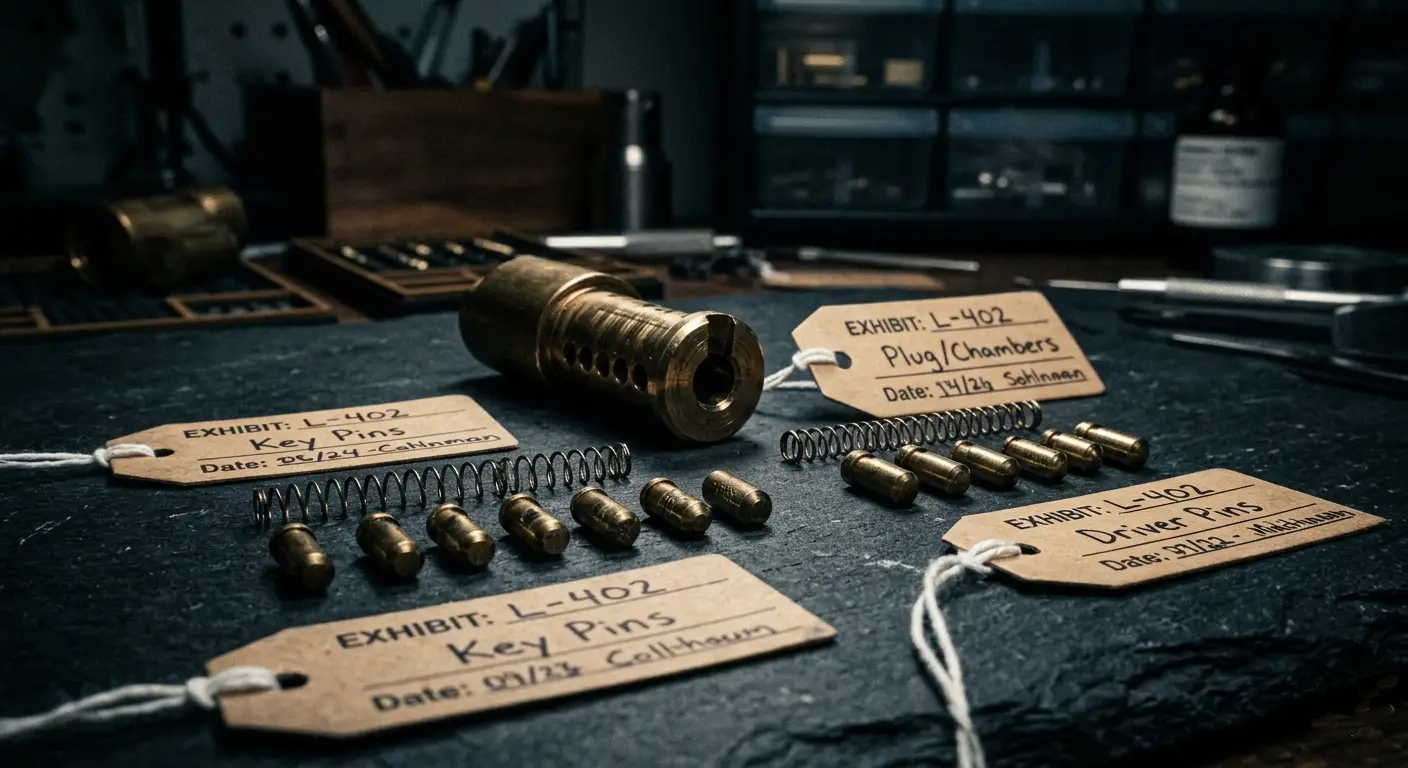
Imagine this: an insurance company receives a claim. A vault was opened, its contents stolen, and the owner swears it was burgled. The door shows no signs of forced entry. The lock is intact. No broken windows, no crowbar marks. By all appearances — nothing happened. But a forensic locksmith disagrees. Under a comparison microscope, the pins inside that lock tell a completely different story: a constellation of sharp steel gouges on soft brass that no legitimate key would ever leave. The claim is fraudulent. The conviction follows.
Forensic locksmithing — also called investigative locksmithing — is one of the most technically demanding intersections of mechanical engineering, metallurgical science, and criminal investigation that exists. It's the discipline of reading physical evidence left behind by a security breach, and doing it well enough that the results survive cross-examination in a court of law. It isn't about picking locks. It's about knowing that someone else did — and proving exactly how.
3
Primary attack categories: destructive, covert, surreptitious
0.025"
Average pick width — thin enough to leave marks a key never would
CFL
Certified Forensic Locksmith — the credential that holds up in court
Advertisement · 728 × 90
Before a forensic locksmith can identify an attack, they have to understand exactly what a non-attacked lock looks like. This sounds obvious. It isn't. Every lock that gets used for years accumulates scratches, wear, and minor deformation. Distinguishing those marks from the evidence of a criminal act is the entire job. Get it wrong, and you're testifying to something that doesn't exist.
The Anatomy of Legitimate Wear
In a standard pin-tumbler lock, the internal components are typically manufactured from brass or nickel-silver — softer metals chosen specifically because they're self-lubricating and non-corroding, not because they're durable. Every time a legitimate key is inserted and turned, a predictable mechanical interaction occurs: the key bitting contacts the bottom pins, lifts them to the shear line, and the plug rotates. This sequence, repeated thousands of times over a lock's life, creates specific, recognizable wear patterns.
Normal use creates uniform polishing across the center of the pin tips — the areas in direct contact with the key bitting. The polish is smooth, diffuse, and consistent. The keyway itself develops a subtle burnishing from key entry. The plug face shows faint concentric rubbing from the bow of the key. Everything is symmetrical, predictable, and explainable by normal use.
🔍 The Examiner's First Question
Before analyzing any suspected attack mark, a forensic locksmith asks: "Is this where a key could reach?" If the answer is no — if a mark is in a location geometrically unreachable by any key for this lock — then that mark becomes immediately significant. Location is everything.
The Red Flags of Anomalous Evidence
Forensic examiners specifically look for deviations from these established patterns. The most important red flags fall into two categories:
- Location anomalies: Marks that appear in areas geometrically unreachable by a standard key — on the sides of pins rather than their tips, deep in the keyway where no bitting could reach, or on chamber walls that no key contacts.
- Hardness signature anomalies: Marks whose depth, sharpness, and character suggest a tool of greater hardness than the key material. High-strength steel picks plow through brass rather than polish it. The resulting mark looks fundamentally different — sharper edges, deeper displacement, no burnishing effect.
The distinction between "worn" and "attacked" is a practiced skill developed through the examination of hundreds of locks. It is not something a general locksmith can fake in court — and experienced defense attorneys know this.
Picking a lock leaves no broken components, no visible damage, and — if done well — no obvious sign of intrusion at all. For years, this made picking almost impossible to detect. Then forensic locksmiths looked closer. A lot closer. What they found under the microscope changed how insurance fraud investigations, burglary prosecutions, and safe breach cases are handled to this day.
Single Pin Picking (SPP) — The Precision Attack
Single pin picking involves the individual manipulation of each pin stack — lifting one pin at a time to the shear line, binding the plug incrementally until all pins are set and the lock opens. It's the most skilled form of picking, favored by experienced locksport practitioners and professional covert-entry specialists.
The forensic evidence is highly specific. SPP marks appear as sharp, circular or slightly elongated gouges on the pin tips, typically localized to the upper center of the pin. Because picks are made from hardened steel — often averaging just 0.025 inches in width — they require significant vertical force to overcome spring tension. That force creates deeper material displacement than any legitimate key ever would. The marks are directional: they indicate the tool was lifted from below, not slid across.
Raking — The Probabilistic Attack
Raking forgoes precision in favor of speed. A multi-peaked raking tool is scrubbed back and forth across all pins simultaneously, relying on randomness and spring rebound to accidentally set pins through vibration. It's noisier, faster, and significantly messier — in both the opening attempt and the evidence trail it leaves.
Rake marks are unmistakable: varied, elongated scratches at multiple angles across several pins simultaneously. Under magnification, they produce a cross-hatch pattern of overlapping gouges that no single key could create. The variation in angle and depth reflects the random motion of the tool. Where SPP marks are surgical and singular, rake marks look like a mechanical argument took place inside the cylinder.
"The tension tool is often more incriminating than the pick itself. It leaves a crushing signature at the keyway entrance that is geometrically impossible for any legitimate key to produce."
— Forensic Lock Examination Protocol, IAIL
Tension Tool Marks — The Most Reliable Indicator
If there's one mark type that forensic locksmiths consider the most reliable indicator of a picking attempt, it's the tension tool mark. A tension wrench — sometimes called a turning tool — is wedged into the bottom or top of the keyway to apply rotational pressure to the plug while pins are manipulated. This wedging action leaves deep gouges or a distinct "crushing" of the warding metal at the keyway entrance.
This is crucial: the keyway entrance is a location that a legitimate key never contacts with pressure. Any damage there is either accidental (fumbled key insertion in darkness) or deliberate. And accidental fumbling doesn't create the deep, angular crushing signature that a tension wrench does. Additional "tap" marks — where a pick accidentally struck the plug face or internal chamber walls — can supplement the picture with a clumsy attacker's fingerprints in metal.
⚡ Anti-Forensics: The New Arms Race
Sophisticated attackers are aware of forensic analysis. The response has been the development of "anti-forensics" tools: picks made from plastic rather than steel (which leave much softer marks), Teflon-coated tools that minimize friction and material transfer, and ultra-thin tension wrenches designed to minimize keyway contact. The forensic community's counter-response is increasingly sensitive microscopy and metallurgical surface analysis — detecting the near-invisible traces these tools still inevitably leave.
Advertisement · 728 × 90
Key bumping entered the public consciousness in the mid-2000s when a Dutch security researcher demonstrated it on video: insert a specially cut "bump key," strike it smartly with a screwdriver handle, and — with proper timing — the lock opens in under three seconds. The locksmith community was alarmed. The forensic community was intrigued. Because bumping, for all its apparent invisibility, leaves very specific physical evidence.
The Physics of Bumping
Both bump keys and mechanical pick guns rely on the same principle: kinetic energy transfer. A sharp impact drives the bottom pins (the ones cut by the key) into the top pins (the "drivers"), momentarily transferring energy upward. For a fraction of a second, a gap appears at the shear line — the point where the rotating plug meets the fixed housing. Apply light rotational pressure at exactly that moment, and the plug rotates freely. It's Newton's Laws applied to lock picking.
What Bumping Leaves Behind
Despite its reputation for leaving no trace, bumping leaves highly specific evidence once you know what to look for:
- Impact craters on bottom pin tips: The repeated striking of a bump key creates small "bumping dents" — craters on the bottom pins that normal key use never produces. These are often asymmetric, deeper on one side, reflecting the angle of the key's cut during impact.
- Shoulder marks on the lock face: The bow of the bump key repeatedly strikes the face of the plug during the bumping process. This creates crescent-shaped shiny marks — flattened, polished areas above or below the keyway entrance — that are characteristic of bumping and nothing else.
- Secondary scratch patterns: If the bump key is made from hard steel, the repeated impact can cause it to act as a file during contact, leaving fine scratches alongside the primary impact craters.
🏛️ High-Security Locks and Catastrophic Evidence
In high-security locks designed with anti-bumping features — such as the EVVA 3KS with its magnetically encoded sliders — bumping attempts don't just fail; they cause dramatic visible internal damage. Shattered wafer arms, severely dented cylinder walls, and fractured sidebars become unambiguous testimony that a kinetic attack was attempted and defeated. The lock essentially self-documents the assault.
Mechanical Pick Guns
Electric and mechanical pick guns operate on the same kinetic principle as bumping but deliver rapid successive impacts rather than a single blow. The forensic signature is accordingly different: instead of discrete craters, pick gun marks appear as a series of impact marks across multiple pin tips, sometimes with a characteristic "rake" appearance from the tool's needle passing over several pins in rapid succession. The direction and clustering of marks can distinguish a pick gun from manual bumping to an experienced examiner.
Destructive entry looks simple: if you drill a lock, you've clearly drilled it. But forensic analysis of destructive entry goes far beyond confirming what's obvious. The goal is to identify which tools were used, in what sequence, and — in cases like safe breaches — whether the attacker possessed insider knowledge about specific internal vulnerabilities. That last point has sent people to prison.
Drilling — The Spiral Striae
Drilling is the most common destructive attack on high-security locks, typically targeting either the shear line or a sidebar mechanism. A drill bit leaves a distinctive forensic signature called spiral striae — microscopic grooves running along the walls of the drill hole, left by the cutting edges of the bit as it rotates. These striae are unique enough that forensic examiners can match them to a specific drill bit or bit type.
Beyond the striae, drilling produces metal swarf — those curled metal ribbons you see when drilling steel. Swarf collected from inside a drilled lock can contain fragments of the drill bit material itself, providing metallurgical evidence about the tool. If a bit broke during the attack, fragments may remain lodged in the swarf, potentially allowing identification of the bit brand, material, and diameter.
⚡ The Safe Drilling Pattern Problem
In multiple North Carolina cases, forensic analysis of safe drilling patterns showed that perpetrators had targeted specific internal vulnerability points — the "gate" of a combination lock's wheel pack, or the precise location of relockers behind a hardplate — that are not publicly known. The drilling wasn't random. It was surgical. The implication: someone with specialized safe-technician training, or access to internal technical manuals, was involved. Several convictions followed from this type of analysis alone.
Forced Rotation Attacks
Forced rotation involves inserting a high-strength tool — a large screwdriver, a plug spinner, or a dedicated attack bar — and applying torque sufficient to shear the internal pins or the plug's retaining clips. This is an attack that doesn't require skill; it requires force. The evidence is accordingly dramatic: extreme widening of the keyway, gouged and sheared pins, often the complete removal of upper pin chambers from the cylinder body. There is no ambiguity about what happened. The forensic task becomes establishing what tool delivered the force.
Bypass techniques represent a different class of attack entirely — one that bypasses the lock cylinder itself and targets the weakest link in the door assembly: the spring-loaded latch. These techniques leave no marks on the lock cylinder because the cylinder is never touched. This creates a specific investigative challenge: the evidence isn't in the lock, it's on the latch and the strike plate.
Loiding — The Classic Bypass
"Loiding" is the classic technique, immortalized in a thousand heist films: the flexible card or strip inserted between door and frame to depress the beveled latch and allow the door to open. The real-world version uses a purpose-made shim, a modified credit card, or even a piece of plastic cut from a bottle. The technique works only on spring latches without anti-loiding features and only when the gap between door and frame is sufficient.
The forensic evidence of loiding is found in two locations:
- The latch face: Horizontal or diagonal parallel scratches where the bypass tool repeatedly contacted the angled latch face while pushing it back. The direction of these scratches indicates which direction the attack came from — top, bottom, or the side.
- The strike plate: Paint or plastic fragments transferred from the bypass tool to the strike plate. The color of this transferred material can sometimes be traced to a specific tool, especially if a suspect's belongings include a matching item.
⚖️ The Insurance Policy Problem
The 2004 Maryland case Offutt v. Liberty Mutual Insurance established a significant precedent: picking a lock or using a master key did not necessarily constitute "forcible entry" under certain insurance policy definitions — unless physical toolmarks could be identified and documented. The implication: the forensic locksmith's report wasn't just evidence. It was the difference between a valid and an invalid claim. Physical evidence was the legal trigger for coverage.
Shimming Padlocks
Shimming padlocks involves inserting thin metal shims (often cut from aluminum cans) into the shackle notch to depress the locking pawl and release the shackle without a key. The forensic evidence is found inside the shackle notch: fine scratches and compression marks where the shim contacted the locking mechanism, plus potential material transfer from the shim material itself. Inexpensive padlocks with unprotected shackle notches are universally vulnerable to this attack.
Advertisement · 728 × 90
Because most forensic evidence in lock examination is microscopic, the technical equipment and the procedures for using it are as important as the examiner's trained eye. A chain of improper documentation or a substandard microscope isn't just an inconvenience — it's grounds for inadmissibility in court. The forensic community has developed standardized protocols precisely to prevent that outcome.
The Magnification Hierarchy
Forensic locksmiths use a tiered approach to magnification, escalating from field examination tools to laboratory-grade instruments:
- 10x–20x jeweler's loupe: The first-pass tool, used at the scene for initial identification of marks. Quick to deploy, sufficient to confirm that further analysis is warranted.
- Digital microscope with USB output: Provides magnification up to several hundred times and produces image files directly usable in court documentation. The ability to capture still and video evidence at this stage is critical.
- Laboratory comparison microscope: The gold standard. Allows a "questioned" toolmark — from the crime scene lock — to be viewed simultaneously with a "test" mark created by a suspected tool on a test medium. The visual comparison is conducted in real time and can be photographed for court exhibits.
- 3D scanning and statistical analysis: An emerging technology that digitizes toolmark surfaces in three dimensions, enabling quantitative comparison rather than subjective visual matching. This addresses the primary criticism defense attorneys level at traditional toolmark analysis.
Critical Techniques: Oblique Lighting, Endoscopy, and Casting
Oblique lighting is one of the most powerful and underappreciated tools in the examiner's kit. By shining light at a very low angle across a metal surface — nearly parallel to the surface rather than perpendicular — even shallow scratches cast long, distinct shadows, making them visible under magnification that would otherwise miss them. The technique can reveal marks that appear completely invisible under standard lighting.
Endoscopy allows examiners to insert a small fiber-optic boroscope camera into a lock without disassembling it, viewing pin tips, chamber walls, and internal passages directly. This is often conducted before any disassembly to document the lock's initial state — preserving evidence that disassembly itself might disturb.
Casting becomes essential when toolmarks are on immovable objects — a safe door, a vault wall, a door frame. Using silicone-based casting compounds (Mikrosil is an industry standard), examiners create high-fidelity three-dimensional replicas of the marks for transport to the laboratory. A well-made cast captures surface detail at the micron level.
⛔ The Cardinal Rule: Never Test-Fit a Suspected Tool
One of the most fundamental rules in forensic lock examination — enshrined in every major protocol — is that a suspected tool must never be inserted into a questioned toolmark to see if it fits. Even the lightest contact will permanently alter the original evidence. Once modified, that mark can never be restored. This applies equally to locks, doors, and strike plates. Test-fitting is done exclusively on separate test media, never on crime scene evidence.
All the technical skill in the world means nothing if the evidence doesn't survive the journey from crime scene to jury. The legal framework governing expert testimony is stringent, and forensic locksmiths who testify without understanding it are a liability rather than an asset. The entire discipline is built around the understanding that scientific validity means nothing if procedural validity is absent.
Documentation Protocol — Before the Lock Moves
Before a lock is removed from a door, a forensic examiner's protocol requires that it be photographed "in situ" — in its original position — to document its exact orientation relative to the door, frame, and any surrounding damage. Damage to the door jamb, strike plate, hinges, or frame can corroborate or contradict the evidence in the lock itself. A lock removed without in-situ documentation loses this contextual evidence permanently.
The chain of custody — the chronological record tracking every person who handled the evidence from crime scene to courtroom — must be unbroken. Any gap in this record creates an opportunity for a defense attorney to argue contamination or tampering. Evidence properly logged, sealed, and transferred is evidence that survives challenge. Evidence that wasn't is evidence that doesn't.
The Daubert and Frye Standards
In United States federal courts, the admissibility of expert testimony is governed by the Daubert standard, which requires that the testimony be based on a scientifically valid methodology, that it has been tested and subjected to peer review, that it has a known error rate, and that it is generally accepted in the relevant scientific community. Some state courts still use the older Frye standard, which primarily tests general acceptance.
Forensic locksmithing typically passes both tests when properly conducted. The challenge comes in cross-examination, where defense attorneys frequently attack the "subjective" nature of visual toolmark comparison — the argument that two examiners looking at the same marks might reach different conclusions. It's a legitimate challenge that the field has responded to with increasing quantification through 3D scanning and statistical clustering methods.
Real Cases — When Lock Evidence Decided the Outcome
Forensic lock evidence has been central to several landmark cases that defined the discipline's legal standing:
- Michigan v. Talbert (2008): Forensic locksmith Mark Ames testified that a key provided by the defendant was a duplicate, with the original set still outstanding — directly contradicting the defendant's theft claim. The lock evidence was the linchpin of an insurance fraud conviction.
- Offutt v. Liberty Mutual (Maryland): Established that lock picking or master key use doesn't constitute "forcible entry" under specific policy language unless forensic toolmark evidence can be documented — setting a precedent that transformed how insurance fraud investigations approach lock evidence.
- North Carolina Safe Breach Cases: Multiple cases where drilling pattern analysis revealed insider knowledge of safe vulnerabilities, implicating individuals with professional access to safe technical specifications.
🎓 The CFL Credential — What It Requires
The Certified Forensic Locksmith (CFL) credential, issued by the International Association of Investigative Locksmiths (IAIL), is the most recognized professional standard for courtroom qualification. Candidates must pass a comprehensive examination covering toolmark analysis, investigative photography, evidence chain of custody, and courtroom procedure. Under Federal Rule of Evidence 702, an expert witness must demonstrate that their testimony is the product of reliable principles and methods — the CFL is specifically designed to meet that bar.
Advertisement · 728 × 90
The following is a forensic reference guide to toolmark signatures as they appear under magnification — the descriptions used by examiners when preparing court documentation and comparison reports. Understanding what each attack looks like is the foundation of forensic analysis.
The shift from purely mechanical to hybrid and fully electronic security systems is the defining challenge facing forensic locksmithing today. When a smart lock is bypassed, the entry evidence isn't in the brass pins — it's in an EEPROM chip, an access log, or a transponder communication. The discipline is evolving rapidly to meet this shift, but the physical toolmark remains the foundational piece of evidence in the vast majority of burglary and fraud investigations involving residential and commercial property.
Vehicle Systems Forensics
Modern investigators dealing with vehicle theft must be proficient in a domain that barely existed a decade ago: vehicle systems forensics. This includes analyzing electronic access logs stored in vehicle ECUs, extracting and interpreting EEPROM data from key transponders, examining Bluetooth or RF signal logs, and reviewing digital evidence from vehicle telematics systems. When a car is stolen without physical damage, the digital trail is often the only evidence trail available.
3D Scanning and Statistical Toolmark Analysis
The most significant technical development in forensic toolmark analysis is the application of 3D surface scanning and statistical comparison algorithms. Where traditional comparison microscopy is inherently subjective — two examiners comparing the same marks might reach different conclusions — 3D scanning creates a digital surface map that can be subjected to quantitative comparison. Statistical clustering algorithms can calculate the probability that two toolmarks came from the same tool, providing the kind of objective, reproducible result that modern evidentiary standards demand. This development directly addresses the primary line of defense challenge.
🔬 The Ongoing Arms Race
As attackers develop increasingly sophisticated anti-forensics tools — plastic picks, Teflon coatings, purpose-built bypass tools that minimize contact — forensic examiners are developing increasingly sensitive detection methods. The discipline's strength is that it's grounded in physics: a tool that contacts a surface must leave some trace. The question is always whether current technology is sensitive enough to detect it. Right now, that's an arms race with no end in sight.
// Synthesis & Conclusion
The Lock Is a Witness. It Just Needs Someone Who Can Hear It.
Forensic locksmithing rests on a simple but profound principle: every interaction between a tool and a metal surface leaves a physical record. That record doesn't lie, doesn't forget, and doesn't make deals. It is the purest kind of evidence — objective, physical, and permanent until it's contaminated by someone who doesn't know what they're handling.
The field's reliability depends entirely on the dual pillars of technical mastery and procedural integrity. A skilled examiner who breaks the chain of custody has wasted their skill. A procedurally perfect examiner who lacks the microscopy training to identify a pick mark has wasted their documentation. The discipline demands both, simultaneously, from the moment a scene is entered to the moment testimony concludes.
As security systems evolve toward electronic and biometric authentication, the core methodology — find the anomaly, document it rigorously, interpret it scientifically, and defend it in court — will remain unchanged. The evidence will look different. The discipline will adapt. The obligation to get it right will be the same. It always has been, from Art Paholke's first protocols in a Chicago police lab to the 3D scanning labs of today.
What is forensic locksmithing and how is it different from regular locksmithing?
Standard locksmithing concerns itself with the installation, maintenance, and repair of security hardware. Forensic locksmithing — also called investigative locksmithing — is an entirely different discipline: it applies scientific methodology to examine locks and associated hardware to determine whether they were breached, how, and by what class of tools. The forensic locksmith operates within the framework of evidence law, producing findings that must withstand judicial scrutiny. Where a regular locksmith repairs what's broken, a forensic locksmith reads what the damage means — and testifies to that reading in court.
Can forensic analysis really tell the difference between legitimate key use and lock picking?
Yes — under proper magnification, the difference between legitimate key wear and picking marks is quite distinct. Normal key use creates uniform polishing in specific, geometrically predictable locations. Lock picks, made from high-strength steel and operating in locations a key would never reach, leave sharp, bright gouges that stand out clearly against normal wear. Tension wrench marks at the keyway entrance — a location no legitimate key contacts under pressure — are particularly diagnostic. The examination requires training and appropriate equipment, but the distinction is not subtle to a qualified examiner.
What is the Certified Forensic Locksmith (CFL) credential and why does it matter in court?
The CFL is issued by the International Association of Investigative Locksmiths (IAIL), a division of ALOA. It requires passing a comprehensive examination covering toolmark analysis, investigative photography, chain of custody procedures, and courtroom protocol. It matters in court because U.S. Federal Rule of Evidence 702 requires that expert testimony be the product of reliable principles and methods — the CFL is the recognized credential demonstrating that the examiner has been tested on those principles. Without appropriate credentials, a forensic locksmith's testimony is more easily challenged and potentially excluded.
Does bumping a lock leave evidence that can be detected?
Yes. Despite its reputation as a "clean" attack, key bumping leaves specific forensic signatures: asymmetric impact craters on the bottom pin tips (from the bump key's cut making contact), and crescent-shaped "shoulder marks" on the plug face where the bow of the bump key struck during the repeated impacts. In high-security locks with anti-bumping features, failed bumping attempts can cause catastrophic internal damage that is dramatically obvious under examination. Sophisticated attackers are aware of these signatures, which has driven the development of softer, lower-impact bumping techniques — and in turn, more sensitive forensic detection methods.
How is forensic locksmithing used in insurance fraud cases?
Insurance fraud is one of the most common applications. When a policyholder claims theft or burglary, forensic locksmiths examine whether the locks show evidence of the claimed breach method — or evidence of a different one. In Michigan v. Talbert (2008), forensic analysis proved that a key provided by the defendant was a duplicate, contradicting the claimed theft. The Maryland case Offutt v. Liberty Mutual established that picking or master-key use doesn't trigger "forcible entry" coverage unless toolmarks are forensically documented. These precedents mean that the forensic locksmith's report can determine whether an insurance claim is paid or prosecuted.