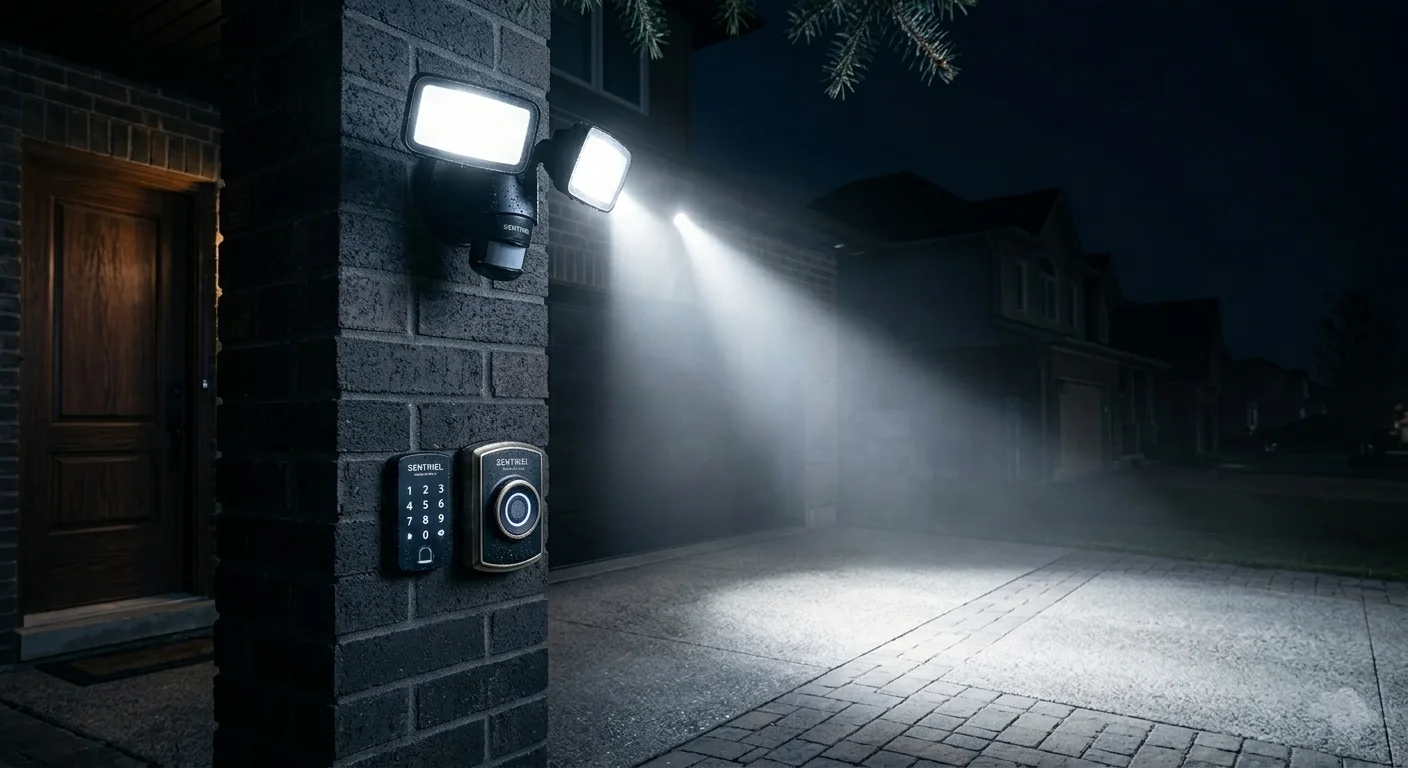
Lighting is the most underrated layer of home security. A $30 motion sensor floodlight is the cheapest meaningful security upgrade you can make. We compared 10 of the best motion sensor lights available right now and ranked them by brightness, detection range, build quality, and real-world security value. Here are our picks.
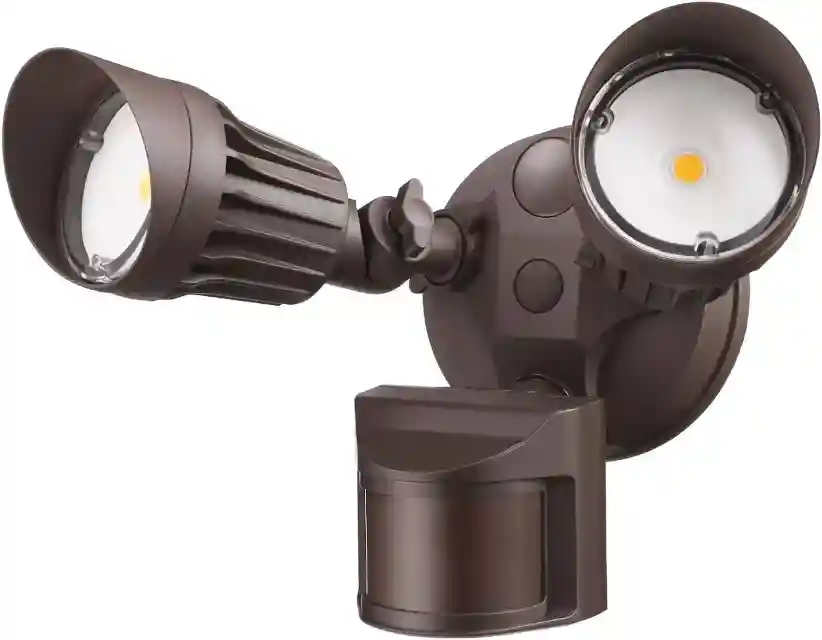
The most recommended motion flood light across multiple review sites. 70-foot detection range, 180° sensing angle, dual adjustable heads, three operating modes (motion/dusk-to-dawn/always-on), ETL certified, and die-cast aluminum construction — all for under $40.
- 70ft detection range — best in class
- Three operating modes including dusk-to-dawn
- ETL certified + Energy Star eligible
- Die-cast aluminum housing
- Energy rebate eligible (86.7% savings)
- Dual adjustable heads
- Under $40
- Requires hardwiring — no plug or solar
- Not smart-home connected
- 1,800 lumens may not cover very large properties
- Bulbs are non-replaceable integrated LEDs
The LEONLITE hits the sweet spot between performance, build quality, and price. The 70-foot detection range means someone walking up your driveway triggers the light well before they reach your door — that early activation is exactly what you want for security. The die-cast aluminum housing resists corrosion and impact far better than the plastic housings on budget competitors. Three modes give you flexibility: motion-activated for security, dusk-to-dawn for constant nighttime illumination, or manual on/off. ETL certification means it's independently tested for safety. At under $40, you could put these on every corner of your house for the price of one smart floodlight camera.
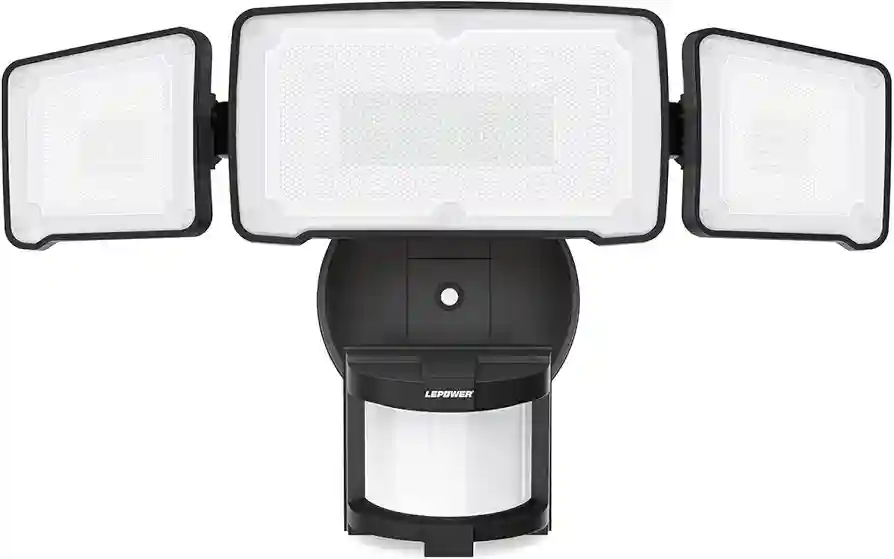
The brightest option on this list at 3,500 lumens with three independently adjustable heads and a 72-foot detection range. When you need to flood-light a large driveway, backyard, or parking area, nothing on this list matches the LEPOWER's raw output.
- 3,500 lumens — brightest on this list
- 72ft detection range
- Three independently adjustable heads
- Adjustable timer (10 sec–10 min)
- Under $35 — incredible value
- IP65 weatherproof
- No dusk-to-dawn mode
- Hardwired only
- Can be too bright for close neighbors
- Non-replaceable LED bulbs
- No smart features
The LEPOWER is pure brute-force illumination. At 3,500 lumens, it's roughly equivalent to a car's headlights on high beam — nobody is sneaking around in that. The three independently adjustable heads let you point light in three different directions from a single mounting point, covering a driveway, a walkway, and a side yard simultaneously. The adjustable timer (10 seconds to 10 minutes) lets you control how long the light stays on after motion stops. At under $35, this is the best lumens-per-dollar on the list. The only real drawback is no dusk-to-dawn mode — it's motion-activated only, so it won't provide constant ambient light at night.
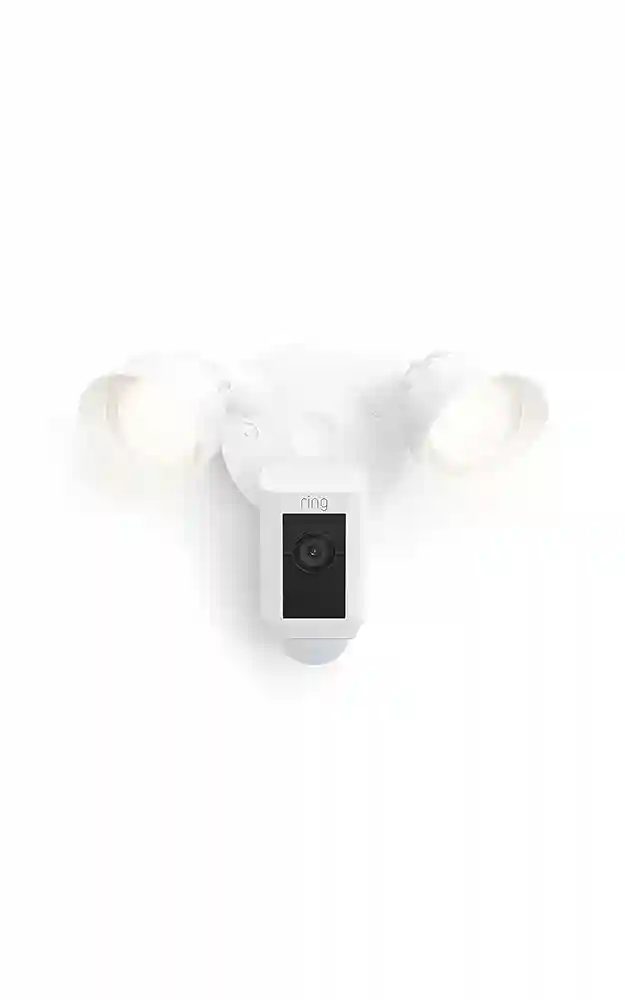
Camera + floodlight + siren in one hardwired unit. When motion triggers, the 2,000-lumen floodlights activate, the 1080p camera starts recording, you get a live notification, and you can speak through two-way audio or blast the 110dB siren — all from your phone.
- Camera + floodlight + siren in one unit
- AI person detection reduces false alarms
- 1080p HD with color night vision
- Two-way audio + 110dB siren
- Full Ring/Alexa ecosystem
- App control for schedules and zones
- Coordinates with Ring Alarm system
- $180+ — most expensive on this list
- Requires hardwiring to junction box
- Ring Protect subscription for recording
- Only 1080p camera
- Alexa ecosystem only
The Ring Floodlight Cam is where lighting and security cameras converge into one device. When the AI-powered motion sensor detects a person (not just motion — it distinguishes between people, animals, and objects), the 2,000-lumen floodlights blast on, the 1080p camera starts recording in color night vision, and you get an instant notification on your phone with a live feed. From there you can watch, speak through two-way audio, or trigger the 110dB siren. It coordinates with the Ring Alarm system — when your alarm is armed, the floodlight cam becomes part of your perimeter. The A Ring Protect plan is needed to save recordings — Solo is $4.99/mo for one device, Multi $9.99/mo for every Ring device at one address. If you have Ring cameras, doorbell, and alarm already, this ties your lighting into that same ecosystem.
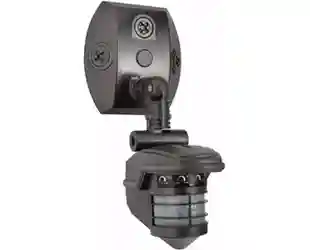
What professional electricians and security installers actually mount on properties. 360° sensor coverage detects motion from any direction. Commercial-grade die-cast aluminum, pre-wired on a universal mounting plate, and a 10-year sensor warranty. Built to work flawlessly for a decade.
- 360° detection — senses motion from any direction
- Professional electricians' #1 choice
- Commercial-grade aluminum construction
- 10-year sensor warranty
- Pre-wired universal mounting plate
- Fully adjustable timer + sensitivity + daylight
- Replaceable standard PAR38 bulbs
- $80-120 — most expensive non-camera option
- Bulbs sold separately
- Requires hardwiring
- No smart home features
- Overkill for some residential uses
The RAB Stealth 360 is the motion light that professional electricians recommend by name. In contractor forums, the consensus is clear: RAB sensors are the most reliable on the market, with a 10-year warranty that they actually honor. The 360° detection pattern (three sensor heads covering all directions) means it catches motion from the sides and behind — not just in front. This matters at corners and entryways where someone could approach from an angle that a 180° sensor would miss. The universal mounting plate makes installation fast for electricians, and the replaceable PAR38 bulb sockets mean you choose your own bulb brightness and color temperature. This is the buy-it-once-forget-it option for homeowners who want professional-grade hardware.
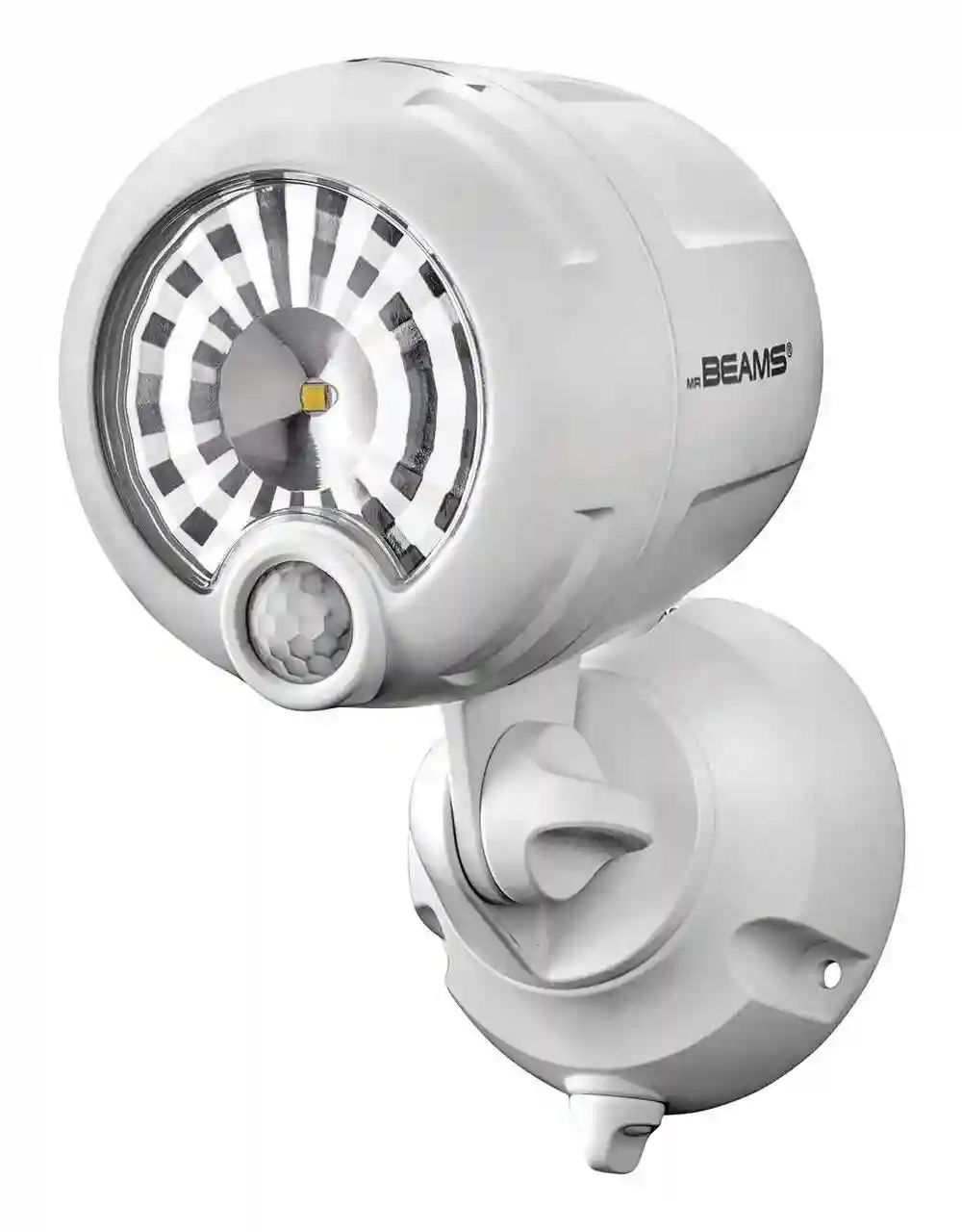
No wiring, no solar panel, no electrician. Runs on 4 D-cell batteries for up to 12 months. Mount it anywhere with two screws. At ~$25, buy three or four to cover every dark corner of your property for under $100 total.
- No wiring needed — battery powered
- 12-month battery life
- Under $30
- Mount anywhere with two screws
- Compact and discreet
- Buy multiples for full coverage
- Only 400 lumens — spotlight not floodlight
- 30ft detection range is short
- Battery replacement needed annually
- Not fully waterproof in heavy rain
- Not suitable as primary security light
The Mr. Beams is the motion light equivalent of the Blink Outdoor camera — put it anywhere, forget about it for a year. Side gates, shed doors, dark walkways, basement stairs, garage side entries — anywhere you want motion-triggered light without calling an electrician. At 400 lumens it's a spotlight, not a floodlight, so it won't illuminate your entire backyard. But it will absolutely light up the 10-foot radius around it when someone walks by. Buy a 3-pack for under $80 and cover every dark approach to your home. These are secondary security lights — pair them with a proper floodlight on your main entry points.
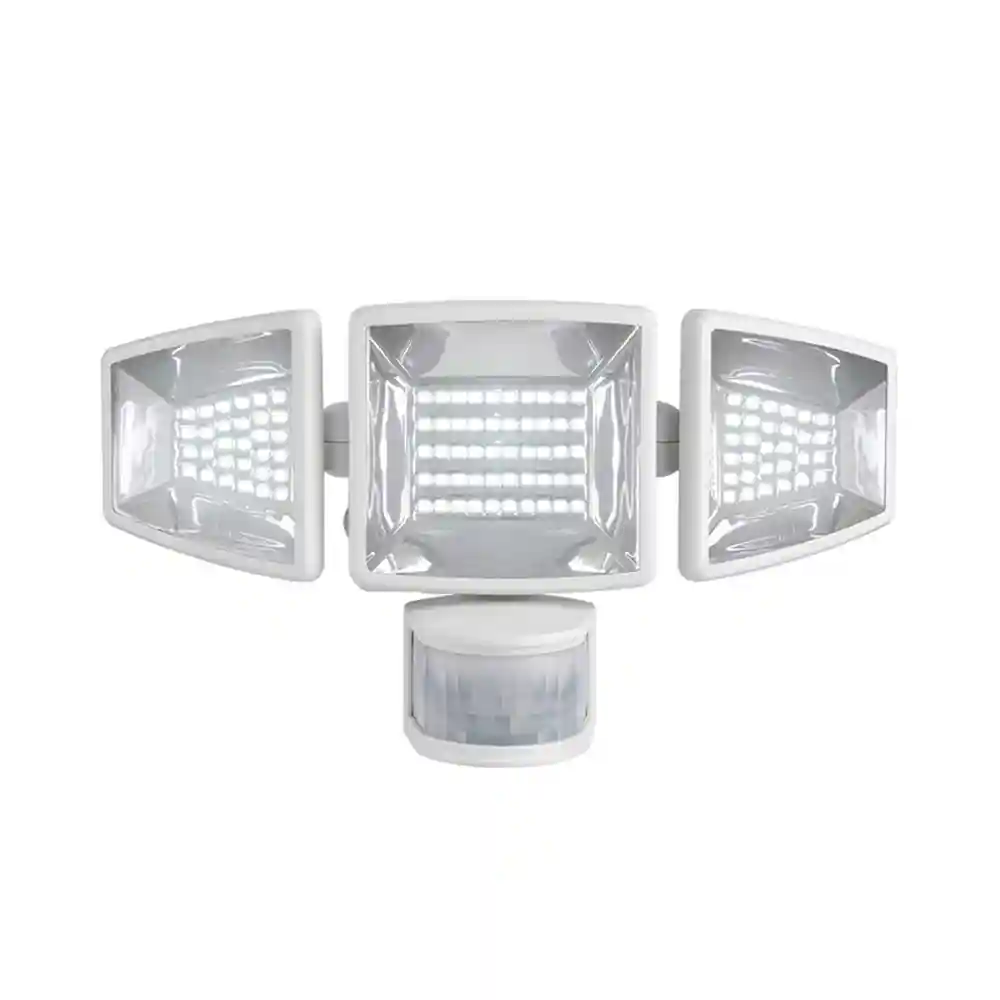
Solar panel can mount up to 15 feet from the light — put the light in shade and the panel in sun. Triple adjustable heads, 1,500 lumens, rechargeable batteries included, and zero electricity cost. The best option for locations with no electrical access.
- Solar powered — zero electricity cost
- Panel mounts separately up to 15ft away
- Triple adjustable heads
- 1,500 lumens — solid output for solar
- Rechargeable batteries included
- No wiring needed
- Depends on consistent sun exposure
- 30ft detection range is shorter
- Less bright than hardwired options
- Batteries degrade over 2-3 years
- Performance drops in overcast winters
The Sunforce solves the biggest problem with solar lights: the panel doesn't have to be on the light itself. The 15-foot cable between the solar panel and the light head means you can mount the light under an eave (in shade) and the panel on the roof (in full sun). That flexibility is unique at this price point. The 1,500-lumen output is respectable for solar — brighter than most solar competitors. The triple adjustable heads let you cover a wide area. For detached garages, fences, outbuildings, or any location where running electrical isn't practical, this is the best solar option. Performance does drop during extended overcast periods and in Canadian winters with limited daylight — hardwired is still the more reliable choice for primary security lighting.
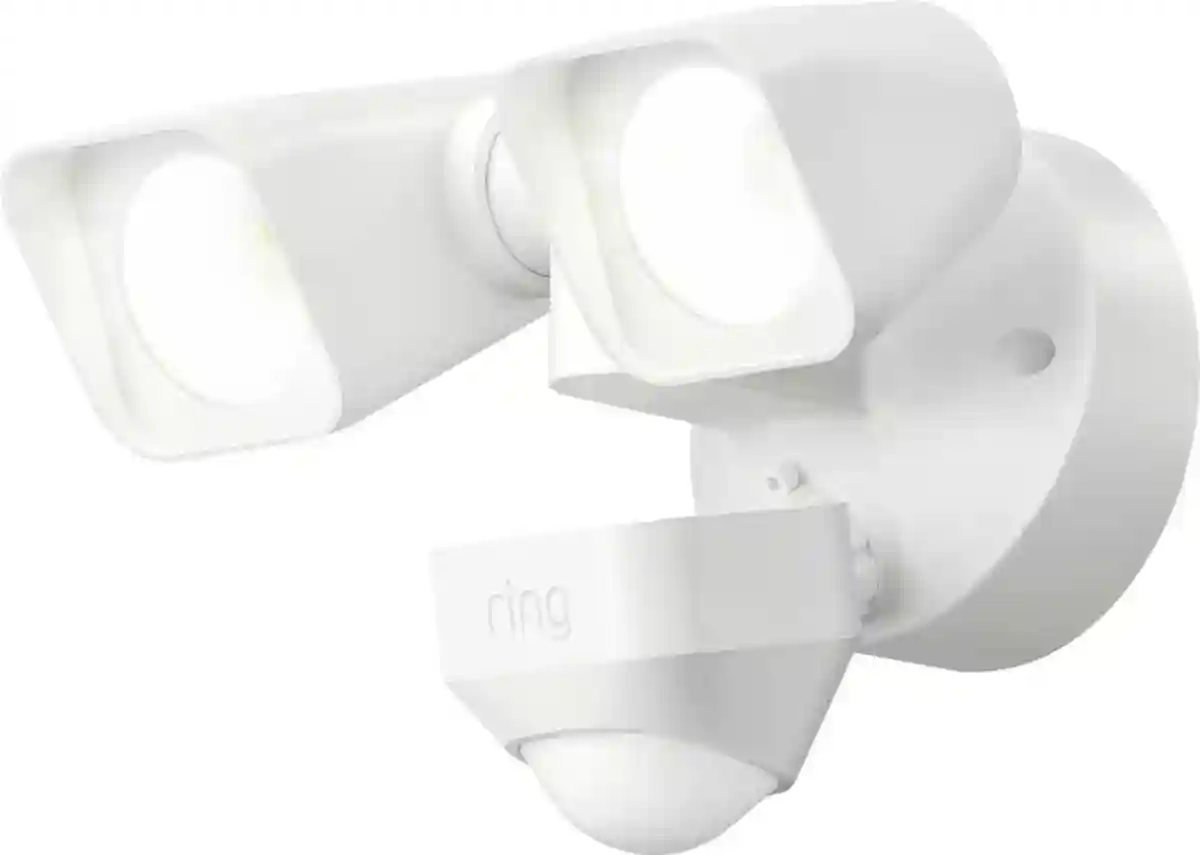
Full Ring app control without the camera. Groups with Ring cameras — when this floodlight detects motion, your Ring camera starts recording automatically. Schedules, automations, and motion zones via the app. Half the price of the Floodlight Cam.
- Full Ring app control
- Groups with Ring cameras automatically
- 2,000 lumens
- Ring Bridge included
- Schedules and motion zones via app
- Half the price of Floodlight Cam
- No subscription needed for the light itself
- Hardwired installation required
- No camera built in
- Ring/Alexa ecosystem only
- Requires Ring Bridge for smart features
- Limited outside Ring ecosystem
The Ring Smart Floodlight is the smart version of a standard motion floodlight — same 2,000 lumens and weatherproof construction, but with full Ring app integration. The killer feature is grouping: pair it with any Ring camera, and when the floodlight detects motion, the grouped camera automatically starts recording. That means you can put this $50 floodlight on the side of your house and a $60 Ring Indoor Cam in the window — when someone walks past the floodlight, the camera captures them. No subscription is needed for the light itself (only for camera recording via Ring Protect). If you already have Ring cameras and want coordinated lighting, this is the move.
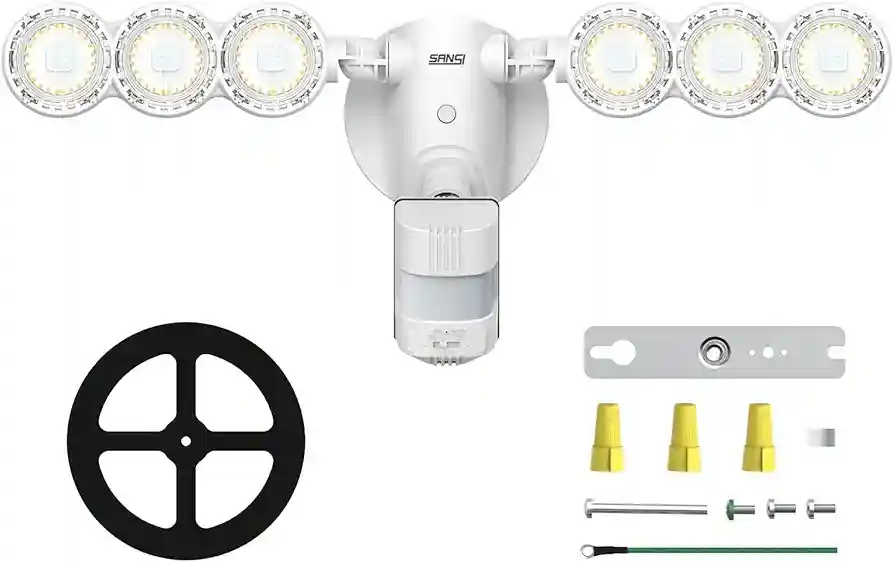
The widest coverage on this list with four independently adjustable heads and 4,800 lumens of output. One unit can illuminate an entire property perimeter. Best for large lots, rural properties, or anywhere you need maximum coverage from a single mounting point.
- 4,800 lumens — massive output
- Four independently adjustable heads
- Covers extremely wide areas
- IP65 weatherproof
- Affordable for the output ($40-50)
- Adjustable sensitivity
- Hardwired only
- Large/bulky unit
- No smart features
- 45W draws more power
- May cause light pollution for close neighbors
- No dusk-to-dawn mode
When two or three heads aren't enough, the SANSI brings four. Each head adjusts independently, letting you point light in four different directions from a single mounting point — front yard, driveway, walkway, and side yard all from one fixture. At 4,800 lumens it's the second-brightest on this list, approaching commercial-grade output. For large rural properties, corner lots, or anyone who needs to flood a wide area, this is the most coverage you can get for under $50. The trade-off is size — this is a big, visible unit. Mount it at a corner of your house for maximum multi-directional coverage.
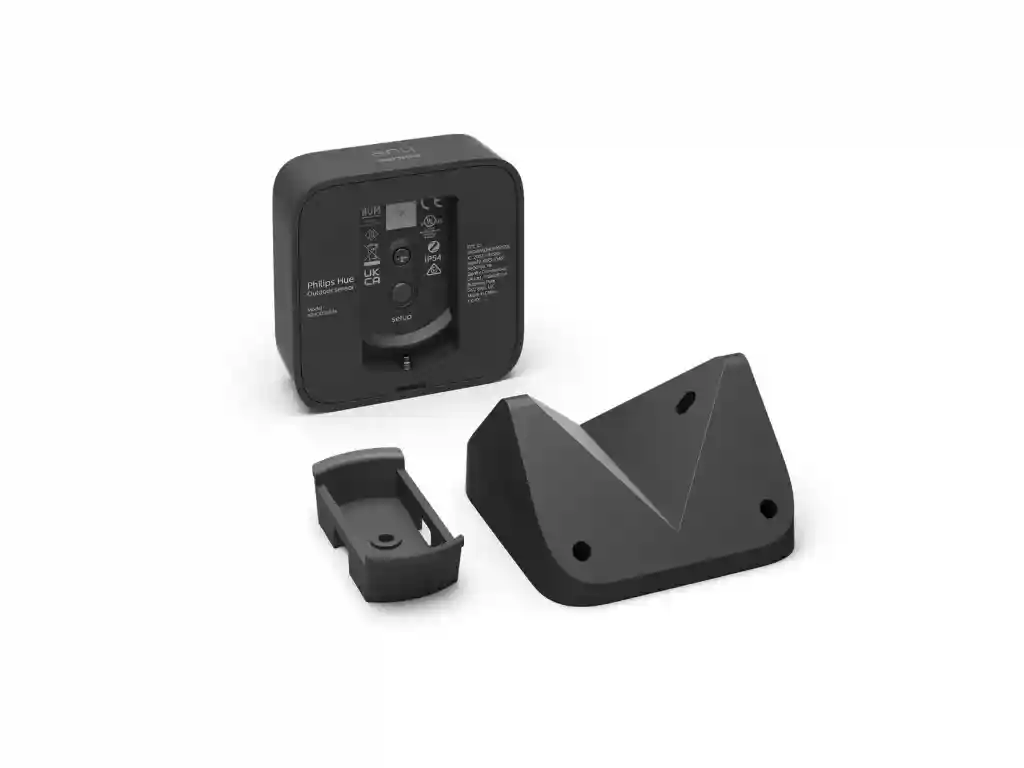
Triggers any Philips Hue light scene when motion is detected — porch lights, floodlights, indoor lights can all respond to outdoor motion simultaneously. The most customizable option for existing Hue smart home users. All major platforms including HomeKit.
- Triggers any/all Hue lights on motion
- All smart platforms including HomeKit
- Fully customizable scenes and automations
- Adjustable brightness, color, schedules
- Outdoor rated IP54
- Works with color and white Hue bulbs
- Sensor only — requires Hue bulbs ($15-30+ each)
- Requires Hue Bridge ($50+)
- Expensive total ecosystem
- IP54 is less weather-resistant than IP65
- Not a standalone solution
The Philips Hue sensor is for smart home enthusiasts who want their outdoor motion detection to trigger a coordinated response across their entire lighting system. When someone walks up your driveway, the porch light turns on, the hallway light inside activates, and the backyard floodlight illuminates — all simultaneously, all automatically. You can customize brightness, color temperature, and duration for each scene. The Hue app lets you set daylight sensitivity so it only triggers after dark, and you can create different scenes for different times of night. The downside is ecosystem cost — a Hue Bridge ($50), the sensor ($50), and a few outdoor Hue bulbs ($25-40 each) adds up quickly. But if you're already in the Hue ecosystem, adding this sensor is a no-brainer.
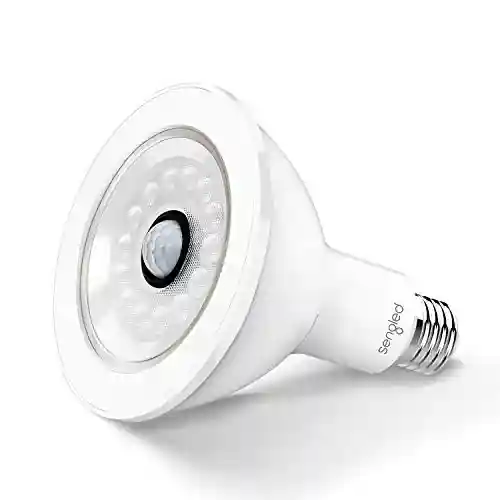
Unscrew your existing porch light bulb. Screw in the Sengled. Your fixture is now a motion sensor light. No wiring, no mounting, no app, no electrician. Under $15. The easiest and cheapest first step in home security lighting.
- Cheapest option on this list ($12)
- Zero installation — screw into existing fixture
- Fits any standard E26 socket
- IP65 for outdoor fixtures
- Instantly upgrades any fixture to motion-sensing
- No app, no wiring, no tools
- Only 1,050 lumens per bulb
- 30ft detection range
- No smart features or app
- No adjustable sensitivity
- Limited to existing fixture locations
- 90-second fixed duration
The Sengled Smartsense is the security upgrade that takes 30 seconds and costs less than lunch. If you have a porch light that's always off because you forget to turn it on, or always on because you don't want to bother — unscrew the bulb, screw in the Sengled, and you have a motion-activated light. It detects motion up to 30 feet away and stays on for about 90 seconds after the last detected movement. No app, no Wi-Fi, no bridge, no setup. At $12-18 per bulb, buy one for the front porch and one for the back door. It's the single easiest security improvement anyone can make to their home — and it's also the cheapest thing on this entire list.
The LEONLITE LED Motion Sensor Flood Light takes our #1 spot — 70-foot detection range, 1,800 lumens, dual adjustable heads, three operating modes, and die-cast aluminum construction for under $40. It's the best balance of performance, build quality, and price for most homeowners. For maximum brightness, the LEPOWER 3-Head at 3,500 lumens is the brighter choice. For zero installation effort, the Sengled Smartsense bulb at $12 is the easiest first step.
Do Motion Sensor Lights Actually Deter Burglars?
Yes — and lighting has the strongest independent research behind it of any measure in home security. It is also the most commonly misquoted, so it is worth setting out what the evidence actually covers before you spend anything.
Two bodies of work matter. Welsh and Farrington's systematic review of thirty-two studies found that improved lighting reduced crime by more than 20% on average across the higher-quality evaluations. Then Chalfin and colleagues ran the first randomised controlled trial of lighting anywhere: temporary lights assigned at random to New York City public housing developments in 2016, producing at minimum a 36% reduction in nighttime outdoor index crime. A follow-up study found the effect still holding three years later. Those are real numbers from good research, and they are where the "over 30%" figure you see quoted everywhere comes from.
Burglars are overwhelmingly opportunistic: they scan for easy targets and avoid anything that increases their visibility. A sudden blast of light when they approach a house does three things simultaneously: it startles them, it makes them visible to neighbors and passersby, and it signals that the homeowner has invested in security.
Motion-triggered lights are more effective than always-on lights for two reasons. First, the sudden activation is jarring — a light that's always on fades into the background, but a light that snaps on when you step into its range is impossible to ignore. Second, motion lights signal active monitoring — they imply someone might be watching, even if no one is. That psychological uncertainty is a powerful deterrent.
Every study above examined permanent area and street lighting in public space — not a motion-activated floodlight on a private house. That is a different intervention, and the gap matters.
Welsh and Farrington's American results were genuinely mixed: of eight United States evaluations, four found a crime reduction and four found no effect at all. And the mechanisms the researchers propose for why street lighting works — more people outdoors, more eyes on the street, a visible signal of community investment — are not the mechanism a floodlight over your garage is using. Researchers also note the effect is theoretically ambiguous in both directions, since better visibility can help an offender assess a target as easily as it can expose them.
So anyone attaching "36%" to a $30 floodlight is borrowing credibility from a study about something else. We are not going to do that.
Here is the better argument for motion lighting specifically, and it does not need a borrowed statistic. The strongest finding in the deterrence literature is that what deters is the belief that someone will respond — a 2019 systematic review of forty years of camera studies found actively monitored systems cut crime by around 15% while passive record-only systems showed no statistically significant effect. Recording deters nobody. Response does.
A light that snaps on is a response. It is the cheapest possible signal that a house noticed you, and unlike a camera it is impossible to miss and impossible to mistake for scenery. That fits the offender-interview data too: in the most-cited survey of burglars, the reason given most often for abandoning a target was the possibility that someone was home — ahead of cameras, dogs and neighbours. A light coming on at 11pm is the most direct way to suggest exactly that.
Two practical consequences. Aim and sensitivity matter more than brightness, because a light that triggers on every passing cat trains your neighbours to ignore it — and the deterrent value was always partly in them looking up. And place lights on the dark approaches, the side gate and the back door, not just the front, since those are the routes chosen precisely because nobody can see them.
For maximum deterrence, pair motion lights with visible security cameras. A motion light that activates a camera recording is the ideal combination — the light exposes the intruder while the camera captures evidence. The Ring Floodlight Cam Wired Plus (#3 on this list) does exactly this in one device.
For more on how burglars choose targets and what makes them abort, see our guide to how burglars actually choose targets.
How Bright Do You Need? Lumens Explained
Lumens measure brightness — the higher the number, the brighter the light. Here's a practical guide to how many lumens you need for different areas:
Pathways and side gates: 100–400 lumens. A Mr. Beams spotlight (400 lm) or Sengled bulb (1,050 lm) is sufficient.
Front door and porch: 700–1,300 lumens. One good motion sensor bulb or a small floodlight.
Driveway and garage: 1,500–3,000 lumens. The LEONLITE (1,800 lm) or LEPOWER (3,500 lm) are ideal.
Backyard and large areas: 3,000–5,000 lumens. The SANSI 4-head (4,800 lm) covers this range.
Large lots and commercial: 5,000+ lumens. Consider multiple fixtures or commercial-grade options.
More lumens isn't always better — excessively bright lights aimed incorrectly cause glare that actually reduces visibility and annoys neighbors. Aim lights downward and adjust the angle to illuminate the ground, not blast light horizontally.
Solar vs Hardwired vs Battery — Which Is Right?
Hardwired (LEONLITE, LEPOWER, Ring, RAB, SANSI)
The most reliable option. Unlimited power means maximum brightness and no recharging. Works year-round in any climate. The downside: you need existing electrical wiring at the mounting location, or you'll need an electrician to run new wire. Best for: permanent installations at primary entry points — front door, garage, driveway.
Solar (Sunforce, various budget options)
Zero electricity cost, no wiring needed, easy DIY install. The trade-off: brightness depends on how much sun the panel gets. Performance drops in overcast conditions and northern winters with limited daylight. Solar panels degrade over 2-3 years and batteries lose capacity. Best for: secondary areas, detached structures, locations without electrical access, and warmer/sunnier climates.
Battery (Mr. Beams)
The most flexible placement — mount anywhere with two screws. No sun needed, no wiring needed. Limited brightness (typically 200-500 lumens) and batteries need replacing every 6-12 months. Best for: side gates, sheds, dark walkways, temporary setups, and supplementing primary lighting.
Use hardwired floodlights at your main entry points (front door, back door, garage) for maximum reliable brightness. Fill gaps with solar or battery lights at secondary areas (side gates, walkways, sheds). This mixed approach gives you strong primary coverage with zero-cost supplemental lighting. Total cost: $30-70 for the main lights plus $25-60 for supplementary lights. Under $130 for whole-property motion lighting.
Where to Mount Motion Sensor Lights
Height: Mount 6-10 feet above the ground. Too high (above 12 feet) reduces the motion sensor's sensitivity. Too low (below 6 feet) limits the coverage area and makes the light easier to tamper with or vandalize.
Angle: Aim the sensor toward the area you want to detect motion in — typically toward the approach path, not directly at the door. The sensor should be perpendicular to the expected path of movement for best detection. Motion crossing the sensor's field triggers it more reliably than motion coming straight at it.
Priority areas (in order of importance for security):
1. Front door — over a third of burglars enter through the front door. 2. Back door — second most common entry point. 3. Garage / driveway — vehicle access and often connected to the house. 4. Side gates — hidden approach routes burglars use to access the back of the house. 5. Ground-floor windows — especially those facing dark, concealed areas.
Avoid: Pointing sensors at heat sources (HVAC vents, dryer exhausts), busy streets or sidewalks (constant false triggers), and your neighbor's property (light trespass and annoyance).
Frequently Asked Questions
Yes. The research on lighting and crime is the strongest in home security, though the well-known percentages describe permanent street lighting rather than a floodlight on a house. Most burglars are opportunistic and avoid well-lit properties. A sudden motion-triggered floodlight startles intruders and draws attention from neighbors, making it one of the most cost-effective security measures available.
For most residential security: 1,500-3,000 lumens. Porches need 700-1,300 lumens. Driveways and backyards need 1,500-3,000 lumens. Large properties may need 3,000-5,000+ lumens. More isn't always better — excessively bright lights cause glare and light pollution.
Hardwired is brighter, more reliable, and works year-round. Solar requires no wiring and costs nothing to run but depends on sun exposure. For primary security lighting at entry points, hardwired is better. For secondary areas like side gates and sheds, solar is a great low-cost supplement.
6-10 feet above the ground, angled downward toward the detection zone. Too high reduces sensor sensitivity. Too low limits coverage and makes the light easier to tamper with. Aim the sensor perpendicular to the expected path of movement for best detection.
Yes. Ring Smart Lighting groups with Ring cameras so the floodlight triggers camera recording automatically. The Ring Floodlight Cam combines both in one device. Even non-smart motion lights help cameras by providing illumination for clearer footage — a well-lit scene produces much better camera video than a dark one.
Front door: 700-1,300 lumens. Driveway and garage: 1,500-3,000 lumens. Backyard: 3,000-5,000 lumens. Pathways: 100-400 lumens. Prioritize entry points first — front door, back door, and ground-floor windows accessible from dark areas.
Testing status. Researched, not tested. Prices are approximate and move constantly at this end of the market.
On the lighting research. Welsh and Farrington's systematic review of thirty-two street lighting studies, and Chalfin, Hansen, Lerner and Parker's randomised experiment in New York City public housing, with the follow-up by MacDonald and colleagues confirming the effect persisted over three years. Both concern permanent public area lighting rather than residential motion floodlights, and we say so wherever the figures appear. The monitored-versus-passive finding is from Piza and colleagues' 2019 systematic review of camera studies. Offender-interview data is from Kuhns et al. at the University of North Carolina at Charlotte, which was funded by the alarm industry's own research foundation — see our guide to how burglars choose targets for the full disclosure.
Subscription pricing for Ring was checked in August 2026 against Ring's own plans page, following the January 2026 rename from Ring Home to Ring Protect.
The Cheapest Security Upgrade You Can Make
A $30 motion sensor floodlight does more to deter a burglar than most people realize. Light eliminates the concealment that opportunistic criminals depend on. It's not glamorous, it's not high-tech, but it works — and it's worked for decades.
For most homes: a LEONLITE or LEPOWER hardwired floodlight on the front and back of the house, plus a few Mr. Beams battery spotlights on the dark approaches. Total cost: under $130. Pair that with visible outdoor cameras, a solid smart lock, and a monitored alarm system, and you have a layered security setup that makes your home a genuinely hard target.
Start with the lights. Everything else works better when your property is well-lit.