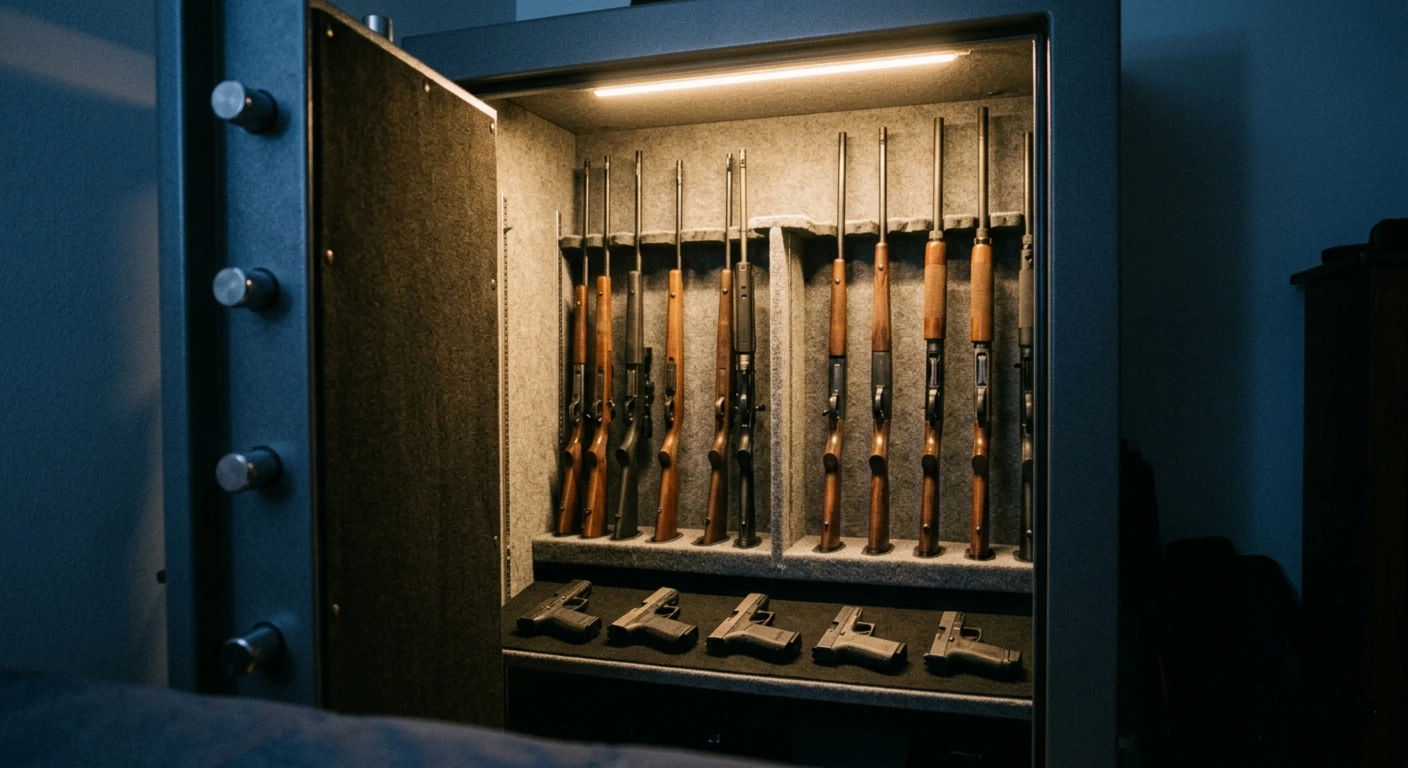
A gun safe sits in an awkward category. It's expensive enough to feel like a serious purchase, but the marketing makes it nearly impossible to tell what you're actually buying. Almost every product on Amazon is called a "fireproof gun safe," but most of them are 16-gauge sheet metal cabinets with unverified fire ratings and biometric locks that have been demonstrated to fail in seconds.
This guide ranks 14 gun safes by what they actually do — what tools defeat them, what fire conditions they survive, and what threats they're designed for. We're going to be specific about steel gauge, lock reliability, and the gap between marketing claims and tested performance. There's also a dedicated section near the end for Canadian buyers, where the legal storage requirements and the available product lineup both differ significantly from the US market.
⚡ Pick Your Threat Model
The right gun safe depends entirely on what you're protecting against. Tap any tile to jump to the right tier.
The Three Threat Models
Gun safes serve three different jobs, and the wrong product wastes hundreds of dollars. Identify which one matters most to you before you shop.
Kid and curious-hands access prevention. The single most common reason American households buy a gun safe. For this threat, what matters is fast access for the owner and zero access for everyone else. A quick-access pistol safe is the right answer. A 1,000-pound rifle vault is overkill.
Burglary protection. The threat is a stranger with a pry bar and 5–10 minutes of time alone in your home. For this threat, what matters is steel gauge (12-gauge minimum body, 10-gauge door), bolt-down anchoring, a lock that resists drilling, and ideally a Residential Security Container (RSC) burglary classification. A mid-size or premium long-gun safe is the right answer. Pistol safes don't help here — they're too small to hold rifles and light enough to walk away with.
Fire protection. The threat is your house catches fire and you want your firearms (and often documents stored alongside) to survive. For this threat, what matters is a fire rating verified by Underwriters Laboratories (UL) or by Intertek, whose mark is branded ETL. Manufacturer-claimed fire ratings without third-party certification are essentially marketing.
Most buyers need two safes, not one. A quick-access pistol safe at the bedside for the home defense gun, and a separate long-gun safe in a closet or basement for everything else. Trying to solve both threats with a single mid-size safe usually means compromising on access speed or capacity.
What Actually Matters When Buying a Gun Safe
Five things determine whether a gun safe is real security or marketing theater. Steel gauge, lock type, fire rating verification, bolt-down anchoring, and capacity math.
Steel Gauge: The Single Most Important Spec
Steel gauge runs inversely — lower numbers mean thicker steel. This one number tells you more about a safe's pry resistance than any marketing claim.
| Gauge | Thickness | Reality Check |
|---|---|---|
| 16 | 0.060″ | Sheet metal. Pries open with a screwdriver. This is a "cabinet," not a safe. |
| 14 | 0.075″ | Security cabinet in single-wall form. But two 14-gauge layers total 0.149″ and can meet California’s gun safe construction standard — check which you are being sold. |
| 12 | 0.105″ | California’s minimum for a single-wall gun safe body, and a sensible floor generally. Note that the Residential Security Container burglary classification is an attack test, not a thickness rule. |
| 10 | 0.135″ | Premium body steel. Doors should be at least 10-gauge on any "real" safe. |
| 7 | 0.180″ | Vault-grade. Browning Platinum, AMSEC BFX, and similar high-end models. |
| 3+ | 0.239″+ | Commercial vault doors. TL-rated. You don't need this; jewelry stores do. |
If a product page doesn't specify gauge, that's the answer — it's thin. Skip it.
Lock Type: Mechanical vs Electronic vs Biometric
Mechanical locks (like the Simplex push-button mechanism Fort Knox fits) have a multi-decade reliability track record because there's nothing to fail — no batteries, no electronics, no firmware. Electronic keypads are faster but require working batteries; quality units like S&G or LP Lock last 7+ years. Biometric is the fastest for emergency access — and the most failure-prone, especially in cheap units. The general rule: pay for quality biometric or stick with mechanical. Skip cheap biometric.
Fire Rating: Trust UL or ETL, Skip the Rest
Manufacturer-claimed fire ratings ("60 minutes at 1200°F") with no third-party verification are essentially marketing. Real fire protection requires independent lab testing — look for UL Class 350 or ETL Verified on the spec sheet. Without one of those marks, the rating is unverified.
The Capacity Math (This Saves You $1,000)
Manufacturer "gun capacity" claims assume bare, slim hunting rifles packed shoulder-to-shoulder with no scopes. In real life, your AR-15s have optics and your bolt guns have variable scopes. The industry rule of thumb: Real capacity = Listed capacity ÷ 1.8. A "24-gun safe" comfortably holds about 12–14 modern scoped rifles. Buy bigger than you think you need — every gun owner fills their safe within a year.
Bolt-Down: Non-Negotiable
An unanchored gun safe is a portable safe. Two people with a furniture dolly can walk a 600-pound safe out of your house in under ten minutes — and once it's in their garage, they have all the time in the world to defeat it. Every quality gun safe ships with pre-drilled mounting holes. Bolt it to the floor. This applies double for pistol safes — those are easy to grab and go.
Under $500: Compliance & Kid Deterrence
Budget gun safes serve two legitimate purposes: meeting legal storage requirements and keeping curious children out. They will not stop a determined burglar with a pry bar. Anyone telling you a $300 safe is "burglar-proof" is selling, not advising. With that honesty out of the way, here are two budget picks that genuinely earn their price tag.
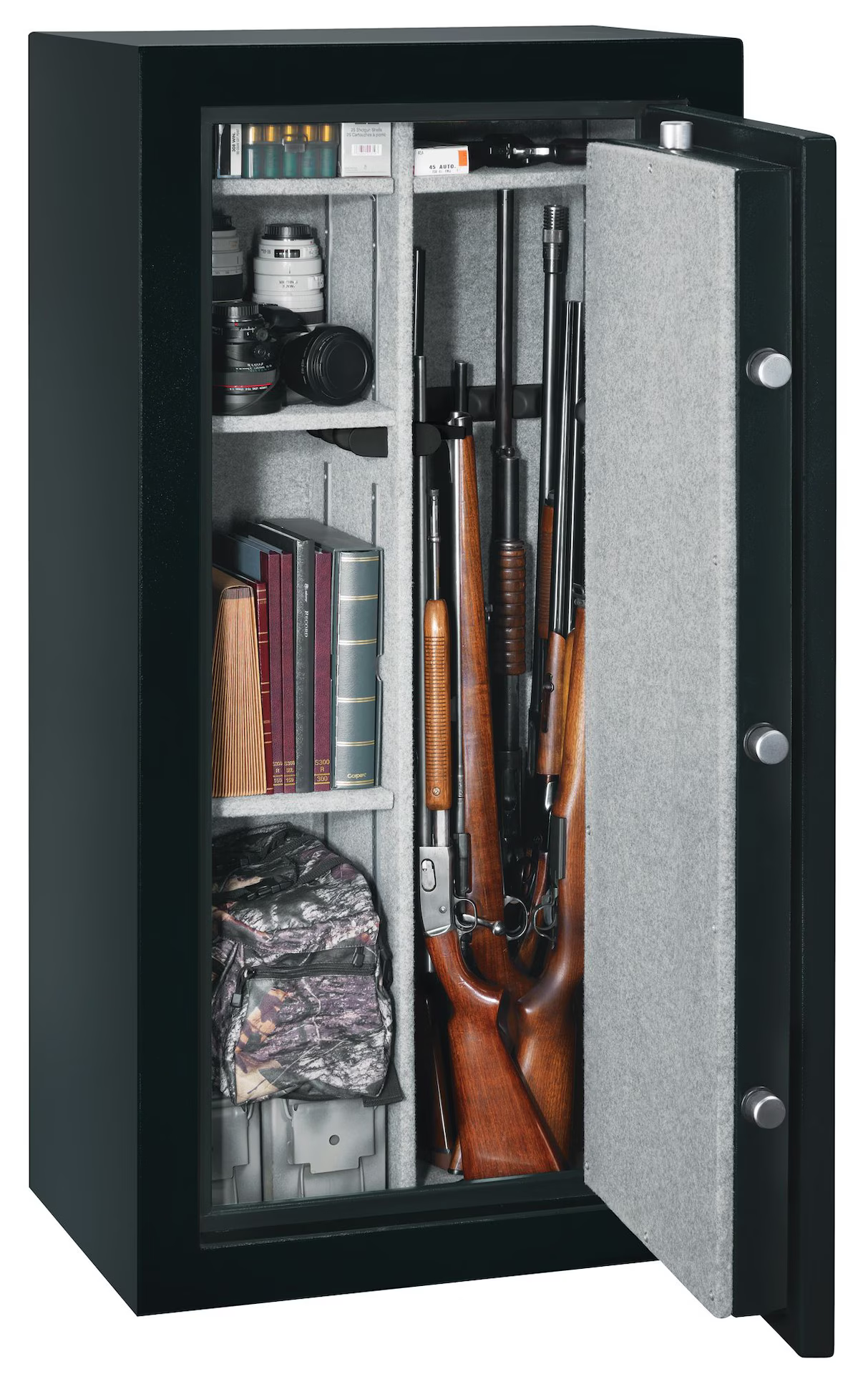
Stack-On Total Defense 24-Gun Safe BUDGET PICK
14-gauge body, 30-minute fire rating (manufacturer-claimed, not UL), electronic lock with backup key, 4-way locking. Available everywhere — Walmart, Tractor Supply, Amazon. Honest assessment: this is a security cabinet pretending to be a safe. The 14-gauge body will yield to a determined pry attack in 5–10 minutes. But for the buyer whose threat model is "keep curious kid out" and "check the legal storage box," it does the job under $500.
Check on Amazon →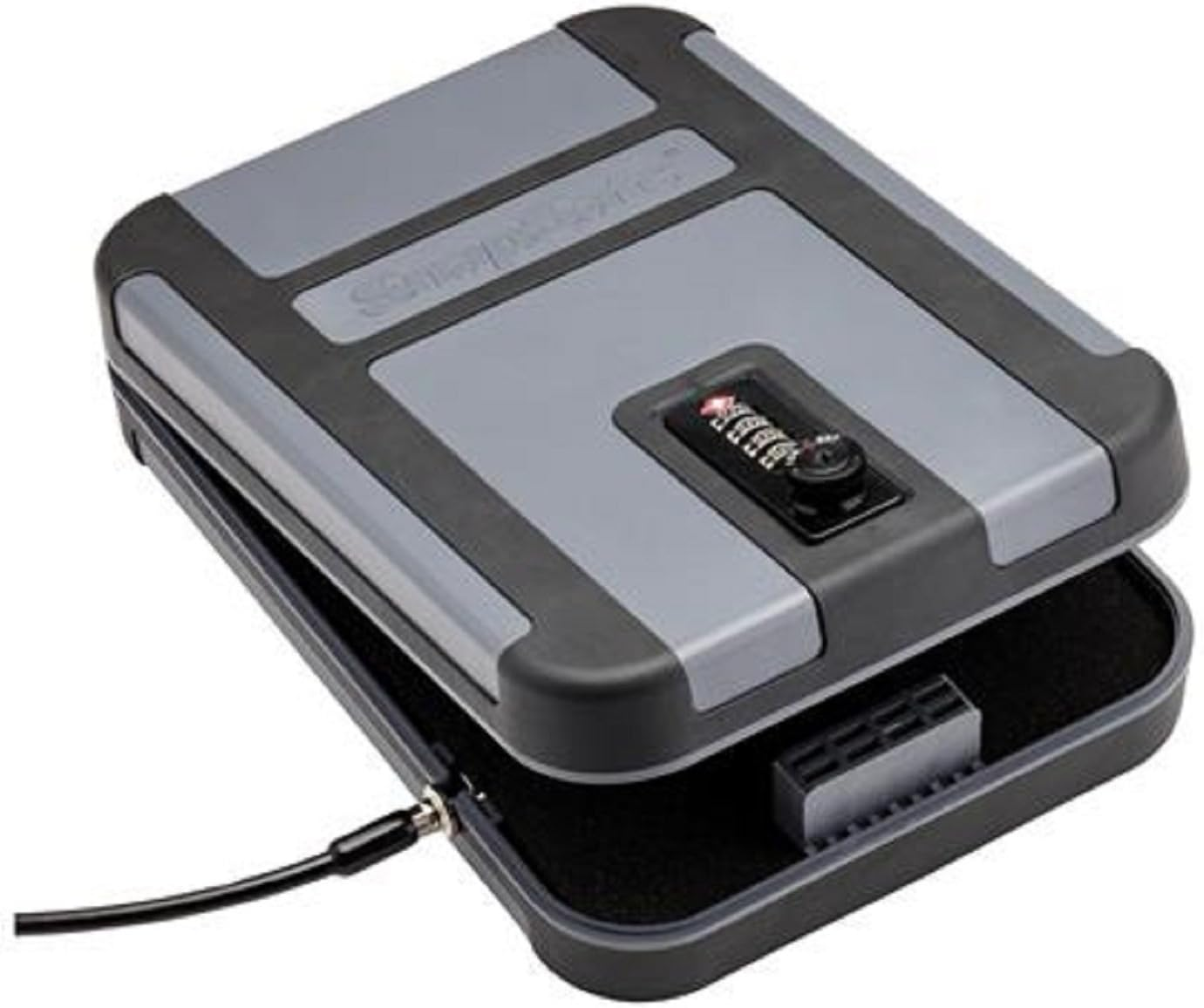
SnapSafe Treklite XL BEST UNDER $100
Meets the Transportation Security Administration’s locked hard-sided container requirement for checked firearms — the agency publishes requirements rather than approving products — and doubles as a quick-access lockbox for a single full-size handgun. Lightweight aluminum body, key lock, included security cable for tethering to a fixed object. The most genuinely useful sub-$100 firearm storage product on the market — works as a bedside lockbox, vehicle storage (where legal), and a travel case for flights. Not a substitute for a real pistol safe with quick electronic access, but at $60 it's tough to argue with.
Check on Amazon →Quick-Access Pistol Safes
The most important gun safe for most American households isn't a giant rifle vault — it's the small one on the nightstand or under the bed that holds the home defense pistol. The job: open in under three seconds in the dark when you need it, stay locked the rest of the time. Five legitimate options here, ranging from a $120 budget biometric to a $300 mechanical pick that has zero failure points.
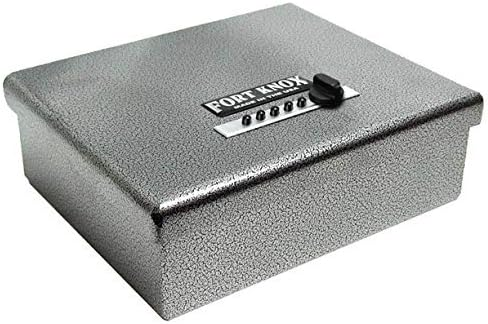
Fort Knox PB1 Personal Pistol Safe EDITOR'S PICK
10-gauge steel body, mechanical Simplex push-button lock, four pre-drilled mounting holes. No batteries. No electronics. No firmware. Nothing to fail. The Simplex push-button mechanism has a multi-decade reliability record across military and law enforcement use. Open in the dark with muscle memory after a week of practice. The PB1 holds one full-size handgun; the PB4 (~$420) holds two and adds an internal light. If you only buy one pistol safe, this is the one.
Check on Amazon →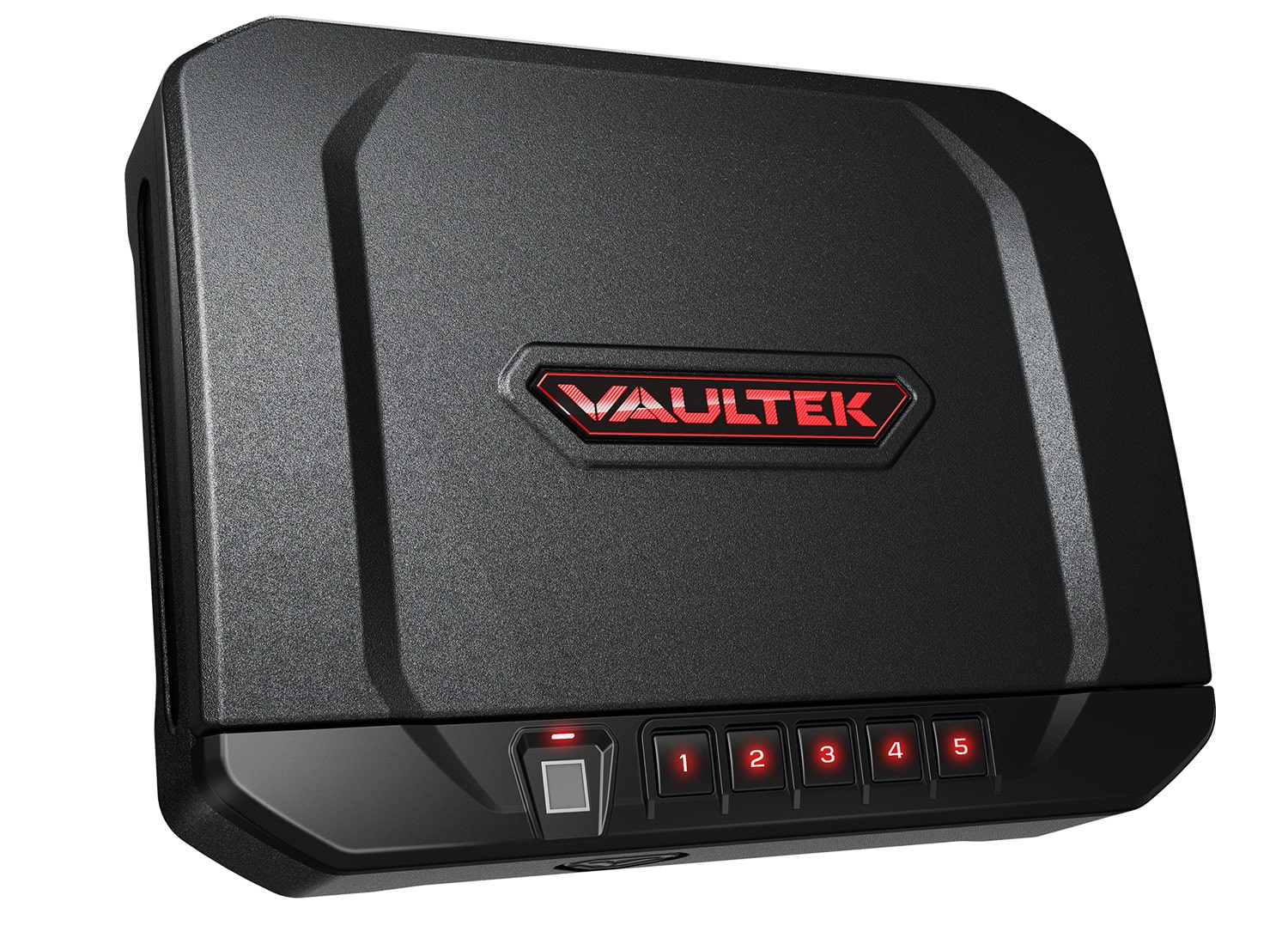
Vaultek VT20i
Biometric + Bluetooth + tamper alarm. 14-gauge steel body, anti-pry bars, rechargeable lithium battery (rare in this category — most use AAs). Tracks failed access attempts via the app and alerts your phone. The biometric scanner is genuinely good — Vaultek invested in it where most cheap brands didn't. Backup: 4-9 digit PIN plus a barrel key. The smart features feel useful rather than gimmicky.
Check on Amazon →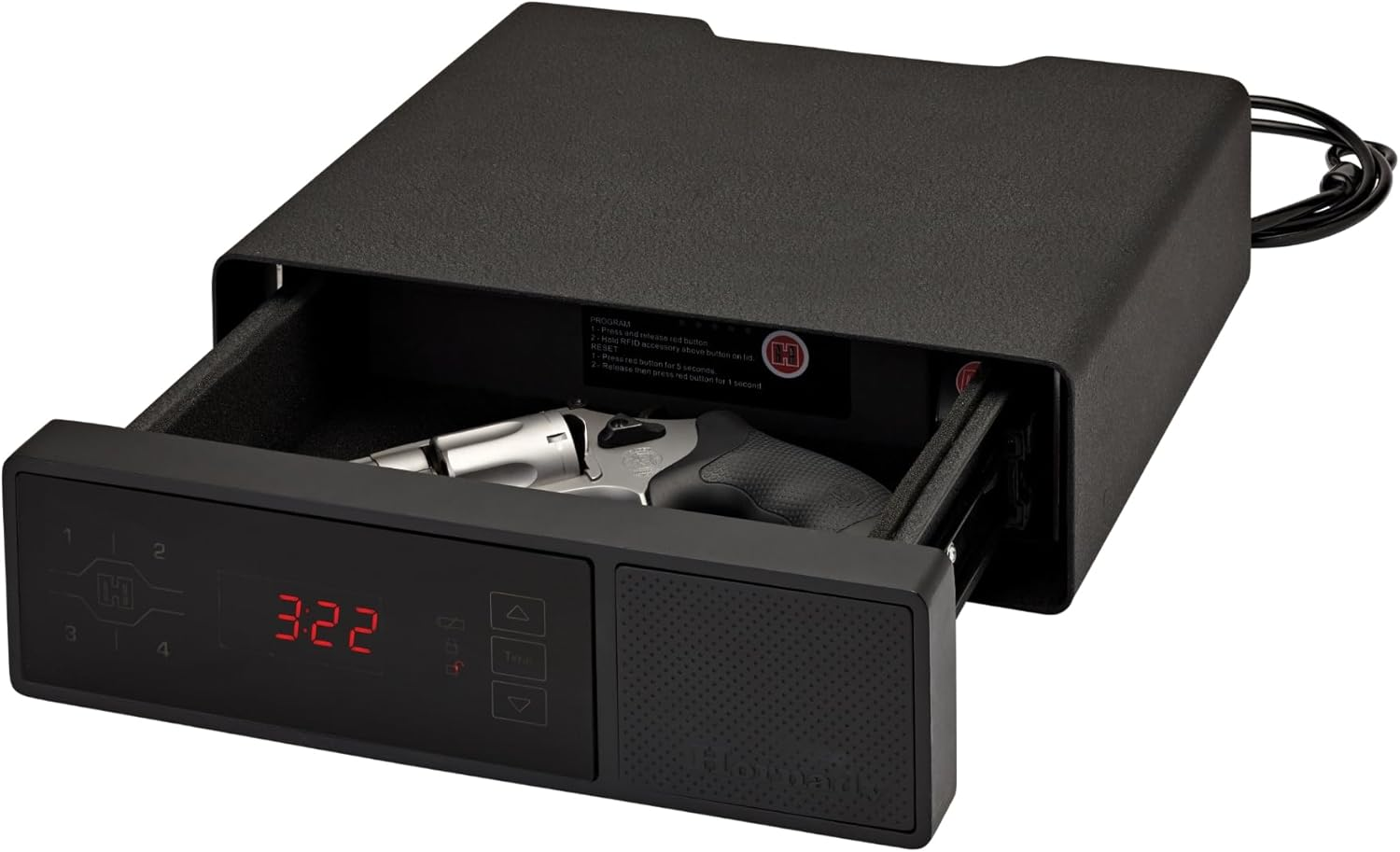
Hornady RAPiD Safe Night Guard
RFID access via included wristbands, key fobs, or stickers — wave the bracelet over the safe and it opens. The clever part: the entire unit is disguised as a digital alarm clock and works as one. A burglar searching the bedroom won't recognize it as a safe at all. 14-gauge steel construction with a steel security cable. AC powered with battery backup. Only catch: capacity is one full-size handgun, no extra magazines.
Check on Amazon →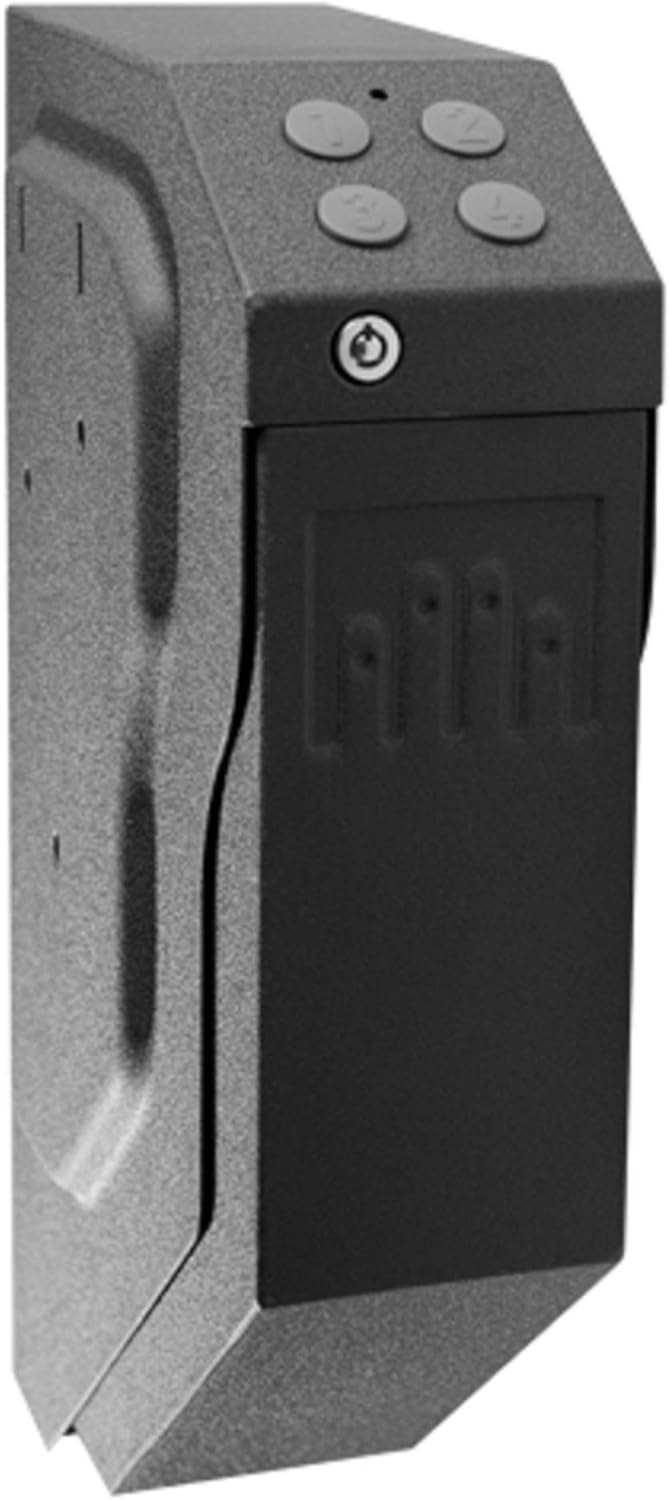
GunVault SpeedVault SV500
The unique pitch: mounts under a desk, shelf, or nightstand with the door swinging downward, so the pistol drops grip-first into your hand. Electronic keypad with audible feedback (or silent mode), 18-gauge body — thin, but the form factor is the value here, not pry resistance. A solid pick for an office desk drawer area or a discreet bedside install where you want fast access without a visible safe on the surface.
Check on Amazon →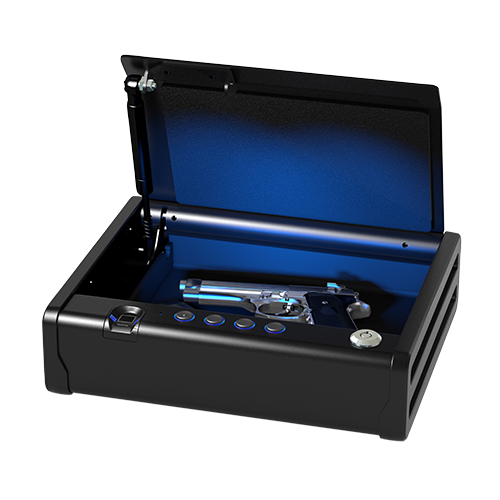
SentrySafe QAP1BLX
Biometric + electronic keypad + override key, gas strut auto-open lid, interior LED light, California DOJ certified. The most popular budget biometric pistol safe in big-box stores (Home Depot, Walmart, Costco occasionally). Honest read: it's better than most of its peers in the under-$150 tier, but the biometric reliability is hit-or-miss based on user reviews. Treat the keypad as your primary entry method and the biometric as a backup. Bolt it down or use the included tether — at 8 pounds it walks away easily.
Check on Amazon →The Fingerprint Safe That Opens With a Strip of Metal
In late September 2019, the YouTube channel LockPickingLawyer published a short video defeating an Amazon Basics biometric pistol safe. Hackaday and The Firearm Blog both covered it within days, and it permanently changed how the firearm community thinks about cheap biometric safes.
The attack was almost embarrassingly simple. The Amazon Basics biometric pistol safe — which contemporary coverage put at about $112 on Amazon at the time — has a small button on the inside of the front panel that registers a new fingerprint. The button can be reached by sliding a thin metal shim through the gap between the door and the frame while the safe is closed and locked. Press the button with the shim, register your own fingerprint, and the safe opens for you. Contemporary coverage described it as opening in seconds, with no tools beyond a strip of sheet metal. Amazon subsequently pulled the safe from sale.
And it stopped being a YouTube curiosity entirely. In February 2024 the Consumer Product Safety Commission widened a recall of biometric gun safes to roughly 120,000 further units across four manufacturers, sold at Walmart, Amazon and Bass Pro Shops. The hazard notice reads the same every time: the biometric lock can be opened by unauthorized users, posing a serious injury hazard and risk of death.
The scale is worth reading slowly. Awesafe: about 60,000 units, with 71 reported incidents of safes opening for the wrong person. Bulldog: about 33,500 units. Sports Afield and Sanctuary: roughly 133,000 between them. A MouTec-branded safe sold by BBRKIN: 2,200 units, recalled after a six-year-old opened one. And on the Fortress Safe recall — models sold from January 2019 through October 2023 for between $44 and $290 — the Commission recorded 39 reported incidents and noted it was aware of a lawsuit alleging a twelve-year-old boy died from a firearm obtained from one of the safes. In every case the remedy is identical: stop using the fingerprint reader, remove the batteries, use the key.
The same vulnerability has been documented on multiple cheap biometric pistol safes since — including several models still sold on Amazon today under various brand names. The lesson isn't "biometric safes are bad." Quality biometric safes from Vaultek, Fort Knox, and Hornady don't have this flaw. The lesson is that the under-$100 biometric pistol safe category is a minefield, and the brand on the box often means very little. A determined teenager with a Google search and ten minutes of access can defeat most of them.
If your threat model includes anyone with curiosity and an internet connection — and for most parents, it does — pay the extra $200 and get a Fort Knox PB1 or a Vaultek VT20i. The cheap biometric route saves money up front and creates a false sense of security for years afterward.
Mid-Size Long-Gun Safes
The mid-size tier is where most rifle owners actually shop. The price-to-protection ratio is better here than anywhere else in the gun safe market — you're getting real 12-gauge steel, real fire ratings (in the better picks), and capacity for a serious collection without crossing the $2,000 line.
Liberty Centurion 24 EDITOR'S PICK
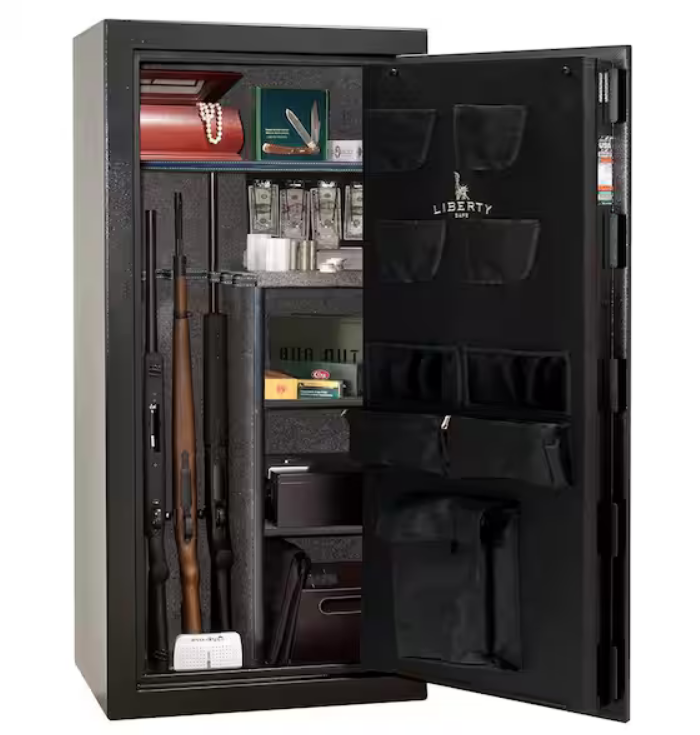
The genuine sweet spot of the gun safe market — with one correction to what we published before. The body is 14-gauge dual-wall steel, not 12-gauge, and the fire rating is 40 minutes at 1200°F, manufacturer-tested. Liberty lists it at 375 pounds and rates it Level 3 on their own 1–10 internal scale. Doubled 14-gauge totals 0.149″, which is how it qualifies as a California DOJ-approved firearm safety device despite failing our single-wall rule of thumb. Electronic lock with mechanical key backup. Holds about 12 modern scoped AR-15s comfortably (despite the "24-gun" name — see capacity math). Liberty often includes free curbside delivery. American-made, lifetime warranty, and Liberty's customer service is genuinely responsive. If you only have $1,000 to spend on a long-gun safe, this is the answer.
Check on Amazon →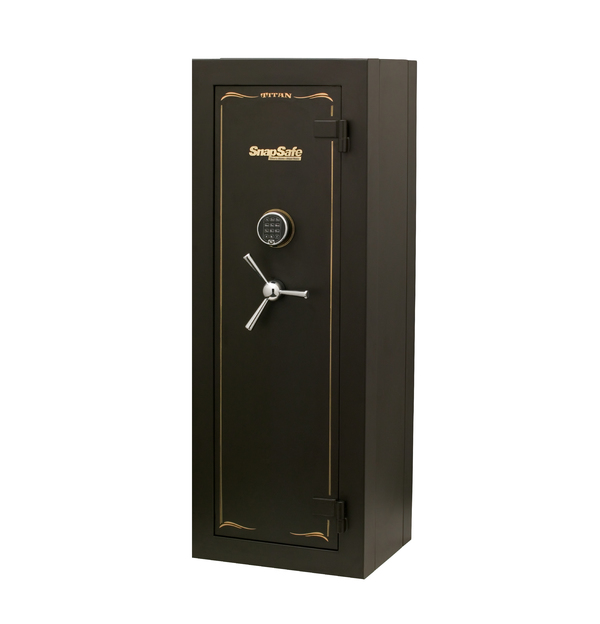
SnapSafe Titan XL
Ships in pieces — assembles in about an hour with a partner and basic tools. The killer feature: it goes through standard doorways. If your basement, gun room, or apartment has a 32" door and you can't fit a 600-pound monolithic safe through it, the Titan XL is your answer. Assembled, it's a real safe with 12-gauge construction, 4-way locking, and decent fire protection. Build quality is solid for the price. The only honest downside: marginally less pry-resistant at the seams than a single-piece body, though the difference is minor for non-professional attacks.
Check on Amazon →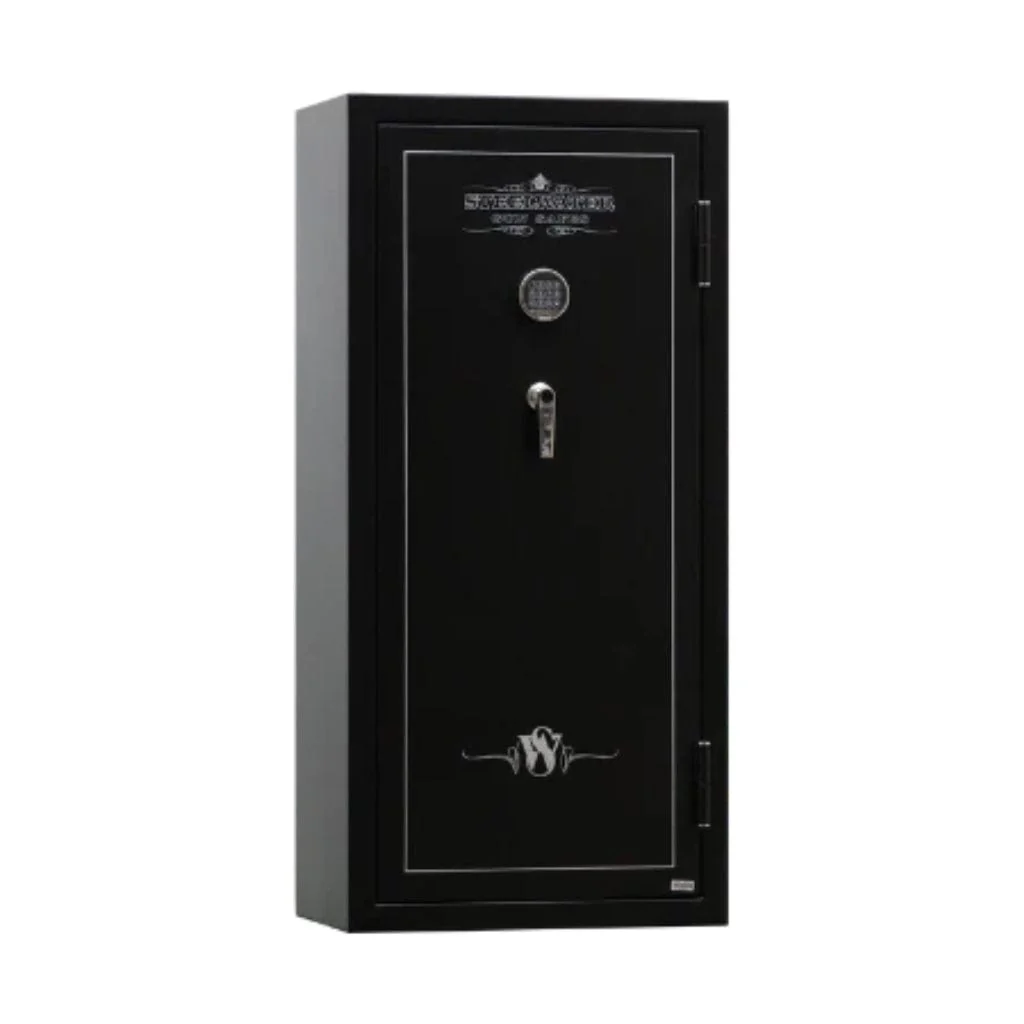
Steelwater HD20
7-gauge door, 11-gauge body, and a 2-hour fire rating at 1875°F (manufacturer-tested, not UL — we could not verify any claim that their protocol is more rigorous than peers’). Heavy-duty bolt work with 1.5" diameter locking bolts, EMP-resistant electronic lock with mechanical override. Holds about 22 long guns realistically. Best pick in this tier if fire protection is your primary concern and you're not willing to jump to the premium tier. The 2-hour rating exceeds what most premium safes offer.
Check on Amazon →Premium Gun Safes
This is where the marketing claims start matching the actual product. Premium safes get you UL burglary classification, 10-gauge or thicker steel, gear-driven locking mechanisms, and lifetime warranties that the manufacturer actually honors. Note what you still don’t get: gun safe fire ratings in this tier are almost universally manufacturer-tested rather than UL 72 listed, including on the picks below. Read the burglary rating and the fire rating as two separate claims backed by two very different levels of proof. If you have a collection worth more than $10,000 or you live somewhere with real fire risk, you've crossed into this tier.
Liberty Fatboy Jr 48 TOP PICK
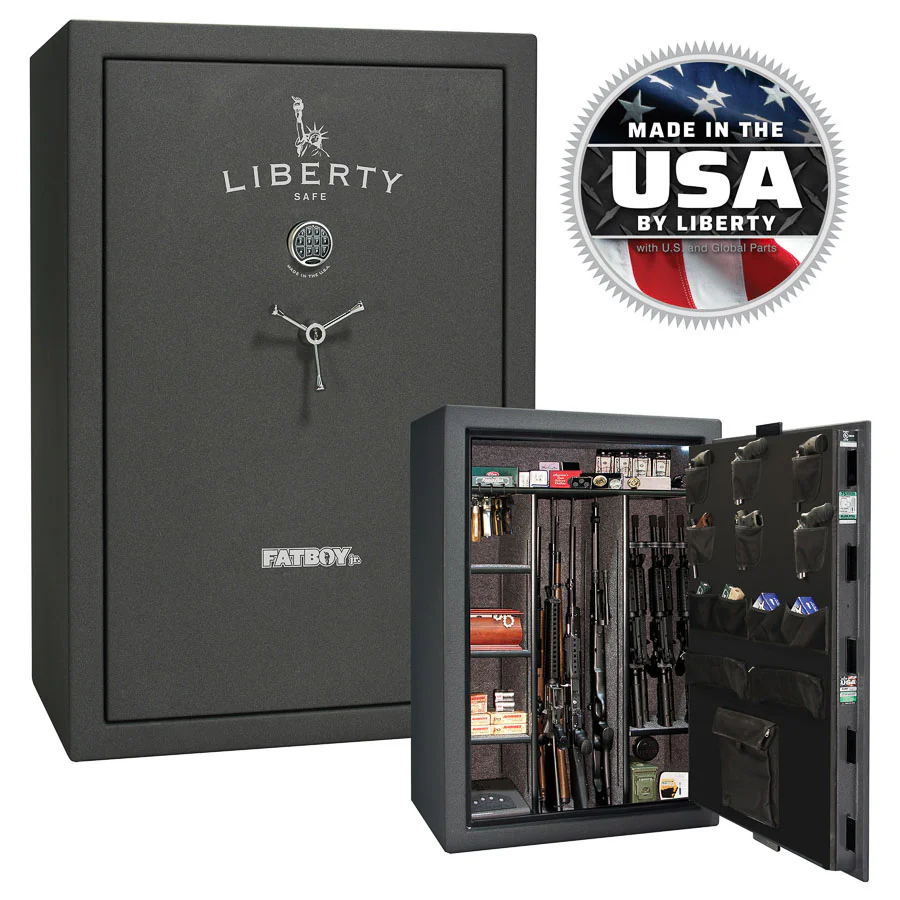
UL Residential Security Container classified — actually tested, not just claimed — though the fire number is Liberty’s own test, not UL’s. Specifications shift between production runs: dealer listings show 11-gauge and 12-gauge bodies and fire ratings of 60, 75 and 110 minutes at 1200°F depending on model year and trim, so confirm against the exact unit you are quoted. Holds about 28 modern scoped rifles realistically. The "Jr" name is misleading — this is a serious safe at around 760 pounds. Bolt counts also vary by generation, and the fourteen-bolt figure we published belongs to the full-size Fatboy rather than the Jr. Lifetime warranty plus Liberty's free safe replacement if it's broken into. The pick for buyers who want premium specs without crossing $2,000.
Check on Amazon →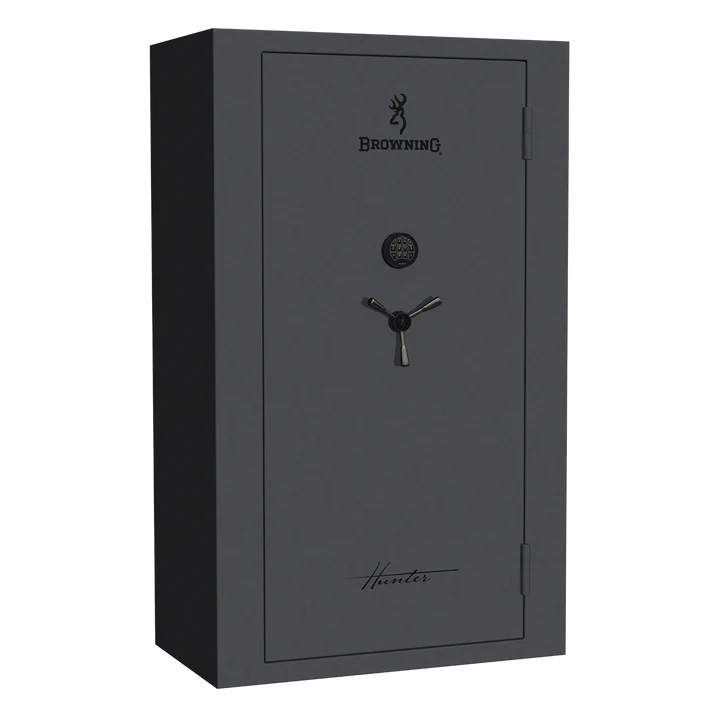
Browning Hunter 49T
12-gauge body, 60-minute fire rating at 1200°F, Browning's signature "Scope Saver" interior pockets that let you store scoped rifles without sacrificing adjacent slots. Comes with the DPX door organizer and Axis adjustable shelving. Browning runs periodic rebates on the Hunter line, but we could not verify current terms — check before assuming a discount. Capacity: about 28 scoped rifles plus handgun storage in the door panel.
Check on Amazon →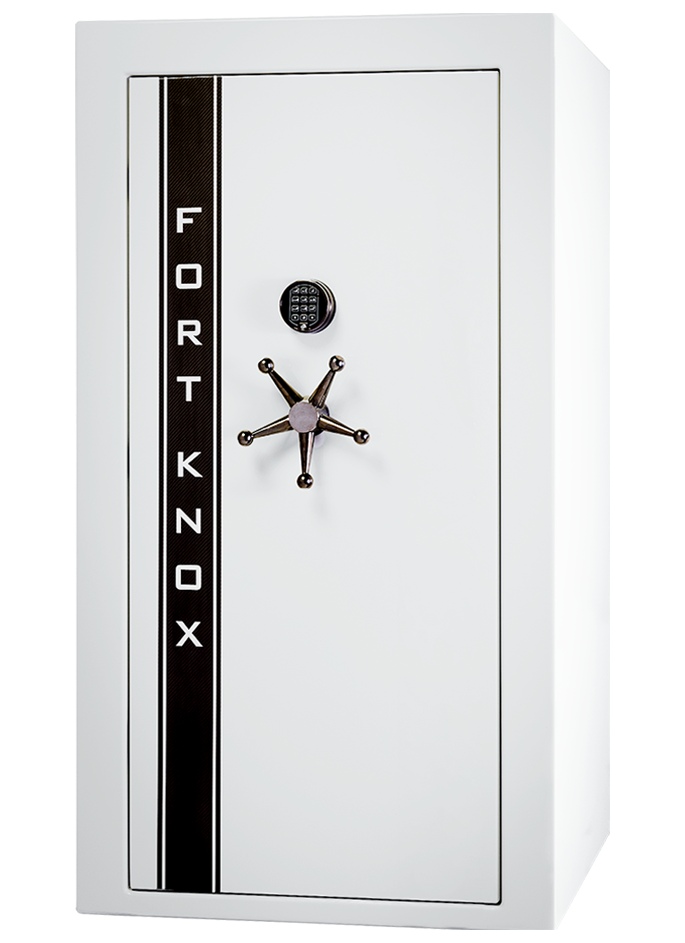
Fort Knox Defender
10-gauge body standard, with optional steel liner upgrades that can take the door to 1/2" of total steel — a "safe within a safe." Gear-driven 1.5" locking bolts, UL-listed mechanical or electronic lock options, lifetime warranty covering everything (lock, bolts, body, fire). Made in Utah. The customization is the killer feature — you can spec the safe to your exact needs, including AR500 armor plate liners, interior lights, and dehumidifiers. The pick for buyers who want a "buy it once" decision.
Check on Amazon →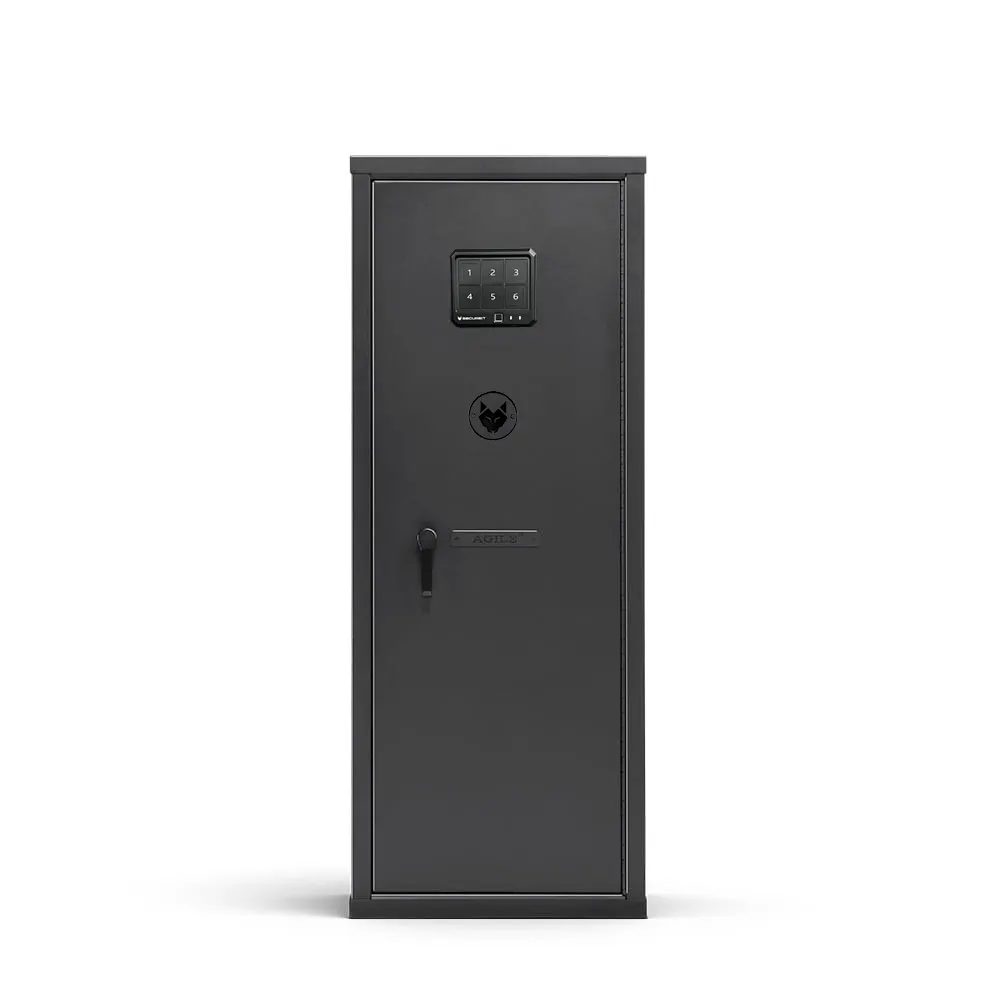
SecureIt Agile 52 Pro
Ignore this if you own classic hunting rifles. Read on if you own modern sporting rifles with optics, suppressors, lasers, and rail systems. SecureIt's "CradleGrid" modular interior is genuinely different from anything else on the market — instead of fixed barrel slots, the interior is a wall of vertical channels and adjustable cradles that hold rifles by their rails or buttstocks regardless of accessories. An AR-15 with a 30mm scope and a suppressor mounted will fit in this safe with room to spare. Most other "12-gun safes" can't hold three of those rifles. Lighter weight (190 lbs) makes apartment/upstairs installation realistic.
Check on Amazon →Vault-Grade ($5,000+)
Vault-grade safes have UL TL-15, TL-30, or TL-30X6 ratings — meaning a trained tester with hammers, chisels, pry bars, drill, and grinders couldn't open them in 15 or 30 minutes of net working time on the door and front face — it is the X6 suffix that extends the test to all six sides. We're talking 7-gauge or thicker steel, multi-layer composite walls, and weights well north of 1,500 pounds. AMSEC BFX series ($4,000–$8,000) and Browning Platinum ($8,000+) are the standard picks. Browning's TL-30 Pro Series starts around $14,000 and requires insured dealer installation.
Honest read: most readers don't need a vault-grade safe. The cost-benefit math only works if you're protecting genuinely valuable items — a serious historical firearm collection, museum pieces, or you're using the safe for cash and jewelry alongside firearms. For everyone else, Tier 3 premium is the ceiling. If you're shopping in this range, you should also be talking to a local safe dealer who can help with delivery, installation, and post-installation servicing — these aren't safes you order on Amazon.
Insurance angle: Some homeowners insurance policies offer reduced premiums or higher firearm coverage limits if your guns are stored in a UL-rated safe. If you have a collection worth more than $25,000, call your insurance agent before buying — the premium discount can offset $1,000+ of safe cost over a few years.
For Canadian Buyers
Canadian gun owners face a different reality from American buyers in three ways: the legal storage requirements are stricter and explicitly defined, the product lineup available in Canada is more limited (most premium US safes don't ship north), and the Canadian retail prices are noticeably higher than US Amazon prices for equivalent products. Here's what actually works in Canada.
Canadian Firearms Program Storage Requirements
This is general guidance, not legal advice — always verify with the RCMP's Canadian Firearms Program for your specific situation. The summary version of the rules for individuals:
Non-restricted firearms (most rifles & shotguns):
- Unloaded
- Then any one of: a secure locking device such as a trigger or cable lock; the bolt or bolt-carrier removed; or storage in a container, receptacle or room kept securely locked and built so it cannot readily be broken into. The regulation is or, not and — a trigger lock on its own satisfies it
- The firearm must not be readily accessible to ammunition, unless that ammunition is itself in a securely locked container — stored with the firearm or separately
Restricted firearms (handguns & certain rifles):
- Unloaded
- Locking device attached and stored in a locked container that cannot be readily broken open; or stored in a vault/safe specifically constructed for restricted storage
- Ammunition: locked container (separate or together with the firearm in the same safe)
Prohibited firearms have stricter rules including separate storage of bolts/bolt carriers for automatic firearms. If you're storing prohibited firearms under amnesty, consult the CFP directly.
The practical takeaway: if you own only non-restricted firearms (a hunting rifle, a shotgun), a basic locked cabinet from Canadian Tire technically meets the legal requirement. If you own restricted firearms, you need either a real safe or a locked container that's clearly built to resist forced entry. In both cases, the law sets a floor — common sense often suggests buying better than the legal minimum.
Most premium American gun safes (Liberty, Browning, Fort Knox high-end models) don't ship to Canada via Amazon. Cross-border freight on a 600-pound safe runs $400+ and customs clearance is unpredictable. Stick with the Canadian retail channel: Canadian Tire for budget, Cabela's Canada and Bass Pro Shops Canada for mid-range, and canadiansafe.ca for Canadian-made premium options.
5 Gun Safes Available in Canada
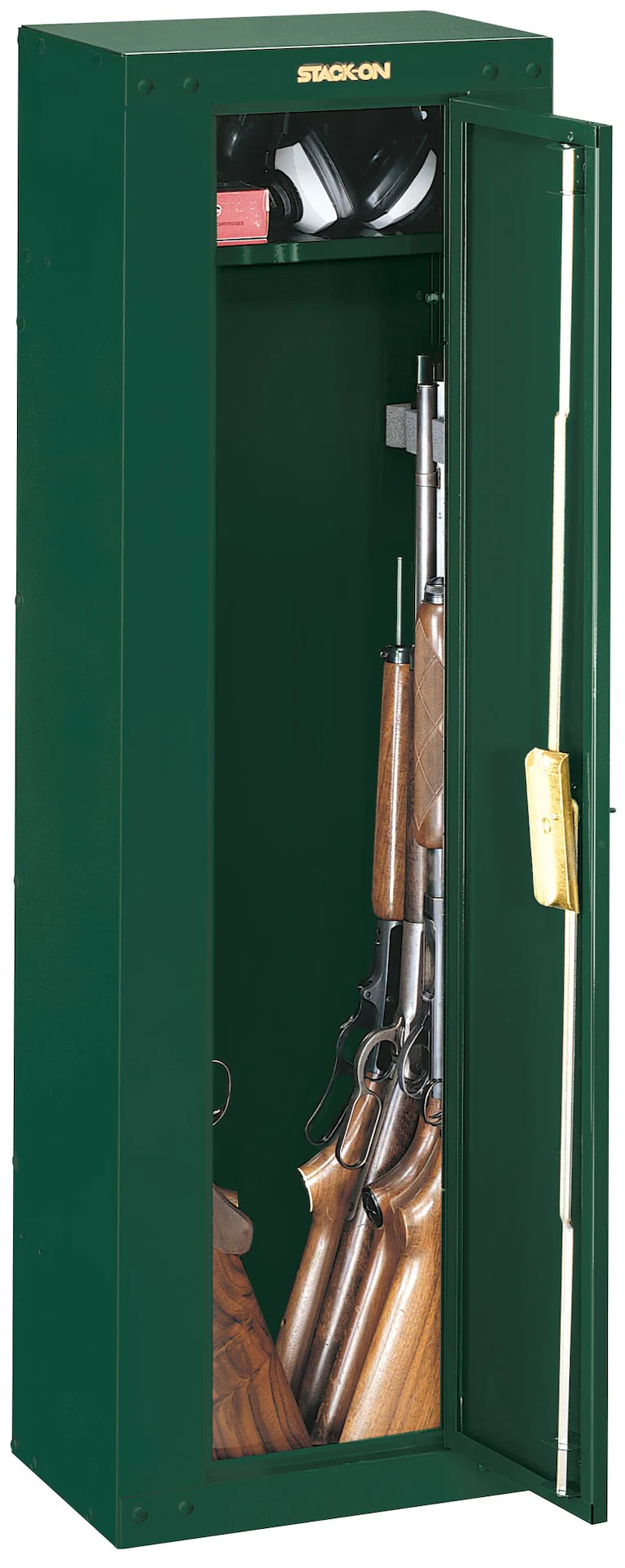
Stack-On 8-Gun Cabinet CHEAPEST CA OPTION
Sold at Canadian Tire and frequently on sale for under $100 CAD. Honest assessment: this is a thin metal cabinet with a basic key lock, not a safe. It holds about 4 long guns realistically (the "8-gun" claim assumes bare rifles tightly packed). It does meet the legal minimum for non-restricted firearm storage in Canada — unloaded firearms with trigger locks, inside a locked container that's "difficult to break into." For Canadian gun owners whose only need is legal compliance and basic deterrence, this is the entry point.
View at Canadian Tire →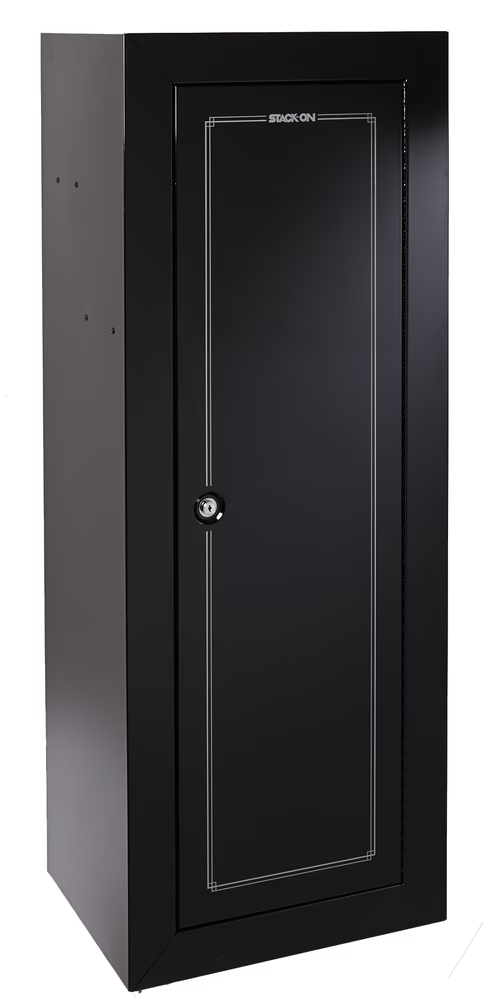
Stack-On 14-Gun Fireproof Safe
A real budget safe (not a cabinet). 30-minute fire rating at 1400°F (manufacturer-claimed), 2-way locking with three 1" steel bolts, electronic keypad with mechanical key backup. Holds about 7-8 modern scoped rifles realistically. Available at Canadian Tire with their 5-year exchange warranty. The natural step up from the 8-gun cabinet for Canadian buyers who want actual fire protection without crossing $1,000 CAD.
View at Canadian Tire →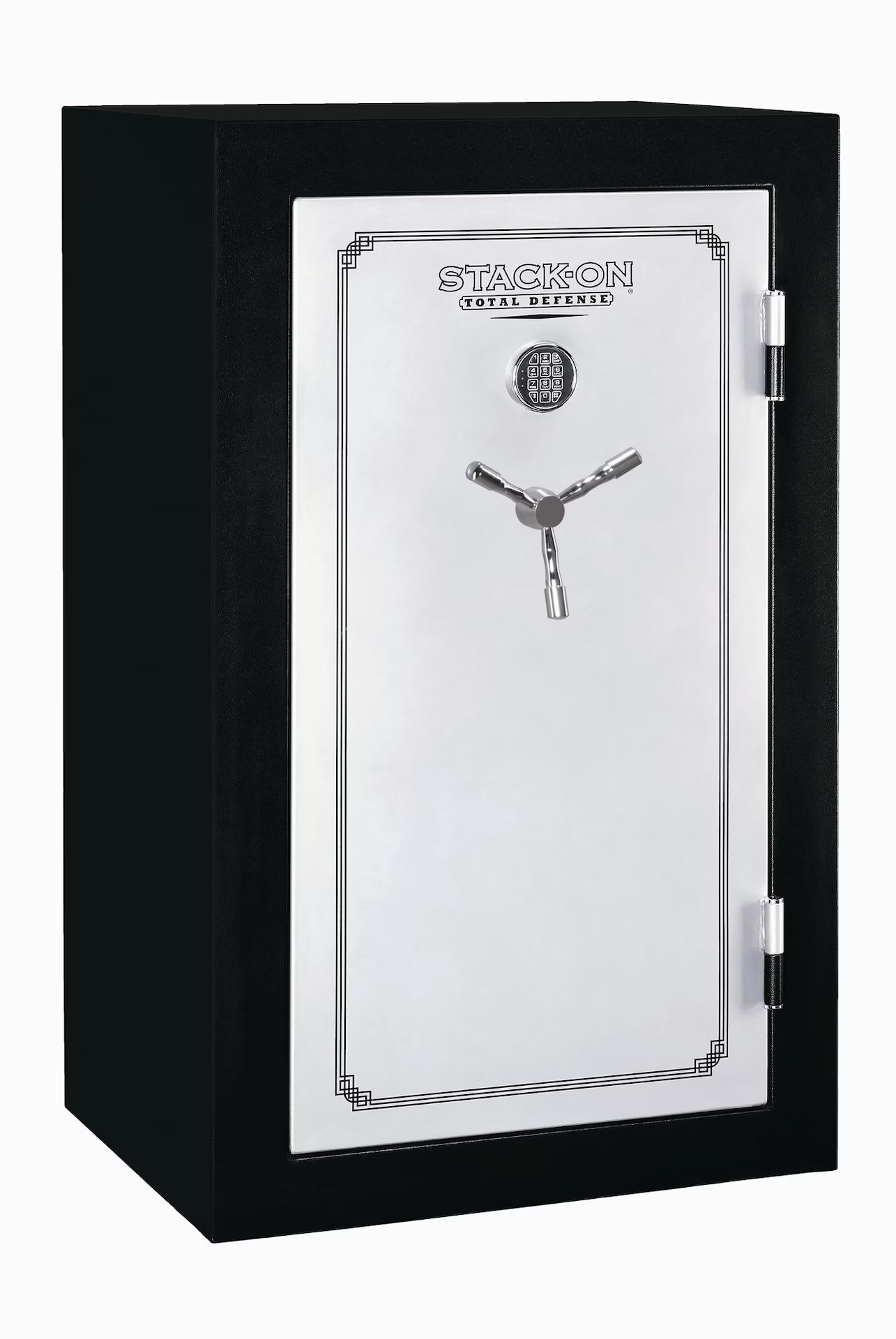
Stack-On 36-Gun Capacity Safe
The bigger sibling. 30-minute fire rating to 1400°F, also waterproof rated to 5 meters for 72 hours (useful for flood-prone basements). 4-way locking system with up to 10 locking points, 1.5" live action bolts. Holds about 20 scoped rifles realistically. Available at Canadian Tire. The pick for Canadian buyers with a serious collection who want something better than the 14-gun but aren't ready to jump to canadiansafe.ca's premium tier.
View at Canadian Tire →
Cabela's Liberty ProVault 18 EDITOR'S CA PICK
Liberty's Canadian-market SKU sold through Cabela's Canada. Real Liberty build quality — 12-gauge body, 30-minute fire rating, electronic lock with mechanical backup. Holds about 10-12 modern scoped rifles. The genuine sweet spot for Canadian buyers who want a real safe without the cross-border shipping headache. Cabela's Canada periodically runs sales bringing this under $1,200 CAD; worth waiting for if you're not in a rush. Their delivery to Canadian addresses is reliable.
View at Cabela's Canada →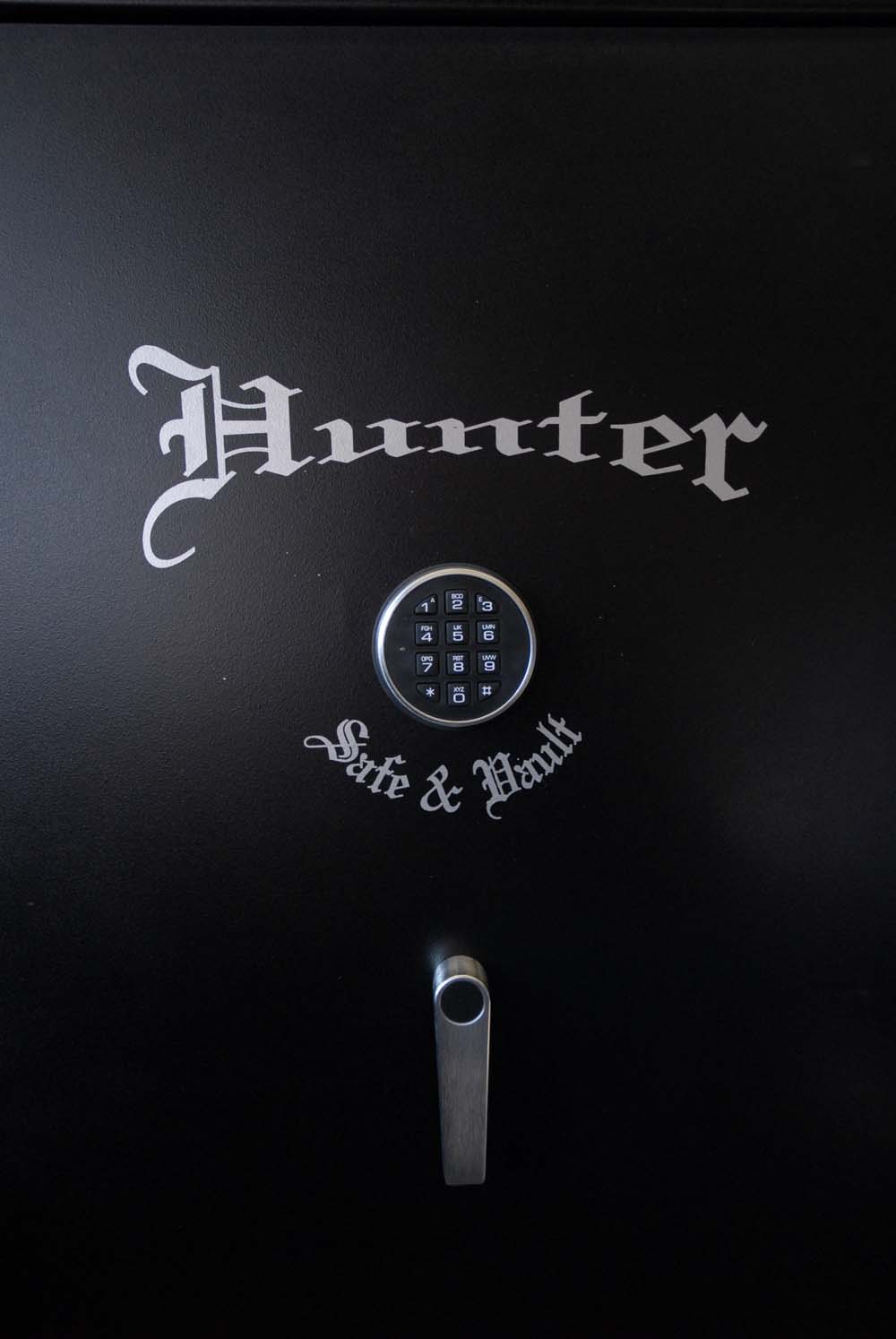
canadiansafe.ca Hunter Series
Actually made in Canada by canadiansafe.ca. Their Hunter series competes directly with mid-tier Liberty and Browning models on specs (12-gauge or 10-gauge construction depending on model, real fire ratings, electronic locks with mechanical backup) but at Canadian prices without cross-border shipping. They'll deliver and install the safe inside your home, which is genuinely useful for 700+ pound units that don't fit through standard doorways. The pick for serious Canadian buyers who want premium build quality from a domestic manufacturer.
View at canadiansafe.ca →Installation: Bolt It Down. Always.
The single biggest mistake new gun safe owners make is treating installation as optional. An unanchored 600-pound safe gets walked out of a house in under ten minutes by two thieves with a furniture dolly. Once they have it in their truck, they have unlimited time and tools to defeat the lock.
For wood subfloors: 3-inch lag screws into floor joists, through the safe's pre-drilled mounting holes. Find joists with a stud finder or by measuring from a known wall. For concrete slabs: sleeve anchors or wedge anchors rated for the safe's full weight. The hardware is $20 at any hardware store. The installation takes 30 minutes.
For pistol safes specifically — which weigh as little as 8 pounds and are designed to be portable — bolt-down or tether is non-negotiable. Most ship with a steel security cable for tethering to a bed frame or fixed object if you can't drill into furniture. Use it. A pistol safe sitting loose on a nightstand is a $200 gift to the burglar.
Match the Safe to the Threat. Buy Bigger Than You Think.
If you take one thing from this article: most buyers need two safes, not one. A quick-access pistol safe at the bedside (Fort Knox PB1 is the answer for almost everyone) plus a long-gun safe in a closet or basement (Liberty Centurion 24 for most US buyers; Cabela's Liberty ProVault 18 for most Canadian buyers). That stack runs $1,300 USD or $1,700 CAD and covers virtually every realistic threat — kid access, opportunistic burglary, and basic fire risk.
If you're spending more, spend it on the long-gun safe. Liberty Fatboy Jr 48 for fire-conscious buyers, Browning Hunter 49T for collectors who want premium interior organization, Fort Knox Defender for the buy-it-once decision. Skip the vault-grade tier unless you're insuring a serious collection.
For Canadian readers: the legal floor is lower than what we'd recommend. A Stack-On 8-gun cabinet meets the law for non-restricted storage, but a real safe (Stack-On 14-gun Fireproof or Cabela's Liberty ProVault 18) is what we'd actually put our own rifles in. canadiansafe.ca is the right answer if you want premium built and delivered domestically. For broader home security context, see our Home Security Guide and how burglars actually choose targets — gun safes are one piece of a layered approach.
Related Reading
For broader home security beyond gun storage, start with our Home Security Guide and how burglars actually choose targets. The deadbolt on your front door matters more than most people realize — see our Best Deadbolts 2026 roundup. For securing the door itself against kicks and pry attacks, door frame reinforcement covers the strike plate and frame upgrades that make a real difference. And if you're thinking about layered security generally, our porch piracy guide applies the same "free fixes first, products second" framework to a different problem.
Gun Safes: FAQ
What's the best gun safe in 2026?
For most rifle owners, the Liberty Centurion 24 (around $999) is the genuine sweet spot — 14-gauge dual-wall body, 40 minutes of manufacturer-tested fire protection, and the right balance of capacity and price. For pistol owners who need quick bedside access, the Fort Knox PB1 (around $300) with its mechanical Simplex lock is the most reliable option because there are no batteries or electronics to fail. For high-end buyers, the Liberty Fatboy Jr 48 with its UL Residential Security Container classification is hard to beat under $1500, though its fire rating is Liberty’s own test and varies by production run.
What gauge steel should a gun safe have?
Steel gauge runs inversely — lower numbers mean thicker steel. 12-gauge (0.105 inches) is California’s minimum for a single-wall gun safe body and a sensible floor generally. RSC certification is an attack test rather than a thickness rule, so gauge alone does not earn it. 10-gauge (0.135 inches) is premium-grade. 7-gauge (0.180 inches) is vault-grade. Single-wall 14-gauge and thinner is a security cabinet rather than a safe. Two 14-gauge layers total 0.149 inches and can meet California’s construction standard, so check whether a body is single or double walled before dismissing it. If a product page doesn't specify gauge, assume it's thin.
Are biometric gun safes safe?
Quality biometric safes from Vaultek, Fort Knox, and Hornady are reliable. Cheap biometric safes — including the well-known Amazon Basics biometric pistol safe demonstrated by LockPickingLawyer in 2019 — can be bypassed in seconds by sliding a thin metal shim through the door gap to trigger the fingerprint registration button. It is also no longer an isolated case: between 2023 and 2024 the Consumer Product Safety Commission recalled several hundred thousand biometric gun safes across brands including Fortress Safe, Awesafe, Bulldog, Sports Afield and Sanctuary, all for the same hazard — the fingerprint lock opening for unauthorized users. The lesson: biometric is fine if you buy quality, and cheap biometric is a category with a federal recall history. Avoid sub-$100 biometric pistol safes from unknown brands. For maximum reliability, mechanical locks (like the Simplex push-button mechanism Fort Knox fits) have a multi-decade track record with no batteries, no electronics, and no failure points.
What does RSC mean for gun safes?
RSC stands for Residential Security Container — a UL certification that requires the safe to resist a five-minute attack with hand tools by a trained tester. It's the baseline standard for a "real" gun safe in the US. California does not require RSC certification. Its standard is Penal Code 23650, which sets construction rules — 12-gauge minimum on a single-wall body, or 0.100 inches of total steel if double-walled — and accepts UL Residential Security Container listing as an alternative route to approval. Gun safes also do not need to appear on the state roster; lockboxes and trigger locks do. Since the 2016 revision the standard has three tiers: Level 1 is that five-minute attack, Level 2 is ten minutes of net working time against two technicians with drills and picks, and Level 3 is the same ten minutes across all six sides. Above those, UL ratings climb to TL-15, TL-30, and TL-30X6 (vault-grade), each requiring longer attack-resistance times with more advanced tools. Most consumer gun safes top out at RSC; commercial vault doors are TL-rated.
Do I need a UL fire rating?
If fire is part of your threat model, yes — and specifically look for UL or ETL certification, not just a manufacturer-claimed rating. Many cheap safes advertise "60 minutes at 1200°F" with no third-party verification, which is essentially marketing. Real UL-rated safes are noticeably more expensive but provide actual tested protection. If you live somewhere with wildfire risk, in a wood-frame older home, or you're storing important documents alongside firearms, the upgrade is worth it.
How do I bolt down a gun safe?
Every quality gun safe ships with pre-drilled mounting holes in the base. For wood floors, use 3-inch lag screws into floor joists. For concrete, use sleeve anchors or wedge anchors rated for the safe's weight. The point isn't to make the safe immovable — it's to make it impossible to tip onto its back, which is the #1 way thieves defeat smaller safes (lay it down, pry the door from below, walk away with it). Bolt-down is non-negotiable for pistol safes and strongly recommended for everything under 1000 pounds.
What are Canada's legal gun storage requirements?
For non-restricted firearms (most rifles and shotguns): unloaded, plus any one of — a secure locking device such as a trigger or cable lock, the bolt or bolt-carrier removed, or storage in a securely locked container, receptacle or room built so it cannot readily be broken into. It is an either/or, not a cumulative requirement. Ammunition must not be readily accessible unless it is itself locked up. For restricted firearms (handguns and certain rifles): unloaded, locking device attached AND in a locked container that cannot be readily broken into, OR in a vault/safe specifically constructed for restricted storage. Stricter rules apply to prohibited firearms. This is general guidance, not legal advice; consult the Canadian Firearms Program for your specific situation.
Will a $100 Amazon gun safe protect my firearms?
Mostly no. Sub-$100 "gun safes" on Amazon are typically 14- to 16-gauge sheet metal with cheap biometric or electronic locks — many of which have documented bypass vulnerabilities. They will keep a curious child or a casual snoop out, which is a real and important threat for many households. They will not stop a determined burglar or hold up to fire. If your only goal is legal compliance and child access prevention, a sub-$100 box is acceptable. For actual security, $300 minimum gets you a real product.