Everyone has seen this one. Someone slides a card into the gap beside the door, wiggles, and walks in. It is the single most recognisable lock bypass in popular culture, which usually means it is nonsense.
It is not nonsense. Loiding — named for the celluloid strips people originally used — works on a genuinely alarming number of doors. It also fails instantly on a door whose hardware was installed correctly. Both statements are true, and the gap between them is one small metal part that costs about two dollars and that almost nobody has ever consciously looked at.
The angle is the whole problem
Look at the edge of your door. The latch sticking out is not a rectangle. One face is cut at an angle, and that angle faces outward, toward the strike plate. That is what lets the door latch itself when you push it shut — the ramp hits the plate, the latch is forced back into the door, and it springs out again once it clears into the hole.
That is a genuinely good piece of design. It is also the entire vulnerability. A ramp that retracts under sideways pressure does not care whether that pressure comes from a strike plate or from something slid into the gap. The mechanism has no way to distinguish between the two. It is doing exactly what it was built to do.
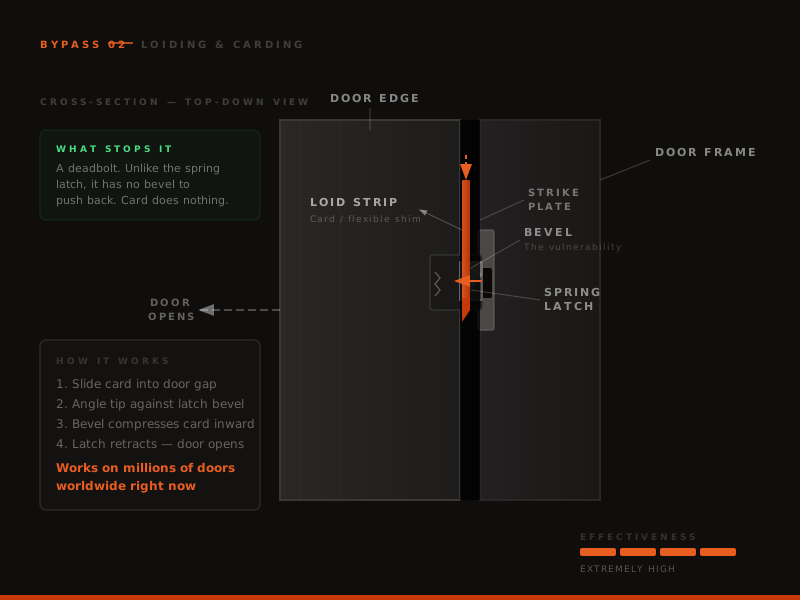
This is not a lock being defeated
Worth being precise, because it changes what you should buy. Loiding does not attack the lock. There is no picking, no manipulation of pins, no interaction with the keyway at all. The cylinder could be the most secure in the world and it would make no difference, in the same way that shimming a padlock ignores the keyway entirely and attacks the shackle instead.
What is being attacked is a spring. That is the mechanism. That is the whole security model of a latch bolt on its own.
Your latch probably has a bodyguard. It is probably asleep.
Lock manufacturers solved this decades ago, and the solution ships on most decent entry hardware sold today. It is called a deadlatch, or a deadlocking plunger, and if you open your door and look at the latch you may be able to see it right now.
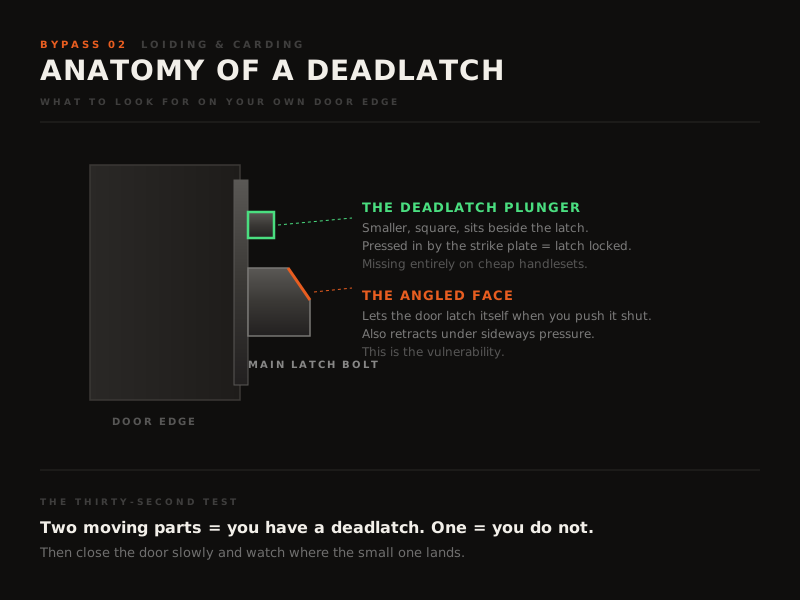
Beside the main angled latch there is a second, smaller piece — usually a squared-off pin or a flat bar, sitting flush against the latch. That is the deadlatch. When the door is closed, that plunger is supposed to be pressed in by the flat face of the strike plate. While it is held in, it mechanically blocks the main latch from retracting. Push a card against the ramp and nothing moves.
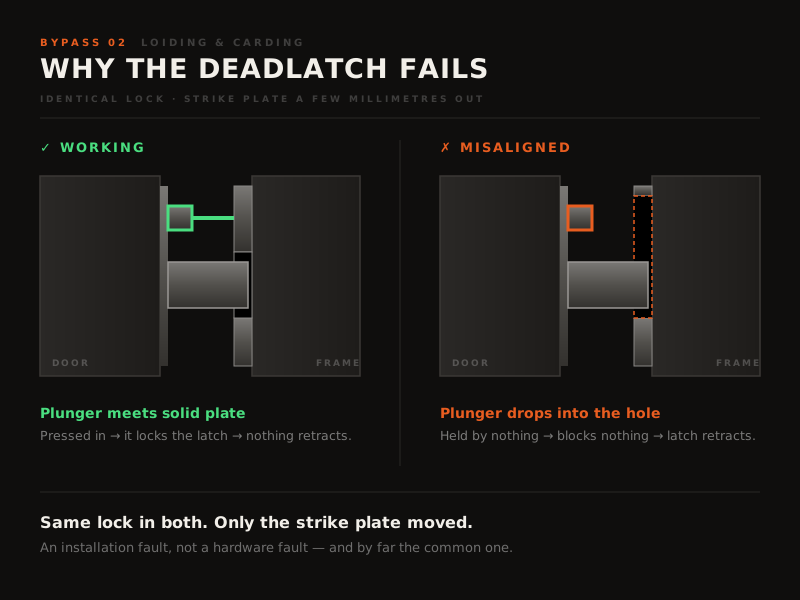
The deadlatch only works if it lands on the plate. If the strike plate is misaligned, or the hole cut into the frame is oversized, the plunger drops into the hole alongside the latch instead of resting on metal. It is then held in by nothing, blocks nothing, and the door is as vulnerable as if the part did not exist.
This is the failure mode we see most often, and it is almost always an installation problem rather than a hardware one. The lock is fine. The lock is doing its job. It was fitted three millimetres off and has been quietly useless ever since.
Check your own door in thirty seconds
This is the part actually worth your time. You do not need tools and you do not need to test the attack on yourself — you just need to look at two things.
First, open the door and look at the latch edge. Count the moving parts. If you see one angled latch and nothing else, you have no deadlatch at all. That is common on interior passage sets, and distressingly common on cheap exterior handlesets. If you see the angled latch plus a smaller pin or bar beside it, you have one, and it is worth checking whether it is doing anything.
Second, close the door slowly and watch where that pin lands. This is the whole test. Press the pin in with your thumb while the door is open and you will feel it move independently of the main latch. Now close the door and look through the gap, or open it a crack and inspect. If the pin is resting on the face of the strike plate, held in, the deadlatch is working. If it has dropped into the strike hole alongside the latch, it is not.
A misaligned strike plate is one of the cheapest fixes in home security. It is usually two screws, a small adjustment, and occasionally a new plate. No locksmith required, no new lock required.
While the door is open, look at the gap too. A wide, sloppy gap between door and frame gives far more room to work with than a tight one, and it tends to travel with other problems — a frame that has shifted, weatherstripping that has compressed, a door that has sagged on its hinges.
Which doors are actually at risk
In rough order of how often we run into them:
Doors secured by the handle alone. Apartment interiors, garage-to-house doors, offices, back doors that "nobody uses." These are the ones that matter, because the latch is the entire security of the opening. A great many rental units are exactly this.
Anything where the deadbolt exists but nobody throws it. Worth saying plainly, because it is the most common version of this problem by a wide margin. A deadbolt that is not thrown is a decoration. If you pull the door shut behind you and only the handle catches, you have a latch-only door regardless of what hardware is fitted above it.
Outward-opening doors shift the problem rather than solve it — the latch faces away from the attacker, which helps here, but the hinges are now on the outside, which is its own conversation.
Three fixes, in order of how much they matter
1. A deadbolt, thrown
This ends the conversation. A deadbolt has no angled face and no spring — it is a squared-off bar driven into the frame by the turn of a key or thumbturn, and there is no geometry to exploit. Nothing you slide into the gap will retract it, because there is no ramp for pressure to act on.
If a door only has a handle, adding a deadbolt is the fix, and it is not an expensive one. We went through eighteen of them in our 2026 deadbolt testing; for most homes the Schlage B60N is the sensible answer and costs less than a takeaway.
2. A correctly aligned deadlatch
If you already have the part and it is landing in the hole, fixing the alignment restores protection you already paid for. Shim the plate, reposition it, or fit a plate with a smaller opening. This is a genuinely worthwhile hour.
3. Closing the gap
Latch guards, security astragals and strike plate upgrades all work by removing the access the attack needs. They are a reasonable supplement, particularly on outward-facing commercial doors. They are not a substitute for the first two.
The complete fix. No angled face, no spring, nothing for lateral pressure to act on. If a door has only a handle, this is the single purchase that matters — see our deadbolt testing for what survived.
If your deadlatch is landing in the hole instead of on the plate, repositioning the strike restores protection you already paid for. Two screws and twenty minutes. Costs nothing and fixes the most common version of this problem.
A metal plate covering the gap so there is nothing to reach through. Genuinely useful on outward-opening and commercial doors. A supplement to the two above, not a replacement for them.
A deadbolt stops this attack completely, and then the frame becomes the weak point instead. Reinforcing the strike area is the natural next step — we covered that in door frame reinforcement.
The short version
Loiding is not a lock-picking skill and it is not exotic. It exploits a design compromise that every spring latch makes in exchange for the convenience of a door that latches itself. The compromise is fine. What is not fine is a door where the part meant to compensate for it was never fitted, or was fitted badly and has been decorative ever since.
Three things, then. Look at your latch and find out whether you have a deadlatch. Close the door slowly and find out whether it lands on the plate. And if the door matters, put a deadbolt on it and actually throw the thing.
That last one is free, and it defeats this attack more completely than any amount of hardware you can buy. Most of what determines whether a door gets tried at all comes down to what a person can see from the street — which is a whole separate piece, and arguably the more useful one.
Next in this series: under-door tools, which open handle-locked doors from the outside without touching the lock at all. Back to all bypass techniques.