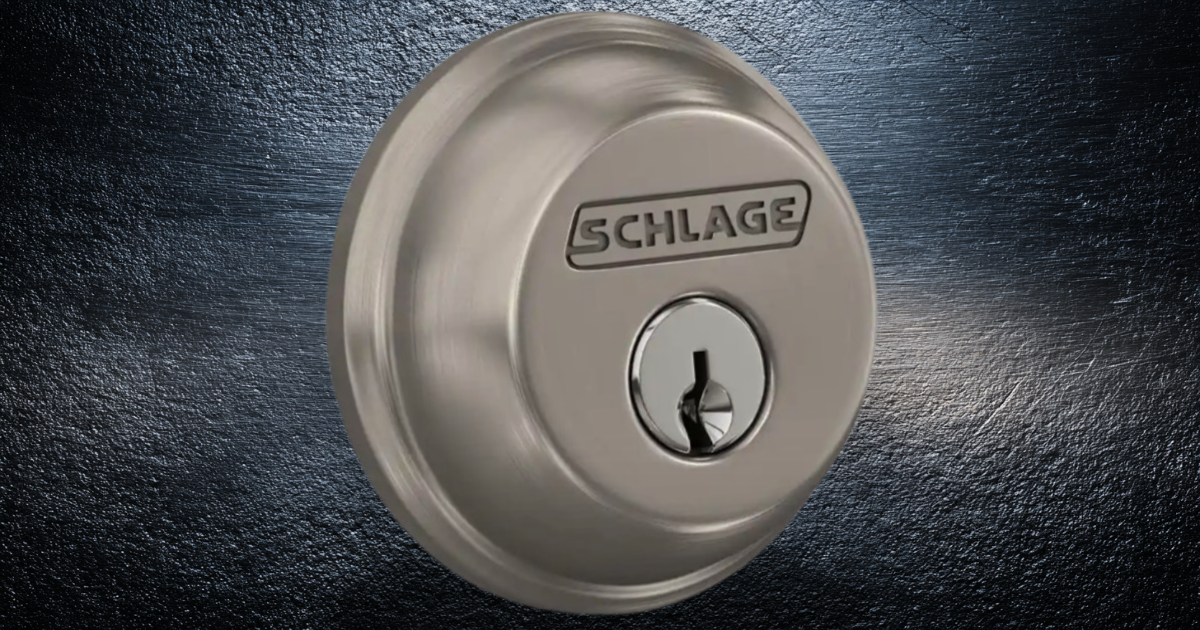
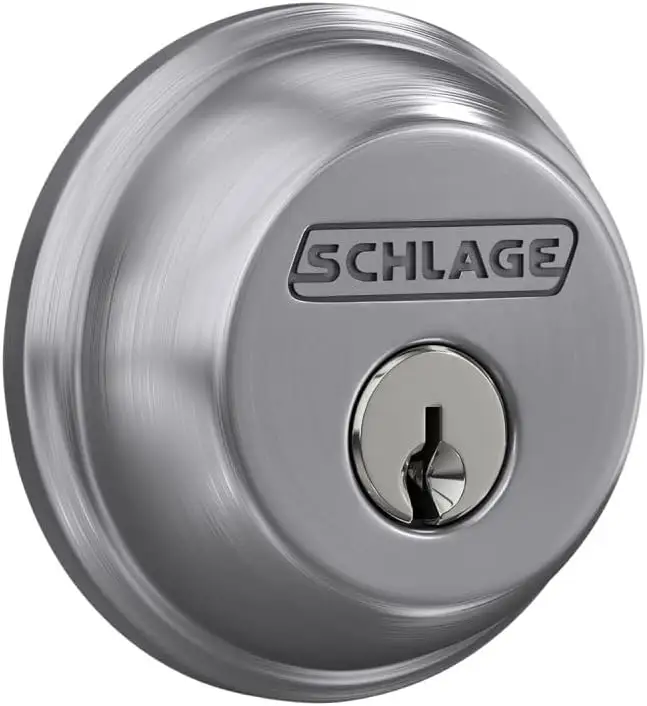
Schlage B60N: The Best Thing In The Box Is The Strike Plate.
Everyone reviews this lock on the cylinder, which is its weakest half. Almost nobody mentions that Schlage ships a frame reinforcer and three-inch screws in the carton — the exact upgrade that fixes the failure most residential doors actually suffer. It's a two-dollar stamping and it's the reason to buy this deadbolt.
By Johnny T.·March 2026·12 min read
Some links on this page are affiliate links — we may earn a commission.
Researched — not tested
Everything below comes from manufacturer specification sheets, the ANSI/BHMA standards this lock is certified against, retailer listings, and locksport consensus. I do not own a B60N and have not had one in my hands. Where that limits what I can say, the page says so. Where that limits what we can say, the page says so.
The verdict
7.5/10
Buy it, and don't throw away the metal plate. The B60N is a genuinely good piece of hardware sold slightly dishonestly. The bolt is excellent — full one-inch throw, oversized diameter, a hardened steel roller inside the zinc to defeat sawing. The strike reinforcer with 76 mm screws is the single best-value component in mass-market residential security, and it's included free.
The cylinder is the ordinary part: five pins in a Schlage C keyway, which is a standard practice lock for anyone learning to pick. Schlage's "anti-pick shield" does not mean what buyers think it means. And the retail listings for this SKU contradict each other on grade, on bolt throw, and on which standard it's certified to — one major listing still cites a standard that stopped covering deadbolts in 2008.
Bolt & strike hardware9
Frame reinforcement included10
Cylinder & key control5
Value for money9
Honesty of the marketing4
How to read this review
Every claim carries a tag saying where it came from. Nothing here is presented as hands-on that isn't.
TestedPhysically in hand. Nothing on this page carries this tag.
DocumentedVerified in a published standard, spec sheet or primary source. Linked at the bottom.
ManufacturerSchlage's own claim. Treated as a claim, not a fact.
CommunityLocksmith and locksport consensus. Informed opinion.
VerifySources disagree and we could not settle it. Flagged rather than picked.
The one-line version
The cylinder is average, the bolt is very good, and the free steel plate at the bottom of the box is worth more than both.
Chapter 1
The Part In The Bag
Why the cheapest component is the reason to buy this lock
Open a B60N carton and you get the lock, two keys, three latch plates, a strike — and a separate steel plate that Schlage calls a strike reinforcer, packed with 76 mm (3-inch) screws.Manufacturer Schlage's own description says the screws are there to anchor through the jamb and into the wall stud against kick-in attacks. Documented
If you've read our door frame guide, you know why that matters more than everything else in the box. ASTM F476, the standard that measures door assemblies rather than locks, defines a jamb failure as the strike screws pulling out or the jamb splitting at the strike. Documented A standard deadbolt is fixed with screws around 3/4 inch long, every bit of which is held in one thin softwood board that is not attached to the structure of the house. Three-inch screws cross the shim gap behind the jamb and land in the king stud.
So the highest-value item in a $40 lock carton costs Schlage roughly the price of a coffee, and it is the only mass-market residential deadbolt package we're aware of that ships the fix as standard.
The part that annoys me
Schlage does not tell you this is the important bit. The reinforcer appears in the instructions as one more step in a sequence, alongside choosing a latch plate and lining up a faceplate. There is no line saying this plate and these screws are what stops the door being kicked in; the rest of what you paid for is what stops the door being opened with a key.
Those are two completely different threats, and the marketing copy blends them into one sentence about protection against crowbar, hammer, wrench, saw, lock pick and kick-in — as though the cylinder and the strike were defending against the same thing. They aren't, and the strike is doing far more work.
The practical consequence is predictable: search any retailer's photo gallery for this lock and you'll find customer install shots with the flat strike fitted and the reinforcer nowhere in sight.
One caveat worth stating, because we hold other pages to it. Fitting the reinforcer means driving 3-inch screws into the framing around your door. That's the same job, and the same risks, covered in the guide: pilot-drill every hole, and stop immediately if a screw meets something that isn't wood. Electrical cable runs near door openings, and the code that governs its depth assumes nobody drives a fastener that long.
Chapter 2
"Grade 1" Means Two Different Things
And one big listing is citing a standard that expired for this product class
The B60N carries two certifications, on two different scales, from two different standards. Distributor spec sheets list both: Documented
ANSI/BHMA A156.36-2016 — Commercial Grade 1. A156.36 covers auxiliary locks, which is the category deadbolts sit in. Grade 1 is the top of a three-step scale, and it's the number everyone quotes.
ANSI/BHMA A156.40-2015 — Residential Grade AAA. A156.40 is the separate residential deadbolt and deadlatch standard, and it uses a three-letter rating covering security, durability and finish as three independent scores. AAA is top marks in all three.
Nobody explains this on a product page, so here's the plain version: Grade 1 and AAA are not the same claim. Grade 1 is a single pass/fail level on the commercial scale. AAA is three separate grades reported together on the residential scale, and the middle letter — durability — is a cycle count, not a security measure. A lock can post a high letter there by simply lasting a long time.
Both are lab tests of the lock in a test fixture. Neither one puts your jamb, your screws or the wall behind your door in scope. That is exactly the gap we've written about at length, and the reason a Grade 1 deadbolt on an unreinforced frame is a Grade 1 lock on an ungraded door.
The listing mess
While checking the grade, the same single SKU turned up described four different ways across major retail and distributor listings: Sources disagree
Spec
What most sources say
What at least one listing says
Grade
ANSI Grade 1
"Grade 2 Deadbolt" in the product title — with "ANSI Grade 1" in its own body text
Bolt throw
1 in.
9/16 in.
Certified to
A156.36-2016 and A156.40-2015
"ANSI/BHMA Certified A156.5-2001"
Keyway
Schlage C
SC1 — the aftermarket blank designation for the same keyway, not a different lock
The last two are worth dwelling on. A156.5 has not covered deadbolts since 2008, when BHMA moved auxiliary locking products out of it into the new A156.36. Documented A listing citing A156.5-2001 for a deadbolt in 2026 is quoting a standard that was superseded for this product class eighteen years ago.
And the 9/16-inch throw figure is almost certainly a spec-sheet error — but it's a striking one, because 9/16 in. happens to be precisely the minimum bolt projection ASTM F476 requires at its two lowest grades. Documented Someone somewhere appears to have copied a floor value into a product spec.
None of this makes the B60N a bad lock. It does mean that if you're comparison-shopping deadbolts by reading listings, you are reading unreliable data — which is a large part of why our deadbolt roundup works from manufacturer documentation rather than retail pages.
Chapter 3
The Bolt Is The Good Half
One inch of throw, and where the other half inch lives
Three specifications on the bolt are genuinely above average, and they're all measurable rather than adjectival: Documented
Full 1-inch throw. The bolt projects a full inch past the door edge. Against the jamb-spreading attack — force the two jambs apart until the bolt clears its pocket — throw length is the specification that matters, because it sets how far the frame has to move before the bolt is free.
Half an inch retained in the housing at full throw. Schlage publishes this, and it's an unusually honest number to publish. It means the bolt is supported at both ends under load rather than cantilevered out of the door edge.
Solid zinc bolt with a hardened steel pin inside that spins. A saw blade meeting a free-spinning hardened roller can't get a bite. This is a real anti-saw measure and it's not universal at this price. Manufacturer
Fig. 03
B60N bolt at full throw — plan section
SECTION · NOT TO SCALE
1Half an inch of bolt retained inside the housing at full throw. Supported at both ends, not cantilevered.
2One inch of projection. This is the number that matters against jamb spreading.
3Hardened steel roller pin inside the zinc bolt. Spins under a saw blade so the teeth can't bite.
4Door-to-jamb clearance. Where a pry bar and a shim both go to work.
5The reinforcer plate and its 76 mm screws, crossing the shim gap into the king stud.
6Bolt pocket cut through strike, reinforcer and jamb board — the mortise the whole assembly depends on.
Dimensions from Schlage published specification for the B60N. Bolt geometry is representative; we have not sectioned one.
Worth being precise about what throw does and doesn't buy. It is a strong defence against spreading and prying. It does nothing against a kick, because a kick doesn't move the bolt — it breaks the wood the bolt is sitting in. That is the reinforcer's job, and it's why the two components in this box are complements rather than alternatives.
Chapter 4
The Cylinder Is The Ordinary Half
Five pins, a famous keyway, and a shield that doesn't do what you think
The standard B60N ships with a five-pin cylinder in the Schlage C keyway, two keys per lock. Documented That is the most common residential cylinder in North America, and its ubiquity cuts both ways.
On the good side: keys are cut everywhere, rekeying is trivial for any locksmith, and the C keyway accepts Schlage's Everest and Primus upgrade cylinders if you ever want restricted key control on the same door.
On the honest side: a five-pin Schlage C is one of the standard locks people learn to pick on. It's a fixture of beginner sets and belt-ranking discussions, and the community treats it as an entry-level rather than a challenge target. Community It is also a well-known bump-key target, for the ordinary reason that a five-pin standard-keyway cylinder is exactly what bump keys are made for — the mechanism is covered here.
What "anti-pick shield" actually is
This deserves unpicking, because the phrase does a lot of work in the marketing and almost none of what buyers assume.
Schlage describes the anti-pick shield as an integrated metal shield surrounding the latch that stops attempts to bypass the deadbolt mechanism, and elsewhere as protection against manipulation of the cylinder driver through the door. Manufacturer That is a real and useful feature — it defends the space between the cylinder and the bolt against someone drilling or fishing at the connection.
It is not pick resistance in the cylinder. Picking happens inside the plug, against the pin stacks, with a tension wrench and a pick in the keyway. A shield around the latch is on the wrong side of the lock to affect that at all. Two different attacks, one marketing phrase covering both.
"It's pick and bump resistant — it says so on the box."
The features that earn that phrasing are the shield, the free-spinning collar and the hardened bolt insert, which resist manipulation through the door, wrenching, and sawing respectively. They are all genuine. None of them changes what a pick feels inside a five-pin C-keyway plug. If you want meaningful pick resistance from Schlage, the path is a Primus or Everest cylinder, not this one.
VerdictTrue of the lock body. Not true of the cylinder, which is where "picking" happens.
Two things you can do about it, neither widely known:
The six-pin option exists. Schlage lists an N6-5 cylinder variant — six-pin, still keyed to five — and the B560 is specified with a six-pin cylinder on request. Documented Neither is what you get off a big-box shelf, and no retail listing we found flags the difference.
Rekeying to security pins. Any locksmith can pin a C-keyway cylinder with spools or serrated drivers for the price of a callout. It's the cheapest genuine security upgrade available to this lock, and it's never mentioned on a product page.
The broader point, and the reason the score above isn't lower: for a residential front door, picking is not the threat you're defending against. It's slow, it requires practice, and every dataset on forced entry puts manipulation far behind prying and forcing. An average cylinder on a well-anchored frame is a better door than an excellent cylinder on a jamb held by two short screws.
Chapter 5
Where This Review Came From
Four evidence streams, including the two that came up short
Every review on this site is built by working four sources and reporting what each one yielded — including when the answer is nothing. Publishing the empty rows is the point; a table with four confident rows and no gaps is a table someone filled in from imagination.
Tab. 01
Evidence synthesis — Schlage B60N
Stream
What we did
What it yielded
Documentation teardown
Read the Schlage residential specification, the B-series distributor sheets, and the two ANSI/BHMA standards this SKU is certified against.
The strongest stream by a distance. Bolt geometry, retained length, dual certification, cylinder pinning, fire rating and the 76 mm reinforcer screws are all published figures.
STRONG — every number in this review
Standards cross-check
Checked the cited certifications against what those standards actually cover, and against ASTM F476's assembly-level requirements.
Turned up the finding in Chapter 2 — a live retail listing citing A156.5 for a deadbolt, a class that standard stopped covering in 2008. Also confirmed the 9/16 in. throw figure matches an F476 floor value.
STRONG — the original finding on this page
Failure-mode mining
Attempted to categorise low-star reviews across retailers to produce a counted breakdown of complaints, the way we do elsewhere.
Abandoned. The corpus is unusable for this purpose — see Chapter 6. We are not publishing a percentage we can't stand behind.
FAILED — reported, not faked
Documented pick logs
Looked for recorded openings of this specific model with picker, tool, technique and time logged.
Nothing model-specific and rigorous enough to log. Plenty exists on five-pin Schlage C cylinders generally, which is why the cylinder assessment is tagged Community rather than Documented.
THIN — no per-model timings
Two of four streams produced usable evidence. That ratio is normal and we'd rather show it than pad the table.
Chapter 6
Why There's No Failure-Mode Table
What the 4.8-star rating on this lock is actually made of
On other reviews we read a few hundred one- and two-star reviews, categorise the complaints and publish counts. It's slow, and it's the most useful thing a review site can do, because failure modes cluster and the clusters tell you what actually goes wrong in service.
That method broke on this product, and the reason is worth publishing.
Work through the customer reviews for B60N listings across major retailers and a pattern shows up fast. A large share of the visible reviews — including a majority of those surfaced first — carry the disclosure "This review was collected as part of a promotion" and are attributed to schlage.com rather than the retailer. Documented They are manufacturer-collected reviews, syndicated into retail listings.
Read a run of them and the character is unmistakable. They are about packaging, finish, colour matching and how easy the install was. Several praise the strike plate's long screws. Almost none describe the lock after a year of weather, or a key that stopped turning, or a thumbturn that went loose.
This is not an accusation of fakery
Promotional-collection programmes are disclosed, legal and common. Reviewers are typically given a product and asked for an honest opinion, and most of these read as sincere. The problem isn't dishonesty — it's selection. A corpus gathered by asking recipients of a free lock to comment shortly after installing it will over-represent first impressions and under-represent long-term failure, no matter how honest each individual review is.
Which means the aggregate star rating on this product is measuring something real, just not the thing you're trying to find out.
So the honest output is: we do not have failure-mode data for the B60N, and neither does anyone quoting its star rating at you. If you own one that has been on an exterior door for several winters, that is genuinely more useful than anything on this page — tell us what went wrong and we'll build the section properly and credit you.
What we learned instead
A 4.8-star average assembled largely from promotional first-impression reviews is a measure of unboxing, not of service life.
Chapter 7
Against The Alternatives
And who should buy something else
Lock
Cylinder
Throw
Frame reinforcer in box
Where it wins
Schlage B60N
5-pin Schlage C
1 in.
Yes — 76 mm screws
The default. Best hardware-per-dollar on a normal front door.
Schlage B560 / N6-5 option
6-pin available
1 in.
Yes
Same lock, better cylinder, if you can find it specified.
Same mechanical platform with codes and logging bolted on.
Buy it if
You want one deadbolt for a normal exterior door and you don't want to think about it again.
Your current strike is fixed with short screws — you're getting the lock and the frame fix in one purchase.
You need doors keyed alike; the C keyway makes that easy and cheap.
You may want restricted keys later. The upgrade path within Schlage is real.
Buy something else if
You specifically want pick and bump resistance. Five pins in a standard keyway is not that, whatever the box says. Look at a Primus or Everest cylinder, or a different platform entirely — our deadbolt roundup covers the high-security end.
Your door is a fire-rated apartment or condo door. Check the label before you change anything; adding unlisted hardware to a rated assembly isn't permitted. Note that B60, B80 and B81 are available UL listed for 3-hour fire doors — availability is not the same as your specific unit being listed. Documented
Your frame is already reinforced. Then you're paying for the reinforcer twice, and the cylinder becomes the thing you're actually buying — at which point spend more on the cylinder.
Questions
The Ones People Actually Ask
Short answers
Is the Schlage B60N actually Grade 1?
Yes, on two scales: ANSI/BHMA A156.36-2016 Commercial Grade 1 and A156.40-2015 Residential Grade AAA. Some retail listings say Grade 2 in the title while saying Grade 1 in the body — those are listing errors, not different products. Both certifications test the lock in a fixture, not your door frame.
What's the difference between the B60N and the B60?
The N is a cylinder and keying designation rather than a different lock body — the standard N cylinder is 5-pin, keyed 5-pin, C keyway, keyed alike in groups. Listings use B60 and B60N interchangeably, which is part of why the specs across retailers are inconsistent.
Can I use the 3-inch screws on my old strike plate instead?
Yes, and if you're not replacing the lock today, that's the single cheapest security upgrade available to you. The reinforcer plate spreads the load better than a flat strike, but the screws are doing most of the work. Full method in the door frame guide.
Does it come keyed alike with other Schlage locks?
It can be. The standard listing is keyed alike in groups of four, and it may be keyed to match Schlage FE-series keypad locks. If you want a whole house on one key, buy the set together or have a locksmith rekey them — the C keyway makes this cheap.
How pickable is it, really?
A standard five-pin Schlage C cylinder is a commonly used practice lock, not a challenge lock. We don't have logged per-model timings for the B60N specifically, which is why that assessment is tagged as community consensus rather than documented. Also worth keeping in proportion: picking is a slow, skilled attack that barely features in forced-entry data.
Single cylinder or double cylinder?
Single, in almost every case. A double-cylinder deadbolt needs a key to exit, which is a serious hazard in a fire and is restricted or prohibited in many jurisdictions. Consider it only where there's glass within reach of the thumbturn, and check your local code first — the better answer to that problem is usually laminated glazing.
Specification
Model
B60N single cylinder deadbolt, B-Series (residential)
1 in. throw; 1 in. × 2-1/4 in. radius corner; 1 in. housing diameter; approx. 1/2 in. retained in housing at full throw; solid zinc with hardened steel spinning insert
Strike
1-1/8 in. × 2-3/4 in.; supplied with strike reinforcer and 76 mm (3 in.) screws
Cylinder
5-pin, Schlage C keyway, two keys per lock. Optional N6-5 six-pin variant
Backset
Adjustable 2-3/8 in. or 2-3/4 in.
Bore
Cross bore 1-1/2 in. or 2-1/8 in.; edge bore 1 in.
Door thickness
1-3/8 in. to 1-3/4 in. standard; optional up to 2-1/4 in.
Fire rating
Available UL listed for 3-hour fire doors (B60, B80, B81). Verify the specific unit
Warranty
Limited lifetime mechanical and finish (residential)
Street price
Roughly $33–$52 depending on finish and retailer
Where to buy
Schlage B60N Single Cylinder Deadbolt
~$33–52 USD
Check the carton for the strike reinforcer and the long screws before you leave the shop — that's the component this whole review turns on, and it's the one nobody photographs.
Finish choice affects price more than anything mechanical. The lock is identical underneath.
Amazon USAlso stocked by every major hardware retailer
The Bottom Line
Good Lock, Better Strike Plate
The B60N is the deadbolt most people should buy, and almost every reason given for that on other sites is the wrong reason. It isn't the cylinder — that's ordinary, and the packaging is doing some work to imply otherwise. It's that Schlage put a proper bolt and a frame reinforcement kit in a forty-dollar box and then declined to explain which one was doing the heavy lifting.
If you buy one, fit the reinforcer. If you don't buy one, buy the screws anyway. And if you want the lock to be genuinely hard to open with a pick as well as hard to kick, budget another visit from a locksmith to pin the cylinder properly — it's the cheapest upgrade nobody sells you.
Verdict — 7.5 / 10
Excellent hardware, average cylinder, and the most undersold component in residential security sitting in a plastic bag at the bottom of the carton.
Sources & Method
Product specification — bolt, strike, reinforcer, cylinder, backset, bore, fire listing — Documented
Schlage published specification for the B60N and B-Series residential deadbolts, as reproduced on distributor specification pages including
R&H Security Hardware and
Hardware Hut.
Source of the 1 in. throw, latch and strike part numbers, 5-pin C keyway, N6-5 option, adjustable backset, and the strike reinforcer with 3 in. screws.
Dual certification: A156.36-2016 Grade 1 and A156.40-2015 Grade AAA — Documented
Stated on distributor specification listings for this SKU. ANSI/BHMA A156.36 covers auxiliary locks; A156.40 covers residential deadbolts and deadlatches and reports security, durability and finish as three separate letter grades. Standards published by the
Builders Hardware Manufacturers Association.
A156.5 no longer covers deadbolts — Documented
ANSI/BHMA A156.5 foreword: in 2008 the auxiliary locking products were removed from A156.5 and placed in the new dedicated standard A156.36. A retail listing citing "A156.5-2001" for this deadbolt is therefore quoting a superseded scope.
A156.5-2014 front matter (PDF)
Assembly-level requirements and the 9/16 in. figure — Documented
ASTM F476-84 (Reapproved 2002), Standard Test Methods for Security of Swinging Door Assemblies, §X5.2.6: minimum bolt projection of 14.3 mm (9/16 in.) for Grades 10 and 20. Also the source of the jamb/strike failure definition cited in Chapter 1.
Full text ·
background in our door frame guide.
Retail listing inconsistencies — Sources disagree
Observed across live listings in August 2026: the same SKU described as Grade 2 in a product title and Grade 1 in the same page's body; bolt throw given as both 1 in. and 9/16 in.; certification given as both A156.36/A156.40 and A156.5-2001. We have taken Schlage's own specification as authoritative and flagged the rest rather than silently picking one.
Promotional review collection — Documented
Customer reviews syndicated into major retail listings for this product carry the disclosure that they were collected as part of a promotion and are attributed to schlage.com. Observed directly on live listings, August 2026. This is a disclosed and lawful practice; the limitation we describe is one of sampling, not of honesty.
Cylinder difficulty and bump vulnerability — Community
Locksport and locksmith consensus on five-pin standard-keyway residential cylinders. We have no logged per-model opening times for the B60N and have not picked one. If you have documented attempts with picker, tool, technique and time, send them and we'll build the log.
Anti-pick shield function — Manufacturer
Schlage marketing describes an integrated metal shield around the latch, protecting against manipulation of the cylinder driver through the door. Our reading of what that does and does not cover is our own analysis, not Schlage's characterisation.
This is a researched review, not a tested one, and the badge at the top says so. No part of this page describes handling that did not happen. Two of our four evidence streams came up short and Chapter 5 shows which. If you own this lock and have service history on it, that's the missing piece — send it here and you'll be credited.