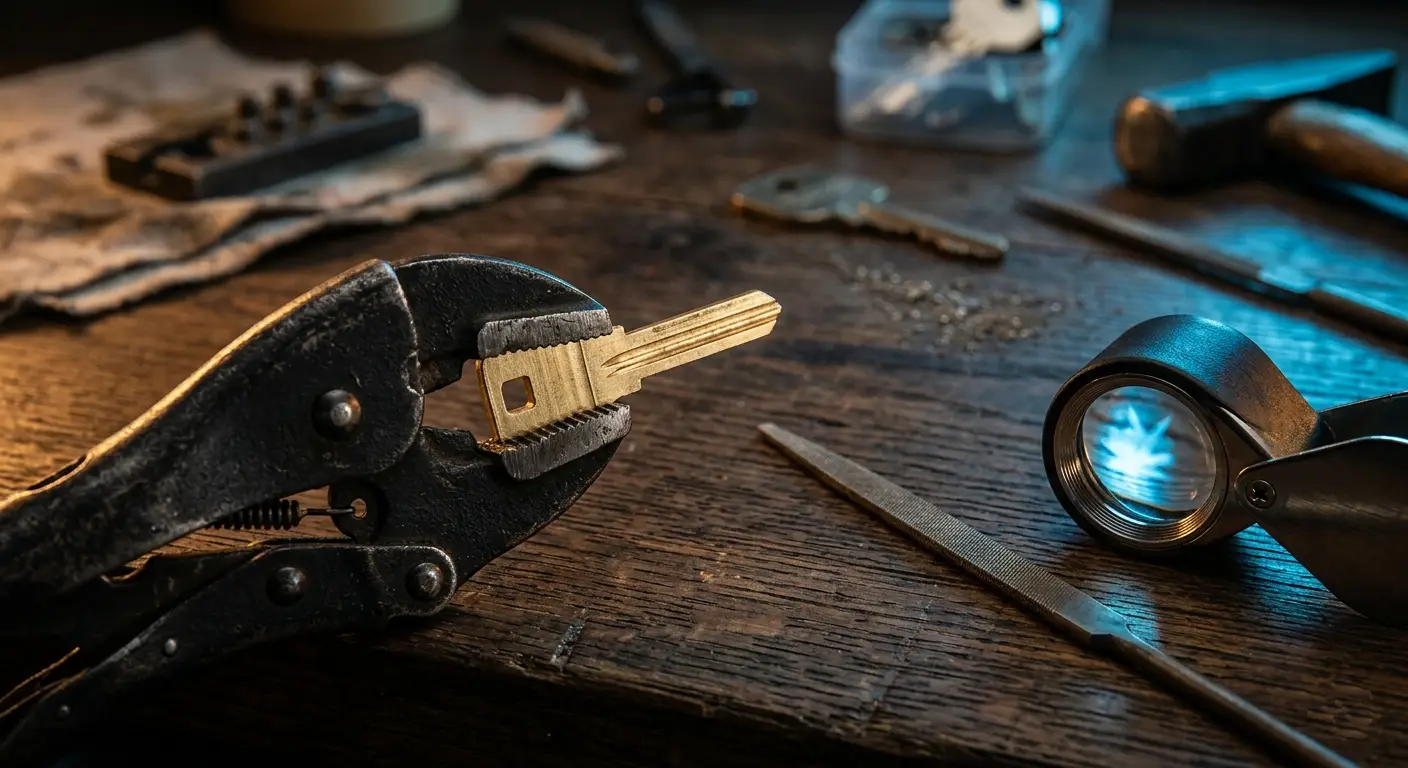
Most people think of lock picking when they imagine someone defeating a lock without the key. Insert some tension, rake some pins, feel for set — it's dramatic, it's well-documented, and it makes for great YouTube content. But picking has a fundamental limitation that almost nobody talks about: when you're done, the lock is closed again and you've got nothing to show for it. You'd have to pick it again next time. Impressioning is different. When you're done impressioning a lock, you're holding a permanent working key. One that works silently, repeatedly, and leaves essentially no forensic trace. And the terrifying part? World-class practitioners can do it in under 90 seconds.
What Impressioning Actually Is
Lock impressioning is the art of creating a working key from a blank — without ever disassembling the lock, without picking it, without any special electronic tools. You insert a soft brass blank that matches the lock's keyway profile, apply firm rotational torque in the opening direction, and rock the key up and down. The pins inside the lock — the ones that aren't sitting at the correct height — bind against the plug's shear line and press into the soft brass surface, leaving microscopic polished marks where they scraped the metal.
You remove the blank, examine it under a 10x jeweler's loupe with bright angled light, identify the tiny shiny spots where bound pins rubbed the brass, and file those spots down with 2–3 light strokes of a Swiss pippin file. Then you re-prepare the surface, insert the blank again, and repeat. Each cycle reveals fewer marks as pins reach their correct heights and stop binding. After 8–15 cycles on a standard 5-pin lock, the plug turns. The lock opens. And you're holding a key that will work on that lock forever.
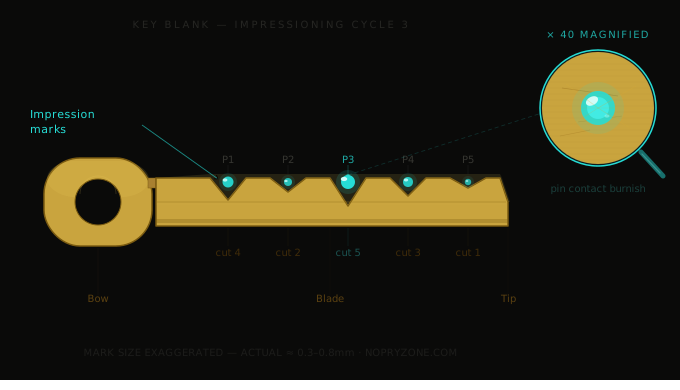
The marks that make it all work — polished spots smaller than a pinhead, visible only under magnification. Each one tells you exactly where to file.
The depth increments you're working with are staggering. Master Lock uses 8 possible cut depths spanning just .015 inches per step — roughly five times the width of a human hair. The total difference between the shallowest and deepest cuts is barely over a tenth of an inch. File three strokes too many at any position and you've overshot the correct depth. There's no way to add material back. The blank is ruined.
Unlike picking, which opens a lock once and must be repeated, impressioning produces a permanent key that works indefinitely. Pick many times — impression once.
How the Technique Works
The technique has one hard requirement: a key blank matching the lock's keyway profile. Wrong profile, wrong pin count, or wrong spacing makes impressioning impossible. Before the first cycle the blade's top surface is prepared to a uniform matte finish — too shiny and marks disappear into the surface; too rough and they're obscured by texture.
The blank goes into the lock and a gripping tool is clamped to its bow for leverage. Firm rotational torque is applied in the opening direction. This is harder than picking tension but not enough to snap the blank. The torque binds the pins that aren't at the correct height, trapping them against the brass surface.
With torque maintained the blank is rocked up and down so the bound pins scrape against the brass, leaving their marks. Some practitioners prefer the "striking" method — tapping the bow with a small mallet — or the "pull-out" method, slightly withdrawing the key under torque so pins drag across the bitting surface. After several seconds of manipulation, you remove the blank and examine it under bright, angled light with magnification.
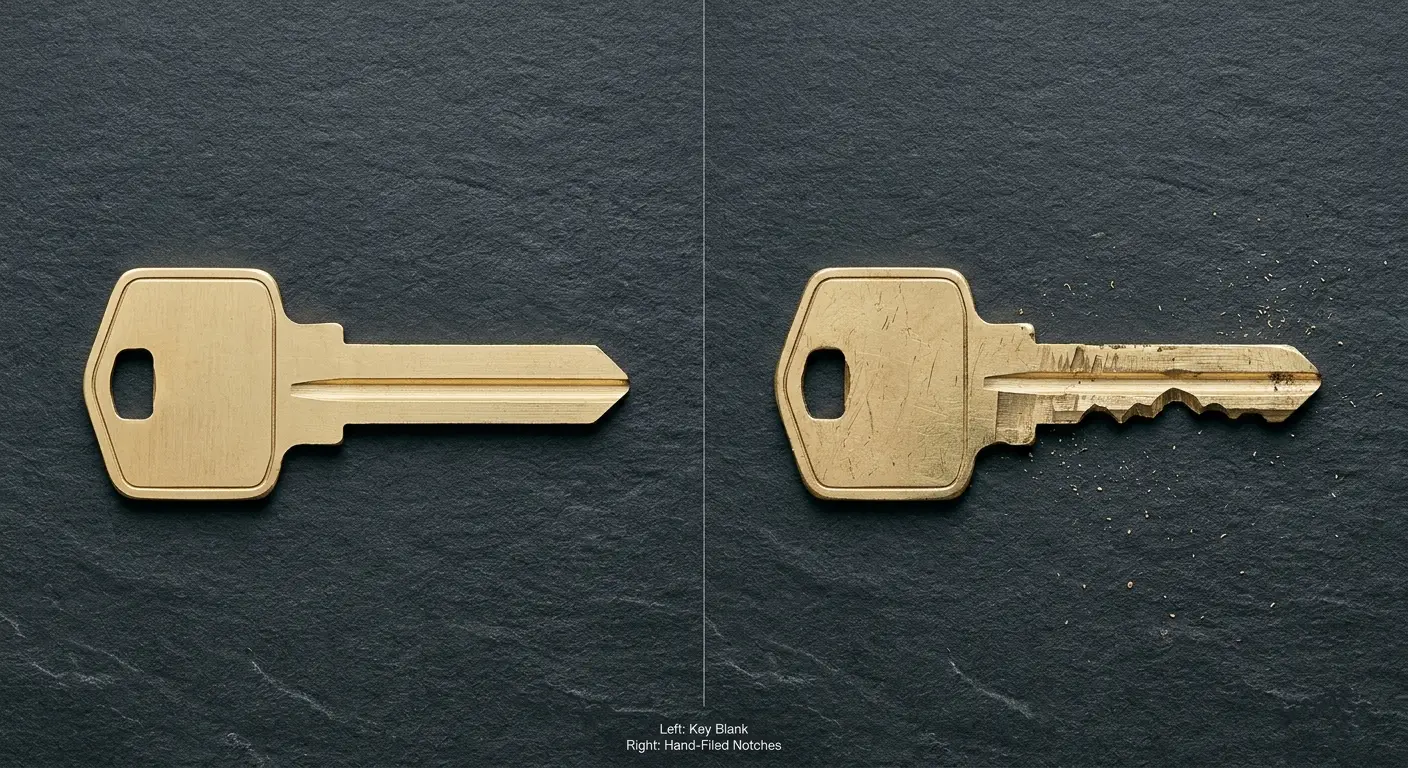
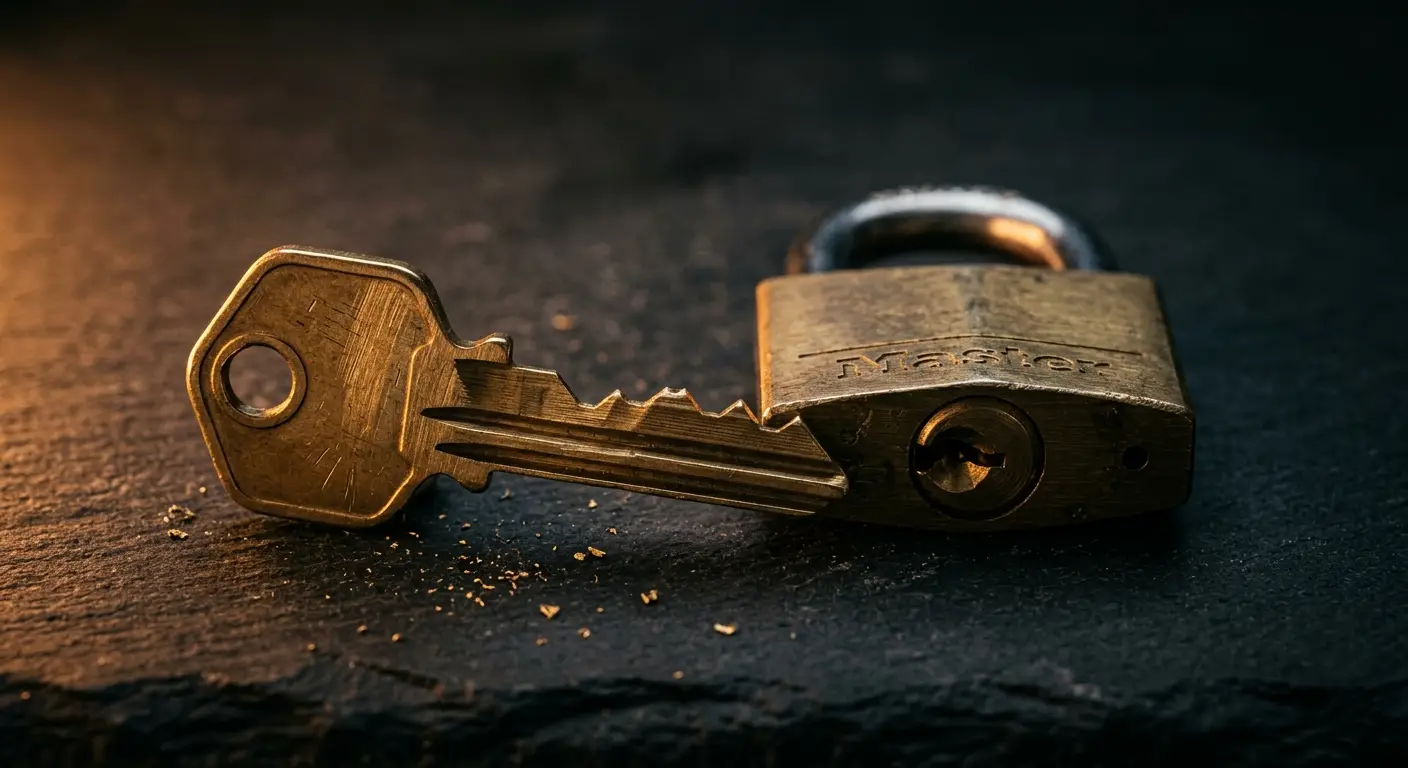
Left: A fresh blank next to a partially impressioned key with cuts developing. Right: The finished product — a working key filed entirely by hand.
Only the marked positions get filed — 2–3 light forward strokes per mark, maximum — using a Swiss #4 cut pippin file. The binding order shifts dynamically: when one pin is filed to the right depth, another pin becomes the new binding pin and begins leaving marks for the first time. This is the beautiful part. The lock is essentially telling you its own combination, one pin at a time, if you know how to listen.
What an Attacker Needs
The file is everything. The universal standard is a 6-inch Swiss #4 cut pippin file, and the specificity is not arbitrary. The #4 Swiss cut removes material slowly and precisely while leaving a very fine, slightly textured surface that's ideal for revealing subsequent marks. Coarser cuts remove material too aggressively; finer cuts leave surfaces too smooth for marks to show. The pippin shape — a teardrop cross-section with one rounded side and two flat sides meeting at a knife edge — allows a single file to both carve smooth valleys mimicking key cuts and shape their sides. Grobet Swiss-made files are the gold standard. A file card is essential because soft brass rapidly clogs the fine teeth.
The key blank must be soft brass — the material marks clearly under pin pressure and files easily. Nickel-silver and steel blanks are too hard to show marks; aluminum marks well but fatigues and cracks under repeated torque. If only nickel-plated brass blanks are available, the plating must be filed off the blade's top surface before starting.
A gripping tool provides the torque control that bare fingers cannot safely deliver. Options range from basic 4-inch vice grips to commercial impressioning handles like the Pro-Lok LT700. For magnification, a 10x jeweler's loupe is the community standard. Bright, angled light is non-negotiable — a focused LED penlight aimed across the blank's surface at a shallow angle makes the polished marks pop against the matte background.
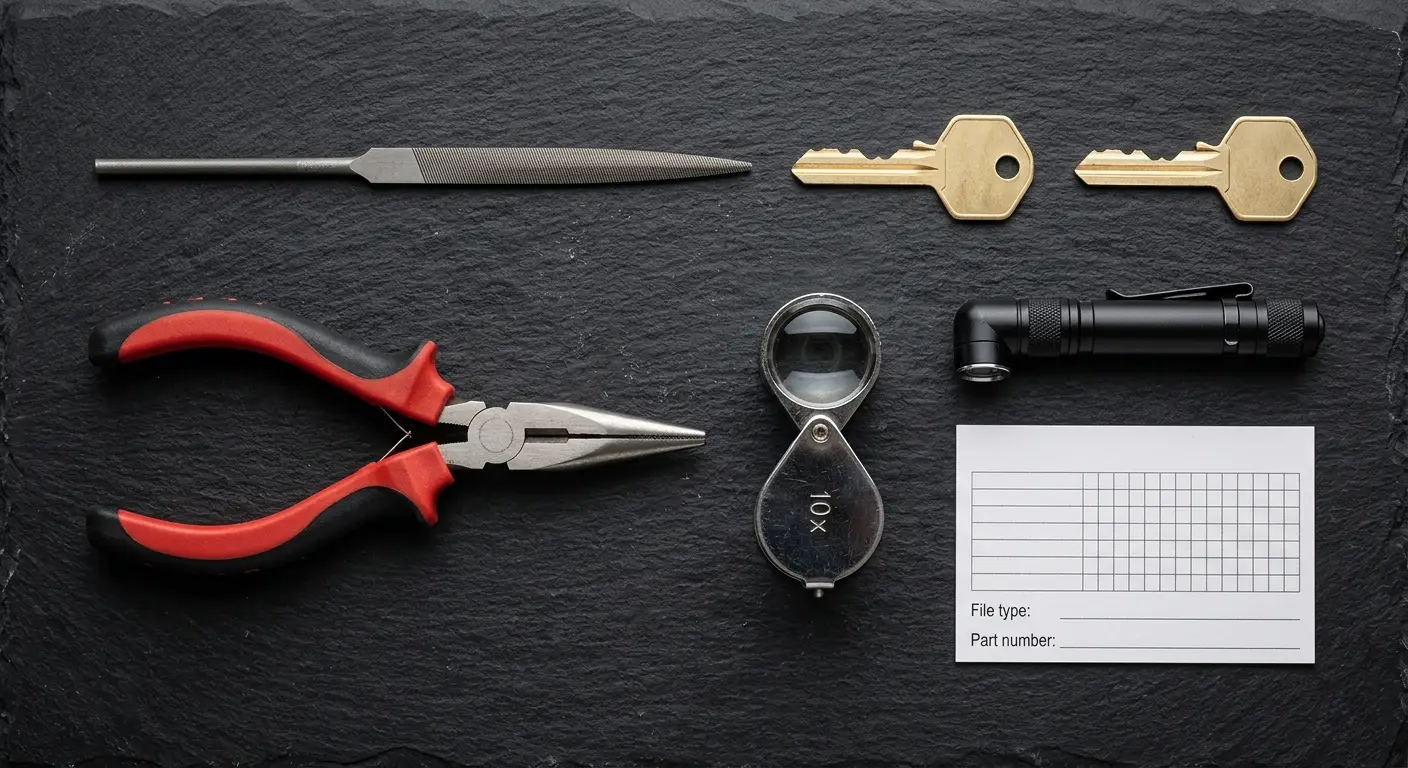
The full kit: Swiss #4 pippin file, brass blanks, gripping handle, 10x loupe, angled LED light, and file card. Total cost under $50.
An optional but powerful preparation technique is knife-edging: filing both sides of the blank's top edge at ~45° angles to thin the contact surface. Practitioners report that knife-edging can make marks from all pins visible where previously only one had been detectable. Some coat the blank surface with permanent marker and look for spots where pins rubbed the ink away, while others apply UV-reactive ink and examine marks under ultraviolet light.
Which Locks Can — and Can't — Be Impressioned
Pin tumbler locks are the primary target, and for good reason: they're the most common lock type in the world, and virtually all standard pin tumbler cylinders are vulnerable to impressioning. Here's the uncomfortable truth for homeowners: anti-picking features like spool pins, serrated pins, and mushroom drivers — the "security pins" that manufacturers advertise — are largely irrelevant to impressioning. They create false sets and slow down pickers, but they do nothing to prevent pins from leaving marks on a brass blank.
A lock marketed as "high security" because it has anti-pick spool pins may resist picking — but can be impressioned just as easily as a basic lock with standard pins. Security pins don't stop impressioning. They stop picking. These are different attacks with different physics.
Wafer and disc tumbler locks (common in automotive and furniture) are actually easier than pin tumblers to impression because the wafers slice clear grooves into the blank. Warded locks are the easiest of all — wards are static obstructions, so a smoked or wax-coated blank instantly reveals contact points without any torque manipulation.
Dimple locks present a different challenge but aren't immune. The most effective approach is foil impressioning: a bump key cut to minimum depth is wrapped in aluminum foil, inserted under torque, and rocked. The foil conforms to pin positions, revealing a map of the lock's bitting. Forensic researchers documented organized criminal groups in Hungary using foil impressioning kits against European dimple cylinders.
Disc detainer locks — such as the Abloy Protec2 we've reviewed — are the most resistant to traditional impressioning. Their rotating-disc mechanism with sidebar engagement produces no useful marks on a blank through conventional methods.
| Lock Type | Impressioning Difficulty | Notes |
|---|---|---|
| Warded | Trivial | Static obstructions — smoked blank reveals all |
| Wafer / Disc Tumbler | Easy | Wafers cut clear grooves into blank |
| Lever | Moderate | Traditional "smoking" techniques work |
| Pin Tumbler (Standard) | Moderate | Primary target — 8–15 cycles typical |
| Pin Tumbler (Security Pins) | Moderate | Security pins don't affect impressioning |
| Dimple | Harder | Foil impressioning is viable |
| Disc Detainer (Abloy) | Extremely Hard | No useful marks produced — most resistant type |
87 Seconds vs. 63 Minutes: The Skill Gap
The performance range in competitive impressioning is staggering. Jos Weyers — the undisputed dominant force in the discipline — holds the competition record at 87 seconds for a 5-pin Abus C83 cylinder. That's roughly 12.5 seconds per pin, or 3.1 seconds per depth increment. At the same 2009 LockCon event where Weyers set that record, one experienced competitor took 63 minutes, and only half the field finished within the hour-long time limit.
When asked about his training method, Jos Weyers was characteristically blunt: "I locked myself in a room with 1,000 blanks and a lock."
— Jos Weyers, multiple-time world impressioning championBeginners typically require 30–60 minutes for a first successful impression. With dedicated practice — at least a few locks per day — practitioners report reaching consistent 10–15 minute times within weeks. Barry Wels, the first non-German to win an SSDeV impressioning championship, estimates it took him about two years of study and 500 keys to reach mastery. But structured instruction compresses the curve dramatically — at a London workshop led by Oliver Diederichsen and Weyers, complete novices were impressioning locks in under 10 minutes by the end of a single day.
The most common beginner mistakes form a predictable pattern. Over-filing is the cardinal sin — once you've removed too much material, the game is over and there's no recovery. Filing marks that aren't actually there (pattern-matching noise instead of signal) is the second pitfall, followed by incorrect torque pressure, failing to properly prepare the blank surface, and neglecting to release torque before removing the blank — which causes catastrophic drag marks that render the blank useless.
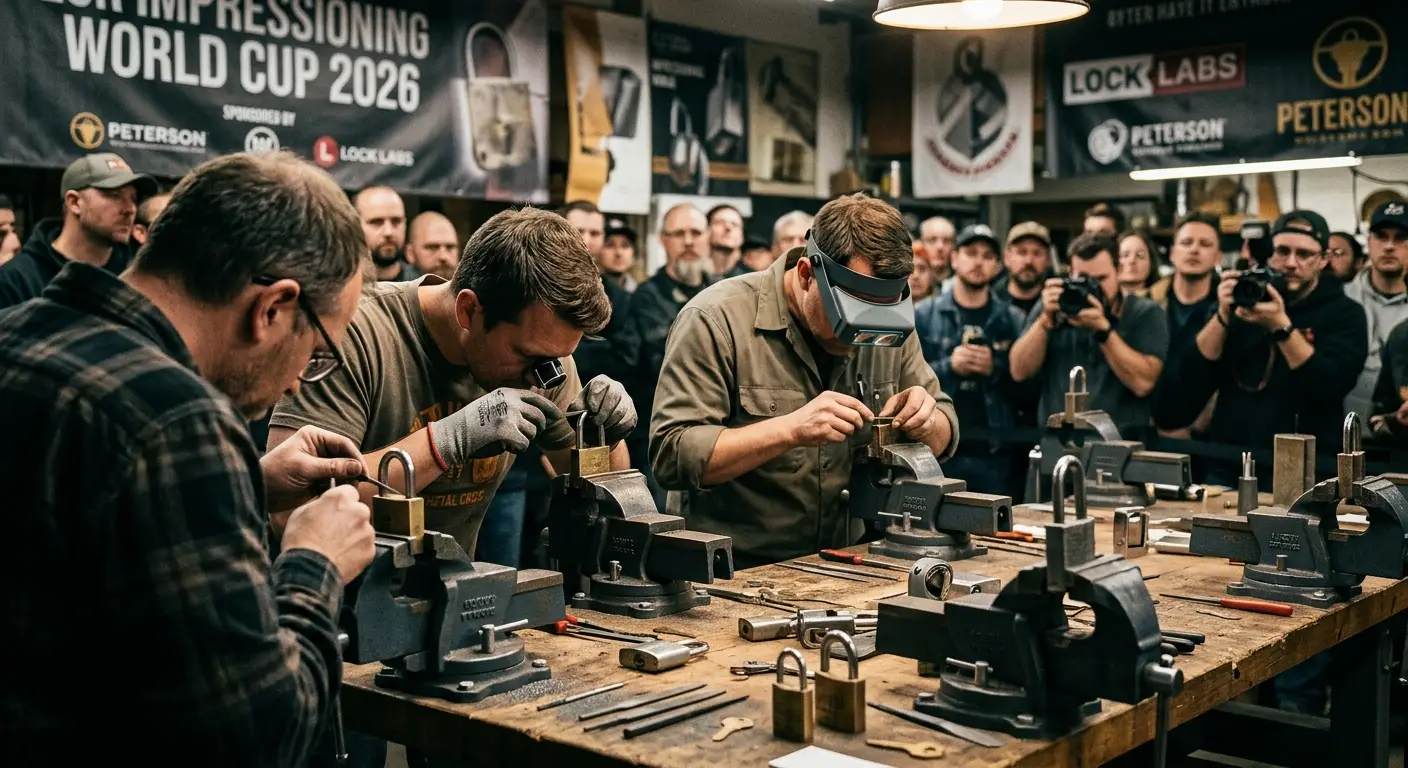
The Dutch Open Impressioning Championship at LockCon — 40 competitors, one hour, and a 5-pin Abus C83 standing between them and the finals.
Inside the Competitive Circuit
Competitive impressioning has its spiritual home at LockCon, the annual conference organized by TOOOL (The Open Organisation Of Lockpickers) in the Netherlands, where the Dutch Open Impressioning championship is a flagship event. The standard competition lock is an Abus C83 5-pin cylinder. In the qualification round, all competitors — 40 at the 2024 event — attempt to impression identical locks within a 60-minute time limit. The 12 fastest advance to finals, where finalists tackle additional locks with 15-minute limits per lock. Winners are determined by most locks opened in the fastest aggregate time.
Germany's SSDeV (Sportsfreunde der Sperrtechnik) — the world's earliest organized locksport group, founded in 1997 — added impressioning to its championship portfolio in 2005. Their format averages times over multiple rounds, rewarding consistency over single-lock speed. A competitor like Weyers, who once impressioned a lock in approximately 72 seconds at an SSDeV event, placed only third because his other rounds were slower.
The competitive pantheon is small and well-defined. Jos Weyers is the dominant force — multiple-time world and Dutch Open champion across more than 15 years, still winning as recently as 2024. Oliver Diederichsen won the 2005 German championship and authored the technique's definitive manual, Impressionstechnik. Barry Wels, TOOOL's founder, became the first non-German to win an SSDeV championship in 2008 with a time of 5:13 — during which he filed through two complete keys.
LockCon also runs a Pentathlon format: five challenges in roughly an hour including pin tumbler picking, dimple picking, impressioning, lever lock picking, and car lock picking. The DEF CON Lockpick Village, run by TOOOL US and Deviant Ollam, features impressioning workshops annually, exposing the technique to the broader hacker and security community. Ollam's book Keys to the Kingdom remains a key reference on key-based attacks including impressioning.
What This Means for Your Front Door
The realistic threat impressioning poses to the average homeowner is low in probability but uniquely dangerous in consequence. FBI data shows that only about 1.36% of all burglaries involve any form of lock manipulation — picking and shimming combined. Impressioning is a small fraction of that small fraction. Opportunistic burglars overwhelmingly choose speed and force over finesse.
But impressioning's threat model is qualitatively different from other bypass methods. It produces a permanent working key that enables repeated, undetectable entry. A picked lock must be re-picked each visit. A bumped lock requires the bump key each time. An impressioned key works silently, repeatedly, and leaves virtually no forensic trace. This makes impressioning particularly concerning for targeted attacks: stalking, domestic abuse, corporate espionage, and scenarios where an adversary wants sustained covert access rather than a single break-in.
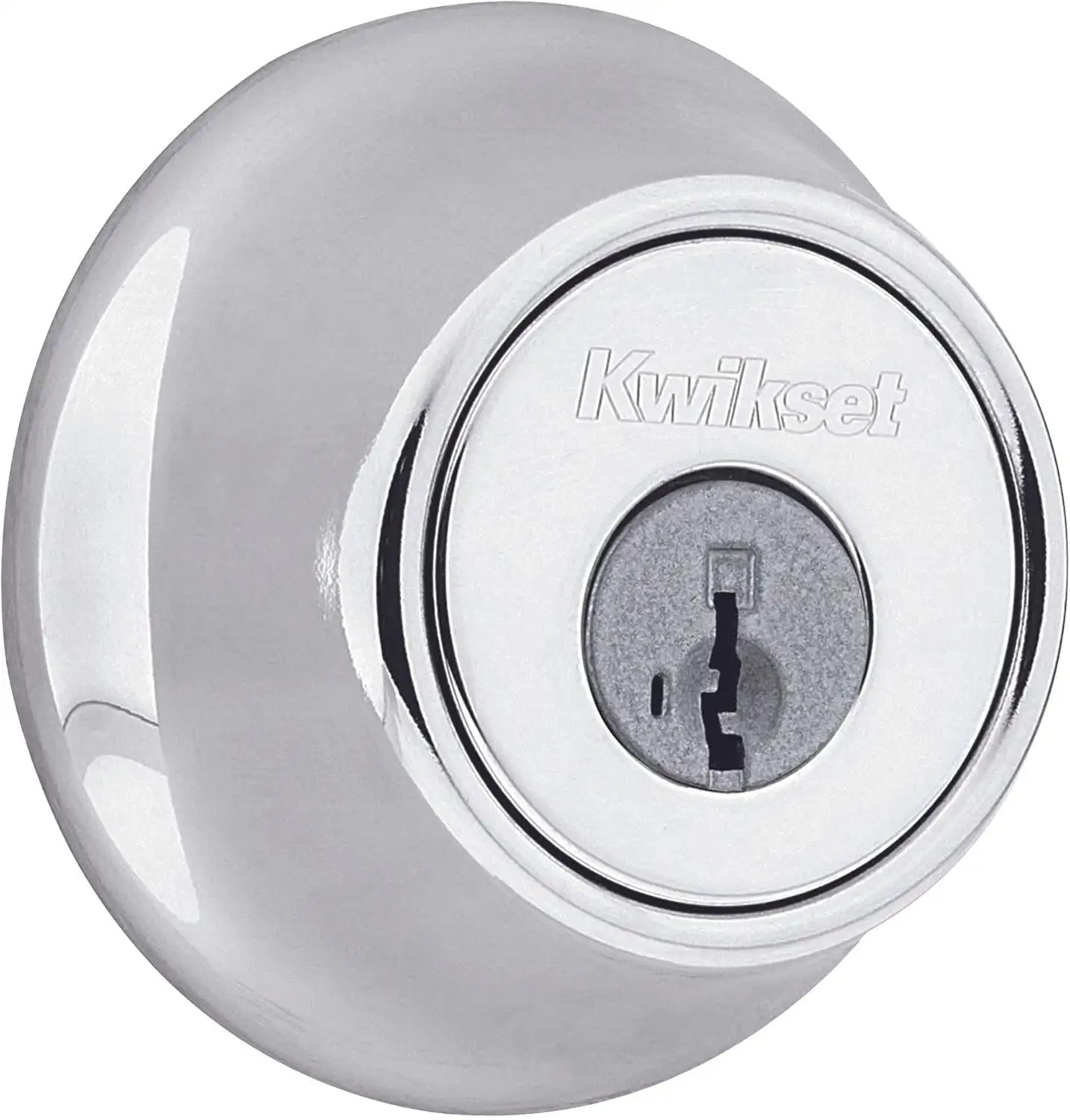
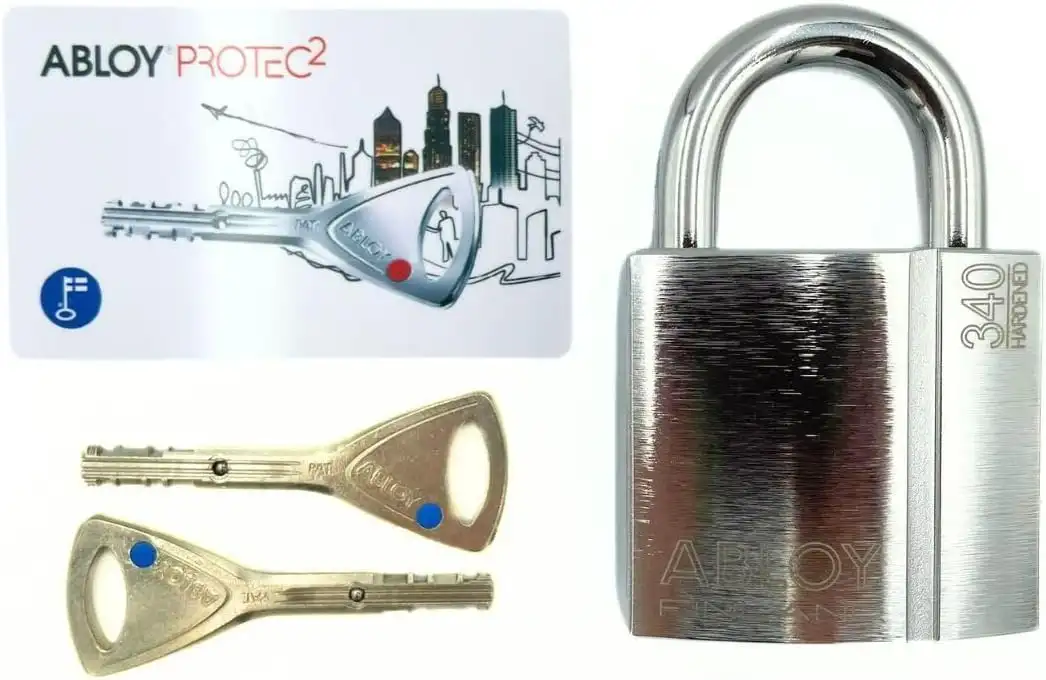
The gap between consumer-grade and high-security. Left: Standard Kwikset (KW1) — universally available blanks, no security pins, trivially impressionable. Right: Abloy Protec2 — no documented impressioning method exists.
Standard residential locks offer essentially zero resistance. Kwikset (KW1 keyway) deadbolts — the most common in American homes — use 5 standard cylindrical pins with loose tolerances, no security pins, and universally available blanks. Standard Schlage (SC1) locks are moderately better thanks to tighter tolerances and spool pins in some models, but remain fundamentally impressionable by skilled operators.
What Actually Stops Impressioning
Meaningful resistance requires specific design features. Restricted keyways are the single most effective defense because impressioning requires a matching blank — no blank, no impressioning. Systems like Medeco, ASSA Twin V-10, Mul-T-Lock MT5+, and our perennial recommendation the Abloy Protec2 use patented, proprietary key profiles available only through authorized dealers with identity verification.
Beyond blank restriction, counter-milled pin chambers (used by ASSA) catch pin protrusions and produce zero useful marks. Medeco's rotating pins must be both lifted and rotated to correct angles while simultaneously aligning a sidebar — a multidimensional challenge that impressioning cannot solve through linear filing. The Abloy Protec2, a disc cylinder with 11 rotating discs and a sidebar, has no documented method of picking, bumping, or impressioning since its 2001 introduction.
Restricted keyways (no blank = no impressioning). Counter-milled pin chambers. Multi-axis pin mechanisms (Medeco). Disc detainer with sidebar (Abloy). Reinforced strike plates with 3-inch screws. At minimum, upgrade from Kwikset to a Schlage B60N Grade 1 deadbolt ($30–60). For high-risk situations: Abloy Protec2 or Medeco M4 ($150–400).
From Ancient Locksmiths to Intelligence Agencies
Impressioning is described by TOOOL as "an ancient technique" — its origins likely predate formalized locksmithing, as the principle of inserting a soft material into a lock to read its internal geometry is conceptually straightforward. The underlying pin tumbler design dates to the Palace of Khorsabad in ancient Iraq (721–705 BC), though the modern pin tumbler was reinvented by Linus Yale Jr. in the 1860s. Historically, wax impressions and smoked blanks were standard techniques for both legitimate locksmiths and housebreakers on warded and early pin systems.
The technique's modern revival within the locksport community is distinctly 21st-century. Before 2005, impressioning was still a bit of a mystery even among experienced practitioners, with most enthusiasts experimenting with marker pens and chemicals on key blanks. Oliver Diederichsen changed this. A German safe technician who, unable to find anyone to teach him the skill, dedicated his time to methodically figuring it out. He won the 2005 German championship and published Impressionstechnik in 2006 — the first comprehensive manual on the subject, including nearly 200 high-resolution photographs and a chapter on forensic trace analysis. Barry Wels called it simply "The Book."
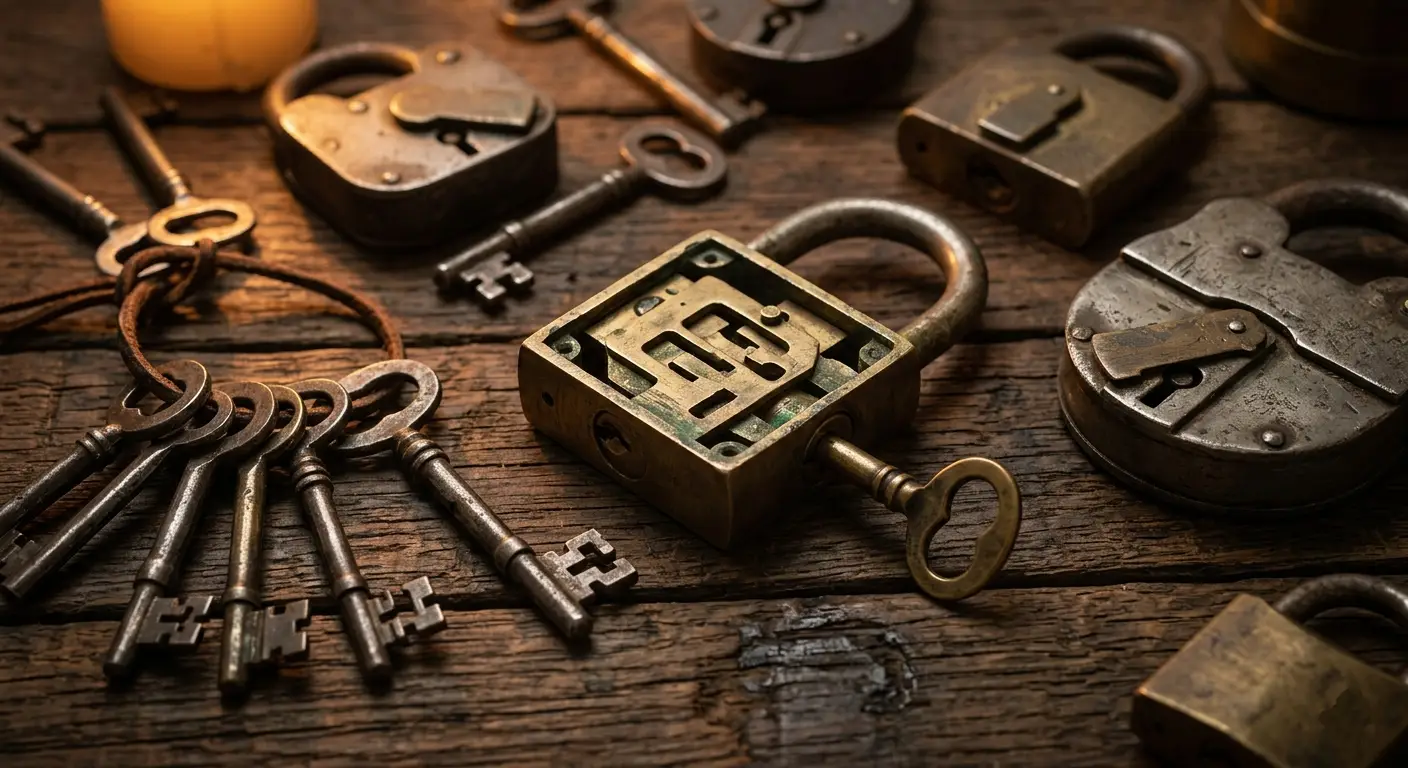
The principle is ancient — inserting soft material into a lock to read its internal geometry has been used by locksmiths and housebreakers alike for centuries.
TOOOL explicitly connects impressioning to intelligence tradecraft: it's a technique still in use today by intelligence agencies worldwide for their operational needs. The technique's covert nature — leaving less forensic evidence than picking — makes it ideal for operations requiring sustained, undetectable access. For professional locksmiths, impressioning serves a specific and valuable niche: key origination when no original key exists and the lock cannot be disassembled. It's non-destructive, requires no lock removal, and delivers a working key to the customer.
A delightful historical footnote: in 1986, a Mr. Wiersma appeared on the Dutch TV show Wanna Bet?! and accepted the challenge to file a working key to a randomly chosen lock in under three minutes — using only files, one blank, and the lock's code number — without ever testing the key in the lock. He was invited as a guest of honor to LockCon 2010, decades later, where the locksport community celebrated his feat as a precursor to their own competitive tradition.
The Details That Should Keep You Up at Night
The impressioning marks on a brass blank are polished spots often smaller than a pinhead — tiny circles where bound pins rubbed the matte surface to a bright finish. They're frequently invisible to the naked eye. The entire difference between a working key and a useless piece of brass can be .015 inches — less than half a millimeter, about five human hairs laid side by side.
Jos Weyers' 87-second record means he completed the full cycle — insert, torque, jiggle, remove, examine marks, file, repeat — roughly every 12.5 seconds per pin. At the same event, half the competitors couldn't finish in an hour. Oliver Diederichsen has filed several thousand keys over his career and says that even after all of them, the feeling when the plug turns is indescribable.
You have just opened a locked lock with a blank key, and now you have a working key for that lock. And a feeling of magic washes over you.
— Chris Dangerfield, Lock Pick WorldThree facts that should reframe how you think about your locks. First: oiled, well-maintained locks are actually harder to impression because lubricant reduces the friction that creates marks — so ironically, neglecting your lock's maintenance might make it marginally safer against this specific attack. Second: security features designed to stop picking (spool and serrated pins) are largely useless against impressioning. Third, and most striking: virtually all standard pin tumbler locks in the world — the type protecting most homes — can be impressioned, yet anti-impressioning features remain far less common than anti-picking features in consumer lock design.
The UL 437 standard requires locks to resist impressioning for 10 minutes, tested by a certified locksmith with 5+ years of experience. But as security researcher Marc Weber Tobias has pointed out at DEF CON, criminals don't follow the time limits established in testing protocols. The standard measures resistance, not immunity — and 10 minutes of resistance is cold comfort when the attacker has all evening.
The Lock Is Telling You Its Own Combination
Impressioning sits at a fascinating intersection of craft, competition, security research, and practical locksmithing. Its power lies in a paradox: it exploits the same binding physics as picking, yet defeats the security features designed to stop pickers. Its primary danger isn't probability — random burglars won't use it — but the unique consequence of producing a permanent, undetectable working key.
The richest takeaway for homeowners: the locks on most front doors offer no resistance whatsoever to a skilled impressioner with a $1 brass blank and a $15 file. That doesn't mean you need to panic. It means you should think about what you're actually protecting, who might want sustained access to it, and whether your lock's keyway is restricted or available at every hardware store in the country.
If the answer makes you uncomfortable, start with a restricted keyway. Upgrade to Schlage B60N at minimum. Go Abloy or Medeco if the threat model justifies it. Because the scariest thing about impressioning isn't that someone might do it to you. It's that if they did, you'd never know.