Review
Safes
Fire Chest
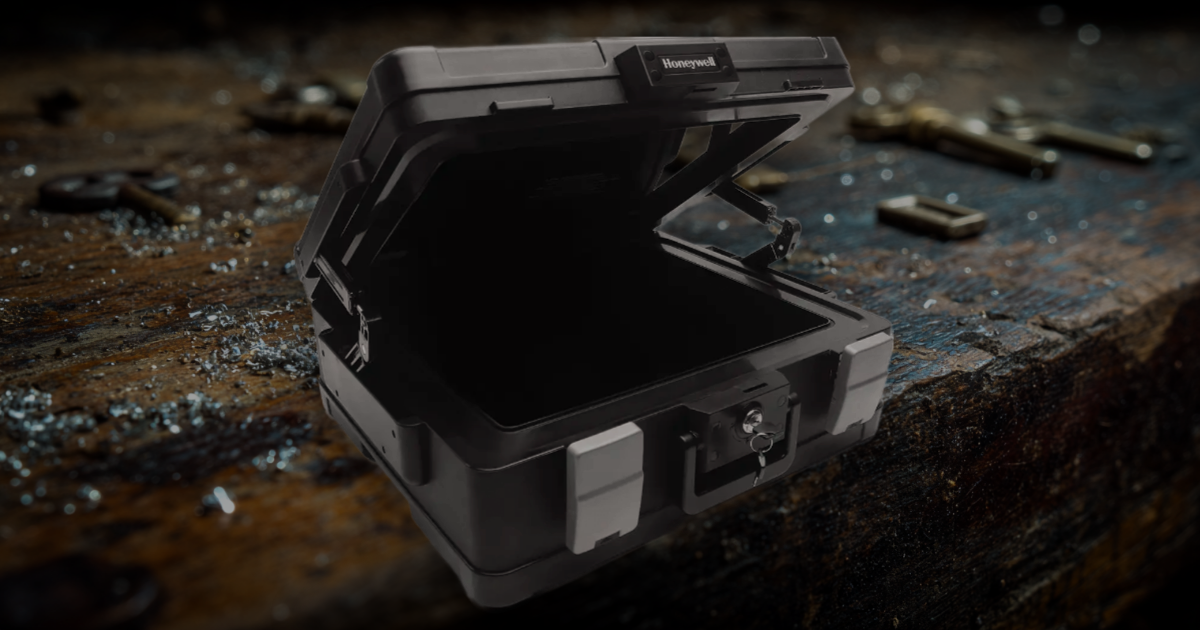
Honeywell 1114G: 60 Minutes of Fire Protection for Your Most Important Papers.
This is not a safe. It's a fire and flood chest that protects paper, and that's what most households actually need. Sixty certified minutes, 100 hours of water resistance, documents flat. One thing the box doesn't mention: Honeywell didn't make it, and Honeywell says so themselves.
By Johnny T.
·
March 2026
·
10 min read
Some links on this page are affiliate links — we may earn a commission.
Researched — not tested
We do not own this chest. Everything below is specification, certification standards and public record — tagged so you can see which is which.
Excellent fire and water protection. Not a security product, and honest about it. Sixty ETL-certified minutes, 100 hours of water resistance at a metre, and an interior that takes legal-size documents flat. For the realistic household disaster — fire, flood, burst pipe — this is the right tool and good value.
The key lock is privacy, not security, and the chest is designed to be carried. Know that going in and the score reads as what it is: very good at one job, not attempting the other.
Fire protection7
Water resistance9
Capacity & usability6
Theft resistance1
Value for money7
How to read this review
Nothing here is hands-on. Scores are relative to the whole safe category, not to whether the product achieves its own stated aim — 60 minutes is solid but mid-range when UL 72 runs to four hours.
TestedPhysically in hand. Nothing on this page carries this tag.
DocumentedPublished standard, specification or company statement.
ManufacturerThe maker's own claim. A claim, not a fact.
CommunityLocksmith and industry consensus. Informed opinion.
The short version
The best fire chest for the money, doing one job properly — and made by a company you've never heard of, under a badge you have.
Start here, because it reframes everything else and almost no review mentions it.
Honeywell does not manufacture Honeywell safes. They are manufactured and distributed exclusively by LH Licensed Products, Inc. — part of Hyman Inc., based in Carson, California — under a trademark licence from Honeywell International. Documented
That isn't a secret or an accusation; it's stated plainly on the products and on the Honeywell Safes website. What's more striking is the line in the site's own footer:
From Honeywell Safes' own website
"The Honeywell Trademark is used under license from Honeywell International Inc. Honeywell International Inc. makes no representations or warranties with respect to these products." Documented
The Fortune 100 company whose name you are buying explicitly disclaims any representation or warranty about the product carrying it. That is unusually candid, it is on their own site, and it means the reputation doing the persuading is not backed by the company that built it.
The licensee's own material puts the strategy plainly, citing a 93% consumer recognition rate for the Honeywell brand as what drives their global expansion. Manufacturer The brand recognition is the product feature.
Does that make it a bad chest?
No — and this is where a lazier review would go wrong. The certification is what matters, and the certification is real and independent. An ETL laboratory tested this chest to a published standard regardless of whose name is on it.
What it should change is where your confidence comes from. Don't buy it because Honeywell is a serious engineering company; that company has explicitly told you it isn't standing behind this. Buy it because the ETL listing says it survived sixty minutes, which is a fact you can check.
It also sets up a genuinely useful comparison across this category. SentrySafe is owned by Master Lock. Honeywell safes are a licensed badge. Gardall is a company that has actually built safes since 1950. Two of the three biggest names in consumer safes are badges; the one most people have never heard of makes the product.
The 1114G is ETL-certified for 60 minutes at 1700°F. Manufacturer Two things to understand about that number.
First, 1700°F is not a separate specification. Fire testing uses a standard time-temperature curve — the furnace ramps along a defined path modelling a developing structural fire. Roughly 1550°F is where that curve sits at thirty minutes; roughly 1700°F is where it sits at sixty. Documented So a "60 minute, 1700°F" chest isn't resisting a hotter fire than a "30 minute, 1550°F" one — it's surviving the same fire twice as long. Compare durations, not temperatures.
Second, ETL is not a lesser mark than UL. ETL Verified is Intertek testing to the same UL 72 performance requirements, with unannounced follow-up audits, and the two are treated as equivalent in rigour. Documented What matters is that an independent laboratory tested it at all.
What to be suspicious of is language that mimics certification without being it — "tested to UL standards," "built to UL specifications," "UL-style construction." Documented None of those mean a lab tested anything. Only a listing in the UL or ETL database does, and both are searchable.
What class, and why it matters
UL 72 fire ratings come as a class plus a duration:
Paper-class protection will not save a hard drive — drives fail far below 350°F. If you're storing backups, that's a Class 125 product and a different purchase. Photographs sit in between and are the thing people most often assume are covered and aren't.
One more line from the standard worth carrying: UL 72 certifies that the contents survive, not that the chest does. Documented Expect a fire-exposed chest to be a write-off you cut open — which is the right outcome if the paperwork comes out readable.
This is the 1114G's quietly best feature, and it deserves more attention than fire ratings usually leave room for.
Class 350 fire protection carries no humidity requirement at all. Documented The certification covers temperature and nothing else. Which is a real gap, because fires are put out with water — a chest can meet its fire rating perfectly and hand you back a block of wet pulp.
Separate water verification closes that. A hundred hours submerged at a metre covers the realistic version: fire hoses, sprinklers, a burst pipe upstairs, a flooded basement, a chest sitting in standing water for days before anyone reaches it.
And water is the more likely event by a wide margin. Burst pipes, appliance failures and roof leaks damage vastly more household paperwork than fire does. This chest earns its keep on an ordinary Tuesday, not in a catastrophe.
Documents lie flat
Sounds trivial, isn't. The 1114G takes legal-size documents flat, where the cheaper H0100 forces you to fold or angle standard sheets. Over years, folded deeds and creased certificates are harder to store, harder to find and more likely to fail at the crease. For a product whose entire purpose is preserving paper, being able to accept paper properly is a real feature.
The lock is a privacy latch. It stops a curious child, a houseguest or a flatmate. It is not a security feature and the manufacturer doesn't claim it is.
That matters because the chest weighs around 42 pounds — heavy enough to be awkward, light enough to be carried by someone motivated. A burglar doesn't defeat the lock; they take the chest. There is no burglary rating here of any kind, and there wouldn't be: fire and burglary are separate certifications, UL 72 and UL 1037 respectively, and a baseline Residential Security Container means a five-minute attack by one person with hand tools. Documented This is a fire container, full stop.
"It's fireproof and lockable, so my valuables are safe."
"Fireproof" appears in no standard — what exists is a class and a duration. And a lock on a portable chest protects against curiosity, not theft. The two features together create an impression of security that neither supports. Cash and jewellery in a 42-pound box with a carry handle are not protected; they're consolidated into one convenient package.
VerdictTwo honest features, one misleading impression.
What belongs in a fire chest
The right contents are things whose loss to fire or flood is catastrophic and whose theft is comparatively unlikely:
- Birth certificates, passports, marriage and death certificates
- Property deeds, titles, mortgage documents, wills
- Insurance policies — the ones you'll need because of the fire
- Photographs of possessions for claims, and an inventory list
- Spare keys, and a written note of where things are
What doesn't belong: cash in quantity, jewellery, firearms, anything a thief would carry out. Those need a bolted-down container — see the SFW205GQC, the Gardall MS912, or the under-$300 roundup.
Digital backups are a special case. Paper-class protection won't save a drive, so either buy Class 125 or — cheaper and better — keep an off-site or cloud copy. The best fire protection for data isn't a box.
Who actually makes Honeywell safes?
LH Licensed Products, Inc., part of Hyman Inc. of Carson, California, under a trademark licence from Honeywell International. Honeywell Safes' own website states that Honeywell International makes no representations or warranties with respect to these products. The certification is independent, so buy on the ETL listing rather than on the badge.
Is ETL certification as good as UL?
Yes. ETL Verified is Intertek testing to the same UL 72 performance requirements, with unannounced follow-up audits, and the marks are treated as equivalent. What matters is independent laboratory testing rather than which lab did it.
Is the Honeywell 1114G secure against theft?
No. The key lock provides privacy, roughly the level of a locked desk drawer, and the chest weighs about 42 pounds with no bolt-down provision. There is no burglary rating, and there wouldn't be — fire and burglary are separate certifications. Use it for documents.
Can I store a hard drive or photos in it?
Not for fire protection. Paper-class rating keeps the interior below 350°F, and drives, flash media and photographs fail well below that. Digital media needs Class 125 and photographs Class 150. The water protection does apply to everything inside.
Why does the fire rating say 1700°F?
Because fire testing follows a standard time-temperature curve, and roughly 1700°F is where that curve sits at the sixty-minute mark. It isn't a separate heat-resistance claim. When comparing chests, compare durations and classes rather than temperature figures.
Is it worth $30 more than the SentrySafe H0100?
Yes, comfortably. Double the certified fire duration, more water resistance, and an interior that takes legal-size documents flat instead of forcing you to fold them. In a category that is pure insurance, doubling the coverage for thirty dollars is an easy call.
Specification
Model
Honeywell 1114G fire and water chest
Actually made by
LH Licensed Products, Inc. (Hyman Inc.), Carson, California, under licence from Honeywell International Documented
Fire rating
ETL certified, 60 minutes at 1700°F — a point on the standard fire curve, not a separate claim
Fire class
Paper class — will not protect drives or photographs
Water rating
100 hours at 1 metre
Capacity
Takes legal-size documents flat
Lock
Key. Privacy, not security
Verify the fire class and duration on the exact model against the ETL listing before ordering. The number on the box is what you're paying for.
Then decide contents before it arrives: documents in, valuables somewhere bolted down. That decision does more for your security than the purchase does.
Amazon US
Sold under the Honeywell Safes & Door Locks line
Here's the question most people never ask until it's too late: if your house burns tonight, where are the birth certificates, the deed, the insurance policy? Not irreplaceable in a technical sense — but rebuilding your identity paperwork while simultaneously handling a claim, temporary housing and the emotional wreckage is a specific kind of misery. This chest exists so you don't.
It does that job well, at a fair price, with independent certification behind it. The badge on the front is licensed and the company it names disclaims any warranty over it — which is worth knowing, and changes nothing about whether the ETL test happened.
Buy it for documents, keep it somewhere sensible, and put the valuables somewhere bolted to the floor.
Verdict — 6 / 10
Excellent fire and water protection, honest about being nothing else, wearing a name its owner won't vouch for.
Sources & Method
- Manufacture and licensing — Documented
Honeywell Safes, Door Locks, Cash Boxes and Paper Shredders are manufactured and distributed exclusively by LH Licensed Products, Inc. (Hyman Inc.), Carson, California, under trademark licence from Honeywell International Inc. The Honeywell Safes site states that Honeywell International makes no representations or warranties with respect to these products, and the licensee cites a 93% consumer recognition rate for the brand.
Honeywell Safes — About
- UL 72 classes, durations and the standard fire curve — Documented
Class 350 (paper, no humidity requirement), Class 150 (film and tape, 85%), Class 125 (digital media, 80%), over durations of 30 minutes to four hours. Testing follows a ramping time-temperature curve, which is why 1550°F pairs with 30 minutes and 1700°F with 60. The standard demonstrates performance during a fire and does not certify the container as usable afterwards.
Standard summarised
- ETL equivalence and false certification language — Documented
ETL Verified marks test to the same UL 72 requirements with unannounced follow-up audits and are treated as equivalent. Phrases such as "tested to UL standards" or "UL-style construction" are not certifications; only a listing in the UL or ETL database is.
UL and ETL compared
- Fire and burglary are separate standards — Documented
UL 72 covers fire; UL 1037 covers burglary via the Residential Security Container rating, where a baseline RSC means a five-minute attack by one person using common hand tools. This chest carries no burglary rating.
RSC explained
- Ratings, dimensions and weight — Manufacturer
Published specification for the 1114G: 60 minutes at 1700°F, 100 hours water resistance at one metre, legal-size capacity, approx. 42 lb. Verify against the current listing before purchase.
We do not own this chest and nothing here is hands-on. If you have had one through an actual fire or flood, that outcome is worth more than every specification above — tell us what happened and you'll be credited.