Researched — not tested
We do not own this chest. Everything below is specification, the certification standards, and the documented record — tagged so you can see which is which.
The bare minimum. Better than a drawer, worse than almost everything else. The certification is real and the price is genuinely low, so if the alternative is a shoebox in a wardrobe this is an improvement.
But thirty minutes is the shortest duration UL 72 issues, the interior won't take a letter-size document flat, and the key lock is a privacy latch. Thirty dollars more buys double the fire time and a chest that fits your paperwork without folding it.
Fire protection5
Water resistance7
Usable capacity2
Security2
Value at the price7
How to read this review
Nothing here is hands-on. The value is in reading the certification properly.
TestedPhysically in hand. Nothing on this page carries this tag.
DocumentedPublished standard, specification, or recorded attack.
ManufacturerSentrySafe's own claim. A claim, not a fact.
CommunityLocksmith and locksport consensus. Informed opinion.
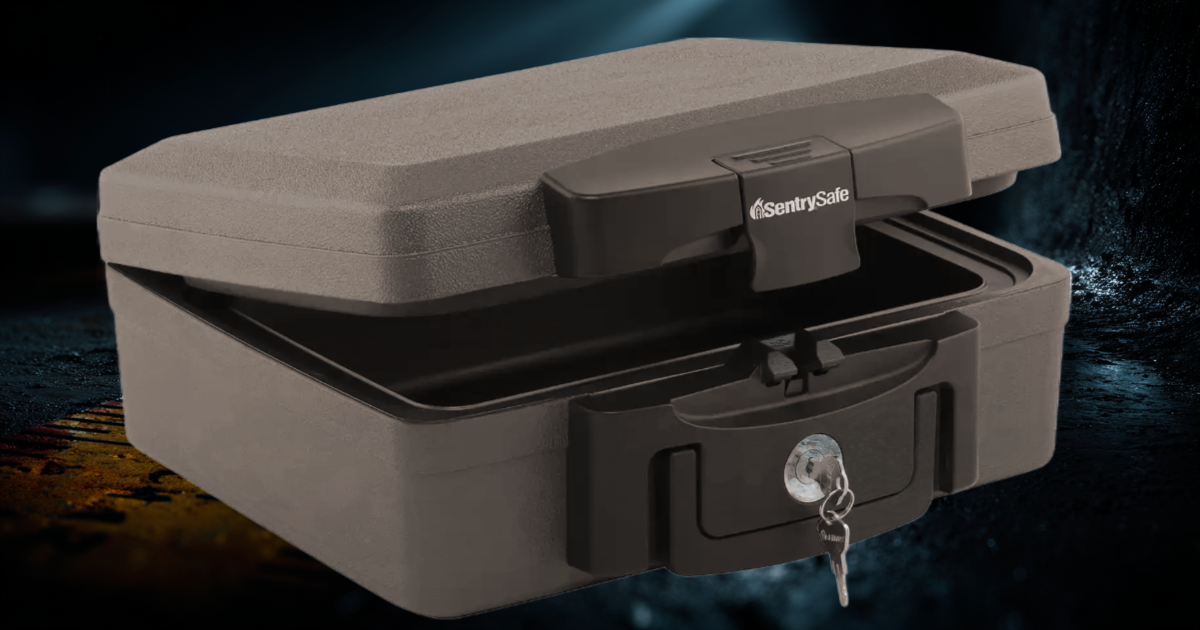
The H0100 is rated for 30 minutes at 1550°F, with ETL-verified waterproofing for 72 hours. Manufacturer Both halves are worth unpacking, because the first one explains something that confuses almost every safe shopper.
Why it's always 1550°F at 30 minutes and 1700°F at 60
Look across fire chests and you'll notice those two pairings repeat endlessly — 30 minutes at 1550°F, 60 minutes at 1700°F — as though every manufacturer independently chose the same numbers. They didn't.
Fire testing under UL 72 uses a standard time-temperature curve. The furnace doesn't sit at a fixed heat; it ramps along a defined curve that models a developing structural fire, climbing fast early and more slowly later. Documented Roughly 1550°F is where that curve sits at the thirty-minute mark. Roughly 1700°F is where it sits at sixty.
So the temperature isn't a separate specification — it's a consequence of the duration. A "60 minute, 1700°F" chest is not protecting against a hotter fire than a "30 minute, 1550°F" one. It's surviving the same fire for twice as long, and the temperature number is just where the curve happened to be when the clock stopped.
What that means when you're comparing boxes
Two chests advertising "1700°F" and "1550°F" are not offering different heat resistance. Compare the durations and the class. The temperature is downstream of the duration and quoting it separately is, at best, marketing decoration.
And be alert to the reverse trick: a large temperature number with no duration attached, or a duration with no class, tells you nothing at all. A complete rating reads like "Class 350, 30 minutes." Anything less is incomplete.
Is thirty minutes enough?
It's the shortest duration UL 72 issues. Whether that's sufficient depends on a variable you don't control: how long the fire burns before it's out and the debris cools.
The honest framing is that thirty minutes covers a fire that is detected early, reported promptly, and reached quickly — which is a large share of house fires, and not all of them. A collapsed structure smouldering for hours is outside what this chest is certified for, and a chest sitting inside that debris is well past its rating long before anyone digs it out.
Sixty minutes doubles that margin for roughly thirty dollars. In a category where the entire product is insurance against a low-probability, high-consequence event, doubling the coverage for thirty dollars is the easiest upgrade decision on this site.
ETL-verified waterproofing for 72 hours is the H0100's genuinely strong feature, and it deserves more credit than fire ratings usually leave room for.
Here's why it matters more than it sounds. UL 72's Class 350 rating — the paper class — carries no humidity requirement at all. Documented The only thing certified is that the interior stayed below 350°F. Moisture protection is simply not part of that test.
Which is awkward, because fires are extinguished with water. A chest that keeps your deeds below 350°F and then lets them sit in run-off has met its certification and lost your documents. Separate water verification closes a real gap, and on this chest it's the part doing quiet, useful work.
It's also the more likely event. Burst pipes, washing machine failures, roof leaks and flooding damage vastly more household paperwork than fire does. A waterproof chest earns its keep on a Tuesday when nothing dramatic happens at all.
"Fireproof means my documents are safe."
"Fireproof" appears in no standard. What exists is a class and a duration — Class 350 for paper, Class 150 for film, Class 125 for digital media — over 30 minutes to four hours. Documented A Class 350 chest will not protect a hard drive, because drives fail far below 350°F, and it carries no moisture protection unless separately verified. The word on the box is doing a lot of work the certification doesn't support.
VerdictMarketing term. Read the class, the duration, and whether water is separately covered.
1. It doesn't fit your documents
The interior measures roughly 3.4″ × 12″ × 7.4″. Manufacturer A standard 8.5″ × 11″ sheet does not lie flat. You fold documents, or angle them diagonally, or roll them.
That is a bigger deal than it sounds for the specific job this product exists to do. Folded deeds, creased certificates and rolled policies are harder to store, harder to find, and more likely to be damaged at the fold over years. For a chest whose entire purpose is preserving paperwork, an interior that can't accept paperwork flat is a design decision working against the product.
2. The lock is a privacy latch
The key lock on a chest like this is there to stop casual opening — a curious child, a houseguest, a flatmate. It is not a security feature and shouldn't be read as one.
This matters more here than on a larger safe because the chest weighs about 17 pounds and has a carry handle. It is designed to be picked up and moved, which means a thief doesn't need to defeat the lock at all. They take the whole thing.
Worth knowing about the brand more broadly: SentrySafe has been owned by Master Lock since 2014 Community, and products across the SentrySafe range have documented bypasses — including one opened with a coat hanger in 2020 and a researcher-published electronic bypass on Sentry and Master electronic models that opens them with no PIN. Documented Full detail in our SFW205GQC review. None of that changes the verdict here, because a 17-pound chest with a carry handle was never a security product.
3. The upgrade is thirty dollars away
This is the one that decides it. For roughly thirty dollars more, the Honeywell 1114G gives you 60 minutes instead of 30, 100 hours of water resistance instead of 72, and an interior that takes legal-size documents flat. In a product category that is pure insurance, that is a straightforwardly better purchase.
Buy it if
- Thirty dollars is genuinely the budget. Real constraints are real. Certified thirty-minute protection beats a drawer by an enormous margin and this is the cheapest way to get any.
- You need a second chest for a specific small item — a passport, spare keys, a backup drive in a bag, an external SSD you'd hate to re-create.
- It lives inside something else. A small chest inside a larger safe is a reasonable way to add a fire layer to a burglary container that has none.
- It's a stopgap. Buying today because the roof leaked yesterday is a good reason to own the cheap one now.
Buy something else if
- You can stretch thirty dollars. The Honeywell 1114G doubles the fire time and fits documents flat.
- You have more than a handful of papers. The interior is the binding constraint here, not the rating.
- You want any theft protection. Look at a bolted-down safe — the SFW205GQC or the Gardall MS912 — and see the under-$300 roundup.
- You're storing digital media. Class 350 protects paper. Drives need Class 125, which this is not.
Whatever you buy, put it somewhere sensible
A portable chest's biggest risk is being carried out, so location does more work than the lock. Low down, out of sight, not in the master bedroom — which is the first room searched. And if it's small enough to pocket, it's small enough to lose to a burglar who never even opened it.
We don't enjoy writing negative reviews, and this isn't really one. The H0100 does what it says: it is genuinely certified, the water resistance is real, and thirty dollars is thirty dollars. Somebody with no fire protection at all and thirty dollars in hand should buy it today rather than wait.
It's the fire chest equivalent of the Master Lock 140D — it exists, it technically functions, and the criticism isn't that it fails but that something meaningfully better sits a few dollars along the same shelf. The interior that won't take a sheet of paper flat is the detail that settles it.
Verdict — 4.5 / 10
Real certification, real limits, and an upgrade thirty dollars away that doubles everything that matters.