Review
Deadbolts
SmartKey
Kwikset SmartKey 980: Budget King or Security Myth?
The lock on more American front doors than almost any other. It is not a pin-tumbler and it cannot be bumped — that part is real. Then there is the screwdriver that opened it for two researchers in about fifteen seconds, at roughly a third of the torque its certification implies, and the catalogue tool that reads its key cuts on any generation.
By Johnny T.
·
March 2026
·
12 min read
Some links on this page are affiliate links — we may earn a commission.
Researched — not tested
We don’t own this lock. Everything below is patent text, published standards, manufacturer specification, locksmith tooling and publicly recorded security research — tagged so you can see which is which. Where an earlier version of this page said something the evidence doesn’t support, it has been corrected, and every change is logged at the end.
Genuinely clever engineering that solved the wrong problem and created a worse one. SmartKey defeats key bumping outright — structurally, not by marketing — shrugs off the rakes that open budget pin-tumbler deadbolts, and re-keys in fifteen seconds without a locksmith. Those are real, and most reviews including our previous one get them backwards.
But it opens under a screwdriver and a wrench at a third of its rated torque, a purpose-built decoder sold to the trade reads its cuts on any generation, and its usable key space collapses to a few hundred combinations. It beats the attacks homeowners have heard of and loses to the ones that are a catalogue purchase.
Covert entry resistance5
Forced bypass resistance2
Key control2
Bolt & hardware7
Value for money6
How to read this review
Nothing here is hands-on. Scores are relative to the whole deadbolt category, not to whether the lock achieves its own stated aim — and the two lowest scores here are for attacks that are published, filmed and repeatable.
TestedPhysically in hand. Nothing on this page carries this tag.
DocumentedPatent, published standard, or a recorded and reported attack.
ManufacturerKwikset's own claim. A claim, not a fact.
CommunityLocksmith and locksport consensus. Informed opinion.
CorrectedSomething we previously published that the evidence doesn't support.
The short version
Bump-proof, immune to a rake, and it opens with a screwdriver. Buy it for the re-keying, not for the security, and know which door you're putting it on.
Almost every article about this lock, including the one that used to be on this page, describes SmartKey as a re-keying feature bolted onto an ordinary pin-tumbler cylinder. That is wrong, and getting it right changes every conclusion that follows.
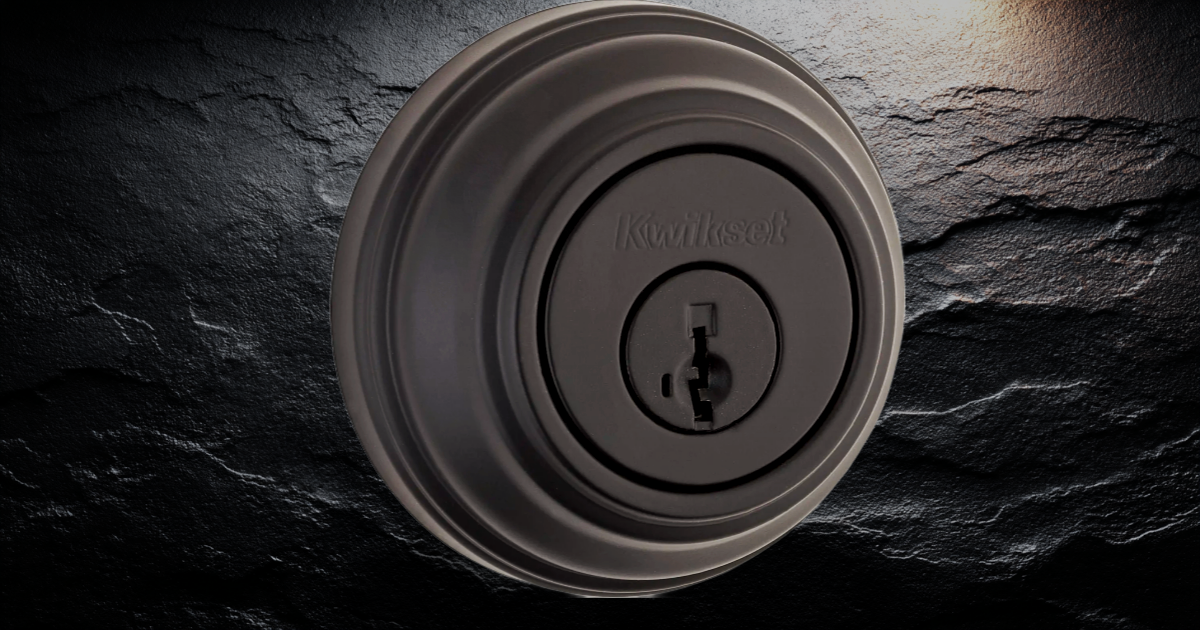
The SmartKey cylinder is a wafer lock with a side locking bar. Five flat wafers sit in the plug. A steel bar runs down the side of the plug, held in interference with the shell. When the correct key lifts all five wafers to their gates, the bar can retract and the plug turns. Kwikset's own patents describe it precisely — United States patents 6,978,647 and 7,225,651, both titled Pick-resistant wafer tumbler lock with sidebars. Documented
Take the architecture from that title and leave the adjective. “Pick-resistant” is the applicant’s own wording on their own filing — a patent title describes intent, and no examiner checks whether a lock lives up to its name. The wafer-and-sidebar construction is a verifiable fact. The security claim attached to it is Kwikset’s, and Chapter 3 is where it meets what people have actually built to open these.
The small rectangular slot beside the keyway is the tell. That's the reset port — a pin-tumbler has nowhere to put one.
There are no top pins. No springs above a shear line. No pin stacks to set.
Looking for the Kwikset Titan? Different lock entirely
The Titan — the 780 and 785 series — is Kwikset’s older line, and it is a conventional six-pin-stack pin-tumbler, certified ANSI Grade 2. Community Everything in this review about wafers, sidebars and bump immunity applies to the SmartKey 980 and not to a Titan.
That distinction cuts the other way too. A six-pin Kwikset pin-tumbler is a soft target for raking, which the SmartKey is not — and Kwikset has been phasing the Titan out in favour of SmartKey precisely because of bumping. Confusingly, the 780 is now sold in both a Pin & Tumbler version and a SmartKey version under the same model number. Check which cylinder is in the box.
Back to the 980, where the absence of pin stacks has one immediate and genuinely important consequence:
SmartKey cannot be bumped
Key bumping works by rapping a specially cut key to bounce the driver pins above the shear line for a fraction of a second. A lock with no driver pins has nothing to bump. Documented Kwikset's BumpGuard branding is, unusually for lock marketing, describing something structurally true rather than an added feature.
This matters because SmartKey was designed in direct response to the mid-2000s bumping panic. Judged against the threat it was built for, it works.
How the re-keying works
Insert the working key, push the supplied tool into the slot beside the keyway, and an internal cradle separates the wafers from the sidebar and holds them apart. Withdraw the old key, insert the new one, remove the tool, and the lock learns the new bitting. About fifteen seconds, no disassembly, no locksmith. Manufacturer
For a landlord turning over a unit, a new homeowner who has no idea how many keys are in circulation, or anyone who has ever changed the locks after a breakup, that is real, unglamorous value. Nobody should sneer at it.
The problem is not that the re-keying is bad. It is that the mechanism which makes re-keying possible — wafers that can be pushed out of engagement by a cradle — is also a mechanism that can be pushed out of engagement by other things.
In 2013, at the DEF CON security conference, investigative attorney Marc Weber Tobias and locksmith Toby Bluzmanis presented a talk titled A Failure of Imagination: Kwikset SmartKey and Insecurity Engineering, and demonstrated the attacks on camera for WIRED. Documented
The headline demonstration needs no interpretation:
The torque attack, and the number that matters
Bluzmanis inserted a four-inch screwdriver into the keyway, gripped it with a wrench, and turned. The lock opened in about fifteen seconds.
Here is the part that should end the argument. The standard behind this lock's certification calls for it to withstand 300 pounds-force-inch of torque. The researchers reported opening it with a little over 100. Documented
That is not a marginal failure. It is roughly a third of the figure the certification implies, achieved with two tools from any kitchen drawer.
Two further attacks came out of the same research. A decoding attack, using a series of single-depth keys to read the position of each wafer in turn and derive the working combination. And an exploit of the reset mechanism itself — the same cradle that makes re-keying convenient, reached the wrong way.
Kwikset's position at the time was that its locks were resistant to wires, screwdrivers and other objects inserted into the keyway. Manufacturer The demonstrations were, in effect, a direct answer to that claim.
The forensic problem
This is the part that should worry a homeowner more than the fifteen seconds.
A SmartKey forced over this way still works with the original key. The door locks, the key turns, everything appears normal. The only symptom is internal: the cylinder will no longer accept a re-key. Community
So there is no scratched keyway, no drilled plug, no splintered jamb — nothing an insurer's adjuster or an attending officer would photograph. If you have ever wondered why "no signs of forced entry" is such a fraught phrase, this is a textbook example of why. Our piece on forensic locksmithing covers what actually gets left behind by different attacks, and why most of it is invisible without a loupe.
What has changed since
Kwikset has revised the SmartKey mechanism over the years, and current production is sold as SmartKey Security rather than plain SmartKey. Manufacturer We could not find published independent testing establishing how much the torque resistance of current stock has improved, and we are not going to guess at a number. Unresolved If you own one and a locksmith has assessed it, we'd genuinely like to hear from you.
Give Kwikset partial credit here, because the internet mostly gives it none — but only partial, and the distinction matters.
Conventional picking tools are ineffective. A rake, the tool that opens a great many budget pin-tumbler deadbolts in seconds, does nothing to a SmartKey, because there are no pin stacks to bounce. Working five wafers against a sidebar with a standard hook is awkward and slow. Combined with structural immunity to bumping, that means the SmartKey genuinely beats an ordinary pin-tumbler cylinder on both of the covert attacks homeowners have heard of. Community
Now the part that undoes most of it. You can buy a tool that decodes this lock.
The decoder you can just order
Locksmith Ledger covered the launch of the LockTech Kwikset SmartKey Decoder, a purpose-built tool that reads the wafer positions inside a SmartKey cylinder non-destructively and works, per that coverage, on any generation of the mechanism. Documented Before it existed, locksmiths were already doing the job with Lishi picks — a tool never designed for it, and one that reportedly took some damage in the process. Documented
Decoding is worse than picking. A pick gets you through the door once. A decoder gives you the cuts, and the cuts give you a working key — permanent, repeatable, and indistinguishable from the owner’s.
So treat “pick resistant” carefully. It is accurate about rakes and hooks, and it is Kwikset’s own phrase from Kwikset’s own patent filing. It is not a statement about what a determined person with a catalogue and a credit card can do, and the locksport reference material is blunt about the wider picture: vulnerabilities in the design allow it to be attacked in a variety of ways. Community
And then there is the key space.
7,776 combinations on paper. 243 in practice.
Five wafers, six depth positions each, gives 65 = 7,776 theoretical differs — already low for a front door lock. But locksport documentation reports that the tolerances are loose enough to accept half-cuts at every position, which collapses the number of genuinely distinct keys to 35 = 243. Community
Put plainly: on a street of SmartKey-equipped houses, the odds that your neighbour's key turns your deadbolt are not academic.
That is the single most under-reported fact about this lock, and it isn't an attack at all — it's arithmetic. No tools, no technique, no research required. It also explains why SmartKey is a poor fit anywhere key control matters: a rental block, an office, a shared building, anywhere the same model is installed in quantity.
One more structural note: the wafers are aluminium rather than the brass used in conventional pin stacks. Community Lighter, cheaper, and less able to resist deformation — which is consistent with what the torque attack does to them.
Kwikset has changed hands repeatedly — Black & Decker, then Stanley Black & Decker, then Spectrum Brands from 2012. In 2021, Spectrum agreed to sell its Hardware and Home Improvement division — Kwikset, Weiser, Baldwin, Pfister, National Hardware — to ASSA ABLOY for $4.3 billion. Documented
The United States Department of Justice sued to block it, alleging the deal would violate the Clayton Act. The court filings are unusually candid: they record that ASSA ABLOY had recently invested in a smart lock lineup designed to take shelf space from Kwikset in major home improvement stores — and then moved to buy Kwikset instead. Documented
The settlement, entered in May 2023, let the deal proceed on condition that ASSA ABLOY divest a list of brands. It closed on 20 June 2023. Here is where everything landed:
Read that column twice. Almost every lock brand this site reviews now sits inside one of two companies. The high-security Finnish and American cylinders, the budget deadbolt in the big-box aisle, the padlock on your shed, the safe in your closet and the smart lock on your door are, with a handful of exceptions, ASSA ABLOY or Fortune Brands.
That is not an accusation about product quality — ASSA ABLOY has left Abloy and Medeco alone, and those remain among the best cylinders made. It is a caution about how much apparent choice you actually have when you compare four brands on a shelf, and about why "we tested five different brands" means less than it used to.
The 980's hardware is good, and the cylinder's problems shouldn't obscure that.
Kwikset certifies the 980 as Grade 1 on all three Builders Hardware Manufacturers Association axes — Security, Durability and Finish. Manufacturer That tri-axis certification is worth understanding: it is not one score, it is three separate test programmes, and the Security axis measures bolt strength, impact and torque rather than resistance to covert attack. A lock can be legitimately Grade 1 and still be picked or bypassed, because those aren't what the grade tests. That isn't a scandal; it's a scope limitation that manufacturers are content to let buyers misread.
The bolt itself is a full 1-inch throw with a titanium-alloy core, on an adjustable latch that fits either a 2-3/8" or 2-3/4" backset. Manufacturer Minimum door thickness is 1-3/4". Warranty is lifetime mechanical and lifetime finish.
"A better deadbolt will stop someone kicking the door in."
It won't, and this is true of every deadbolt on the market including the expensive ones. A kicked door fails at the jamb, where a 1-inch bolt is held by a strike plate screwed into 3/4-inch pine trim with 3/4-inch screws. The bolt doesn't break. The wood does. The fix costs a few dollars: a reinforced strike plate and three-inch screws that cross the shim gap and land in the king stud. Fitting those to a $20 deadbolt buys more real security than upgrading to a $200 one and leaving the short screws in.
So: if SmartKey convenience genuinely matters to you and you understand what you're accepting, the 980 is a reasonable buy for the right door. An interior door, a garage side door, a rental turnover, a workshop. Somewhere the threat is opportunistic rather than deliberate, and where being able to re-key in fifteen seconds is worth more than resisting a determined attack.
For a front door, the comparison is unkind. Our Schlage B60N review puts that lock at both A156.36 Commercial Grade 1 and A156.40 Residential Grade AAA, at a street price we recorded as roughly $33–$52 — below the range previously published on this page for the 980. Verify both at the time you buy, because deadbolt pricing moves constantly. But on current information the higher-rated lock is also the cheaper one.
Can a Kwikset SmartKey be bumped?
No, and not because of a clever countermeasure — because there is nothing to bump. Bumping works by bouncing driver pins above a shear line, and the SmartKey cylinder is a wafer-and-sidebar design with no driver pins at all. This is one area where the marketing and the engineering genuinely agree.
Can a SmartKey be picked?
Not with conventional tools — rakes do nothing because there are no pin stacks, and working five wafers against a sidebar with a hook is slow. But treat “pick resistant” as a claim about rakes rather than about people. A purpose-built LockTech decoder is sold to the trade that reads the wafer positions non-destructively on any generation of the mechanism, and before it existed the job was being done with Lishi picks. Decoding is worse than picking, because it hands over a working key rather than a single opening.
What is the screwdriver attack on SmartKey?
At DEF CON in 2013, Marc Weber Tobias and Toby Bluzmanis demonstrated opening a SmartKey deadbolt by inserting a four-inch screwdriver into the keyway, gripping it with a wrench and turning. It took about fifteen seconds. The relevant standard calls for the lock to withstand 300 pounds-force-inch of torque; they reported using a little over 100.
How many different SmartKey keys are there?
Five wafers at six depths gives 7,776 theoretical combinations. Locksport documentation reports that tolerances accept half-cuts at every position, reducing genuinely distinct keys to about 243. That is very low key control, and it is the strongest argument against using SmartKey anywhere the same lock is installed in quantity.
Is the Kwikset 980 really ANSI Grade 1?
Yes. Kwikset certifies it Grade 1 on all three Builders Hardware Manufacturers Association axes — Security, Durability and Finish. Worth knowing what that measures: bolt strength, impact and cycle endurance, not resistance to picking or bypass. A lock can be honestly Grade 1 and still open to a screwdriver, because the grade never tested for that.
Kwikset 980 or Schlage B60N for a front door?
The B60N, on current information. It carries both Commercial Grade 1 and Residential Grade AAA certification, uses a conventional pin-tumbler cylinder with no documented screwdriver bypass, and we recorded it at a lower street price than the 980. The 980 wins only if do-it-yourself re-keying is worth more to you than the security difference — which is a legitimate choice for a rental or a low-risk door.
The Spec Sheet
Model
Kwikset 980, Signature Series single cylinder deadbolt, SmartKey Security
Owner
ASSA ABLOY since 20 June 2023, via the $4.3 billion Spectrum Brands hardware acquisition Documented
Cylinder
Five-wafer, side-locking-bar. Not a pin-tumbler Documented
Patents
United States 6,978,647 and 7,225,651 — "Pick-resistant wafer tumbler lock with sidebars"
Certification
Grade 1 on all three Builders Hardware Manufacturers Association axes: Security, Durability, Finish Manufacturer
Bump resistance
Structurally immune — no driver pins to bump
Pick resistance
Rakes and hooks ineffective. “Pick-resistant” is Kwikset’s own patent wording, not an independent test result
Decoding tools
LockTech SmartKey Decoder sold to the trade — non-destructive, reported to work on any generation Documented
Forced bypass
Opened in roughly 15 seconds with a screwdriver and wrench at about a third of the rated torque Documented
Decoding
Documented attack using single-depth keys Documented
Key differs
7,776 theoretical; approximately 243 in practice Community
Bolt
Full 1" throw, titanium-alloy core
Backset
Adjustable 2-3/8" or 2-3/4"; minimum door thickness 1-3/4"
Keyway
Kwikset KW1; some variants offered in Schlage SC1
Re-keying
Do-it-yourself, roughly 15 seconds, tool supplied
Warranty
Lifetime mechanical and lifetime finish
Price
Previously recorded here at roughly $55–$75. Verify current pricing — this category moves constantly Verify
Better alternative
Schlage B60N — Commercial Grade 1 and Residential Grade AAA, recorded at a lower street price
Kwikset set out to solve bumping and to make re-keying something a homeowner could do standing at their own front door. They achieved both. The SmartKey cylinder is a genuinely original piece of design, it is immune to the attack that panicked the industry, and rakes bounce off it where they open the pin-tumbler locks either side of it on the shelf.
In doing it, they built a lock that opens to a screwdriver and a wrench in fifteen seconds at a third of its rated torque, leaves no external evidence, hands its key cuts to a tool any locksmith can order, and has roughly 243 usable keys.
The 980 isn't a bad product. It's a mismarketed one. Sold honestly as a convenience-focused deadbolt with excellent covert-entry resistance and a known forced-entry weakness, it would find its audience and deserve it. Sold as "Advanced Security" at eye level in every big-box store in America, it invites people to buy peace of mind that the mechanism can't supply.
Put it on a rental turnover, an interior door, a garage side entry. For the door you actually worry about, spend less and get the B60N — then spend the difference on three-inch screws and a reinforced strike plate, which will do more for you than either lock.
Verdict — 4.8 / 10
Beats the attacks homeowners have heard of. Loses to a screwdriver, and to a tool you can order online. Buy it for the re-keying, and know which door you’re putting it on.
Sources & Method
- Cylinder architecture — Documented
The SmartKey is a user-rekeyable wafer lock using five wafers acting against a side locking bar, not a pin-tumbler cylinder. Kwikset's own patents describe the design: United States patents 6,978,647 and 7,225,651, both titled "Pick-resistant wafer tumbler lock with sidebars." Because the design has no driver pins, it is not subject to key bumping.
Lockwiki — Kwikset Smart Key
- Key differs — Community
Five wafers at six depth positions gives 7,776 theoretical differs. Locksport documentation reports that tolerances accept half-cuts at every position, reducing real differs to approximately 243.
- The 2013 research and the torque attack — Documented
Marc Weber Tobias and Toby Bluzmanis presented "A Failure of Imagination: Kwikset SmartKey and Insecurity Engineering" at DEF CON and demonstrated the attacks for WIRED. A four-inch screwdriver inserted into the keyway and turned with a wrench opened the lock in about fifteen seconds; the standard calls for resistance to 300 pounds-force-inch of torque and the researchers reported using a little over 100. Additional demonstrated attacks covered decoding via single-depth keys and exploitation of the reset mechanism. Kwikset's contemporaneous position was that its locks resisted wires, screwdrivers and similar objects inserted into the keyway.
Conference talk record
- Picking and decoding — Documented Community
Conventional rakes are ineffective on a wafer-and-sidebar cylinder with no pin stacks. That is a claim about tools, not about security: Locksmith Ledger reported the release of the LockTech Kwikset SmartKey Decoder, a purpose-built tool that non-destructively reads wafer positions and is described as working on any generation of the mechanism, and noted that locksmiths had previously used Lishi picks for the same job. Locksport reference material states that vulnerabilities in the design allow it to be attacked in a variety of ways. A secondhand quotation attributing "virtually impossible to pick" to Marc Weber Tobias appeared in an earlier draft of this page; it is a secondary source, it is contradicted by the existence of a commercial decoder, and it has been removed.
Locksmith Ledger — SmartKey Decoder
- Product specification — Manufacturer
Kwikset lists the 980 as Grade 1 certified by the Builders Hardware Manufacturers Association across Security, Durability and Finish; full 1" throw bolt with titanium-alloy core; adjustable backset 2-3/8" to 2-3/4"; minimum door thickness 1-3/4"; KW1 keyway with SC1 offered on some variants; lifetime mechanical and finish warranty.
Kwikset — 980 deadbolt
- Ownership and the antitrust settlement — Documented
Spectrum Brands agreed in September 2021 to sell its Hardware and Home Improvement division — Kwikset, Weiser, Baldwin, Pfister, National Hardware — to ASSA ABLOY for $4.3 billion. The Department of Justice sued in September 2022 to block it under the Clayton Act. The proposed Final Judgment of May 2023 required ASSA ABLOY to divest its Emtek, Schaub, August and Yale residential and multifamily smart lock businesses in the United States and Canada; Fortune Brands acquired those for $800 million. Both transactions completed on 20 June 2023.
ASSA ABLOY — completion announcement
- Changes from the previous version of this page — Corrected
The cylinder was described as a pin-tumbler with a pin stack and security pins. It is a five-wafer side-locking-bar design and has none of those; corrected throughout. Passages describing rake and hook picking results were removed, because a rake acts on pin stacks this cylinder does not have and the underlying basis could not be established; the associated timing and sample-size wording went with them. The heading "Standard Pin Picking: Also Not Great" was replaced, because both its premise and its conclusion were wrong — conventional picking is the one attack this lock resists. "The Forcing Attack: What We Found" became "What the Researchers Found", since the demonstrations are Tobias and Bluzmanis’s, recorded in 2013. The bolt was listed as "1 inch hardened steel"; Kwikset specifies a titanium-alloy core. This page is research, not hands-on, and now says so at the top.
We do not own this lock and nothing here is hands-on. If you are a locksmith who has assessed current-production SmartKey Security cylinders for torque resistance, that is the open question on this page — tell us what you found and you'll be credited.