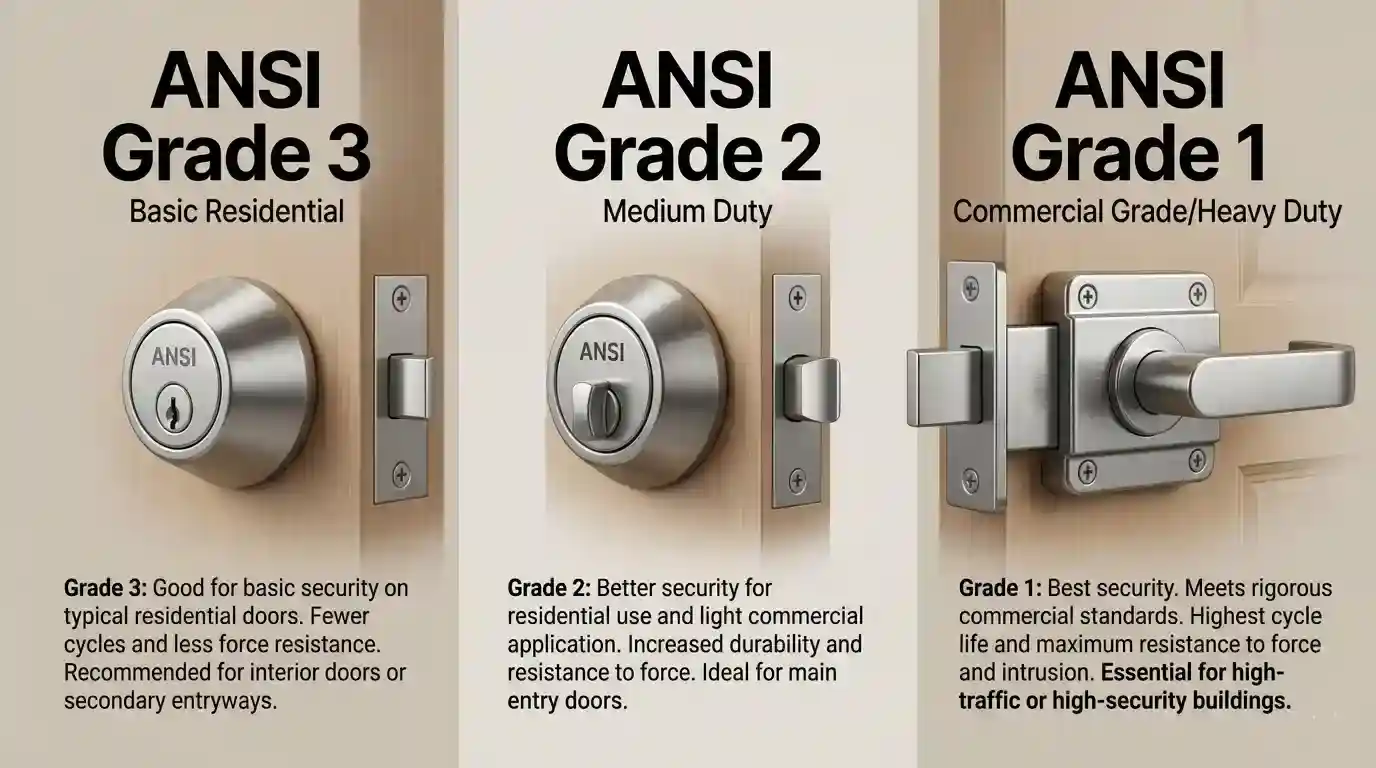
ANSI Grade 1, 2, and 3 aren't marketing tiers. They're the results of real laboratory tests — a million door cycles, 10 kicks from a battering ram, 360 pounds of lateral force. Here's exactly what each grade proves, and which one your front door actually needs.
By Johnny T.·March 2026·11 min read
Walk into any hardware store and flip a deadbolt box over. Somewhere in the fine print you'll find it: ANSI/BHMA Grade 1 — the American National Standards Institute and the Builders Hardware Manufacturers Association, jointly. Or Grade 2. Or, if you're looking at the $19 unit near the floor, Grade 3. Most people read it the same way they read a nutrition label — technically informative, practically ignored. That's a mistake.
Those grades aren't assigned by the manufacturer. They're awarded by an independent testing laboratory after a lock survives a very specific series of attacks, torque loads, cycle counts, and impact blows. A Grade 1 deadbolt has been thrown and retracted 250,000 times on a powered rig, with no lubrication permitted at any point, before it earned that designation. A Grade 3 deadbolt survived 100,000. And if the box in your hand holds a knob rather than a deadbolt, both of those numbers are wrong — which is the first clue that this system is considerably less tidy than the packaging suggests.
The system is run by two organizations most people have never heard of: ANSI (the American National Standards Institute), which provides oversight and accreditation, and BHMA (Builders Hardware Manufacturers Association), which actually writes the tests. BHMA is the only organization accredited by ANSI to develop and maintain performance standards for locks and door hardware in North America — they've been at it since 1983, and the A156 series of standards they publish is the benchmark the entire industry uses.
This guide breaks down what each grade actually requires, which tests are involved, and — most importantly — which grade you need for which door. No fluff. Just the numbers.
250,000
Cycles for a Grade 1 deadbolt
10
Ram blows Grade 1 must survive
40+
ANSI/BHMA A156 standards in the series
Before we get into each grade, one thing worth understanding, because it is the source of almost every wrong number written about this subject: the A156 series covers many different lock types, and each has its own test values. A156.36 covers deadbolts — the one that matters for a front door. A156.2 covers bored locks and latches, your typical knob or lever. A156.13 covers mortise locks. A156.5 covers cylinders; it used to include deadbolts too, but they were split out into A156.36 in 2010, which is why older references get tangled. The grade tiers — 1 toughest, 3 baseline — are consistent across all of them. The numbers behind those tiers are not.
1
Grade 1
250,000 deadbolt cycles
Heavy commercial, institutional, high-traffic
2
Grade 2
150,000 deadbolt cycles
Light commercial, apartment, main residential entry
Hospitals, schools, government buildings — and your front door if you're serious about it
Highest
Here is the thing almost nobody tells you, and it makes everything else on this page make sense: there is no such thing as a Grade 1 lock. There is a Grade 1 deadbolt, a Grade 1 bored lockset, and a Grade 1 mortise lock — and they are tested against three completely different standards with completely different numbers.
That single fact is the source of nearly every wrong figure you will read about lock grades, including on sites that ought to know better.
Which Standard Is Which
ANSI/BHMA A156.36 — Auxiliary Locks. This is the deadbolt standard. If you are buying a deadbolt for your front door, this is the one that matters. It also covers rim locks, narrow-stile locks and mortise deadlocks.
ANSI/BHMA A156.2 — Bored and Preassembled Locks and Latches. Knobs and levers — the handle you turn, not the bolt you throw.
ANSI/BHMA A156.13 — Mortise Locks. The heavy commercial units set into a pocket in the door edge.
ANSI/BHMA A156.5 — Cylinders and Input Devices. The cylinder itself, graded separately. Until 2010 this standard covered auxiliary locks too, which is why older references get tangled.
Now the cycle counts, which is where the internet falls apart. A cycle means throwing the bolt and retracting it once, on a rig running at up to thirty cycles a minute with no lubrication permitted at any point.
Grade 1 requirement
Cycles
Standard
Product
Deadbolt (dead lock)
250,000
A156.36
Your front door
Dead latch
500,000
A156.36
Latching aux locks
Bored lockset
800,000
A156.2
Knobs and levers
Mortise lock
1,000,000
A156.13
Commercial doors
So the famous "a million cycles" figure is real — it belongs to mortise locks under A156.13. Quote it about a deadbolt and you have overstated the requirement by a factor of four. A Grade 1 deadbolt is tested to 250,000 cycles, and that is in the published standard in black and white.
Why so much lower? Because a deadbolt does less work. A knob gets turned every single time anyone passes through the door; a deadbolt gets thrown when you leave and retracted when you come back. The standard is calibrated to realistic service life, not to bragging rights.
What Grade 1 actually buys you on a deadbolt, straight from A156.36:
Bolt strength: 1,350 lbf applied an inch from the door edge, on the bolt centreline, while engaged in the strike. Grade 2 is 1,125 lbf; Grade 3 is 675 lbf. For rim and narrow-stile deadbolts, Grade 1 rises to 1,800 lbf.
Cylinder face impact: ten blows at 75 foot-pounds. Grade 2 takes five, Grade 3 takes two.
Cylinder guard tension: 3,600 lbf trying to pull the guard off the door. Grade 2 is 2,500 lbf; Grade 3 is 1,000 lbf.
Cylinder assembly torque: 300 pound-inches applied rapidly in both directions. Grade 2 is 150; Grade 3 is 120.
Bolt projection: a full inch on any bored deadbolt, at every grade.
What Grade 1 Looks Like in the Real World
Grade 1 hardware is standard in schools, hospitals, government buildings, hotels and anywhere a door gets used a few hundred times a day by people who did not pay for it. On a house it is arguably more than you need — but it is widely available at residential prices, and the Schlage B60N sits at around $33–52 while carrying it.
That torque figure is worth remembering. It is the number a cylinder has to survive before it earns Grade 1 — and it is the benchmark by which some well-known consumer cylinders have been publicly embarrassed.
Grade 2 of 3
Grade 2 — The Sweet Spot
Where most residential deadbolts live — and where most people should probably be
Mid-Tier
Grade 2 is where the overwhelming majority of decent residential deadbolts live, and it is not a consolation prize. On the tests that describe surviving a shoulder, it sits closer to Grade 1 than the numbering implies.
Deadbolt test (A156.36)
Grade 1
Grade 2
Grade 3
Cycles
250,000
150,000
100,000
Bolt strength (bored)
1,350 lbf
1,125 lbf
675 lbf
Cylinder face impact
10 blows
5 blows
2 blows
Cylinder guard tension
3,600 lbf
2,500 lbf
1,000 lbf
Lock body torque
120 lbf-ft
80 lbf-ft
40 lbf-ft
All figures from ANSI/BHMA A156.36, sections 10.5, 11.2 and 12.
Look at the bolt strength row. Grade 2 holds 1,125 pounds against 1,350 — about 83% of Grade 1. Then look at Grade 3 at 675 pounds, half of Grade 1. The gap between 2 and 3 is far wider than the gap between 1 and 2, which is the opposite of what the tidy 1-2-3 numbering suggests.
Two Impact Tests, Not One
You will see two completely different impact figures quoted for deadbolts, and both are correct — they are different tests in the same standard.
Cylinder face impact and cylinder guard impact both use 75 foot-pounds, and the grade sets how many blows the lock has to eat: ten, five or two.
The bolt impact test escalates instead. Grade 3 takes two blows at 60 foot-pounds plus two at 90. Grade 2 adds two more at 120. Grade 1 adds two at 150 on top of that — eight blows, ending considerably harder than anything Grade 3 sees.
So "Grade 1 survives ten blows at 75 foot-pounds" and "Grade 1 survives blows up to 150 foot-pounds" are both true statements about the same lock. They are just describing different parts of the test suite.
There is one more Grade 2 detail that catches people out. Bolt projection is a full inch for all grades of bored deadbolt — the common residential type. But for mortise locks, Grade 2 only has to project 5/8 of an inch, and Grade 2 narrow-stile only 3/4. If you are buying anything other than a standard bored deadbolt, the throw is worth checking rather than assuming.
Grade 3 of 3
Grade 3 — Not Junk. Just Baseline.
It passed real tests — just fewer of them. Context determines whether that's fine.
Residential
Grade 3 has a reputation problem, and the standard itself does not support it.
You will read everywhere that Grade 3 is "for interior doors only" — bedrooms, closets, bathrooms. That is not what A156.36 says. Here is the actual language, from Appendix A of the published standard:
Dead bolt locks are usually the most secure. Those wishing a relatively high level of security specify Grade 1 or 2. Grade 3 is generally adequate in areas where the threat is an attack of opportunity and where the attack is expected to be of short duration.
— ANSI/BHMA A156.36, Appendix A-1.1
"An attack of opportunity, expected to be of short duration" is a precise description of the overwhelming majority of residential burglaries. The standard is not saying Grade 3 belongs on a linen cupboard. It is saying Grade 3 is calibrated for the opportunist rather than the determined attacker — which is who actually turns up.
That does not make Grade 3 a good choice for a front door. A Grade 3 bored deadbolt still has to throw a full inch, but it only has to hold 675 pounds against 1,350 for Grade 1, and it takes two impact blows where Grade 1 takes ten. On a main entry you are giving away the margin that matters. But "unsafe" is the wrong word, and the difference between a Grade 3 deadbolt and no deadbolt is far larger than the difference between Grade 3 and Grade 1.
The Line Nobody Reads
Buried in the same appendix is the most valuable sentence in the entire standard, and it is not about grades at all:
"Where lock strikes are applied to wood frames under 1 inch thick, screws normally furnished are sometimes inadequate. Specify screws of sufficient length to engage the structural stud behind the frame."
The people who write the lock standard are telling you, in the document that defines lock grades, that the screws in the box are not long enough. A box of three-inch screws costs a few dollars and does more for a typical door than moving up two grades. We have a whole guide to this, and it exists because of that paragraph.
The standard is equally blunt about its own limits. Appendix A-4 states that it evaluates locks as a component and "does not take under consideration the variety of doors, frames and other components available, some of which are vulnerable under the kinds of attacks described." A grade describes the lock. It says nothing whatsoever about the wood it is screwed into.
Behind the Grade
What the Tests Actually Look Like
Five categories of testing — here's how each one works
A156.36 sorts its tests into five classifications: operational, cycle, strength, security and finish. The bored-lockset and mortise standards add a sixth, material evaluation. Testing is done on samples — three locks for cycle testing, three for strength, twelve for security — and the rule is unforgiving: failure of any one lock in any test fails the entire qualification.
1. Cycle Testing
The bolt is thrown and retracted on a powered rig at up to thirty cycles a minute. No lubrication is permitted at any stage. Halfway through, the lock is re-tested against the operational requirements — it has to still be working correctly, not merely intact — and it is allowed one repositioning and tightening at the 50% mark.
For deadbolts under A156.36: 250,000 cycles for Grade 1, 150,000 for Grade 2, 100,000 for Grade 3. Dead latches, which take more punishment, run 500,000 / 300,000 / 200,000. Bored locksets under A156.2 run 800,000 / 400,000 / 200,000. Mortise locks under A156.13 run 1,000,000 for Grade 1 and 800,000 for Grades 2 and 3.
Cycle test by standard
Grade 1
Grade 2
Grade 3
Deadbolt (A156.36)
250,000
150,000
100,000
Dead latch (A156.36)
500,000
300,000
200,000
Bored lockset (A156.2)
800,000
400,000
200,000
Mortise lock (A156.13)
1,000,000
800,000
800,000
Cylinder face impact
10 blows
5 blows
2 blows
Typical application
Commercial / high security
Light commercial / home entry
Opportunistic threat
Impact blows are all at 75 ft-lbf. Mortise Grades 2 and 3 share the same cycle requirement.
2. Operational Force Testing
Can a person actually use it? Torque to retract the bolt must not exceed 9 pound-inches for a key, turn or knob, 28 for a lever, or 12 pounds of force for a paddle. Force to latch the door tops out at 4.5 pounds for every grade.
Then the warped-door test, which is the one that predicts real-world annoyance. A 50-pound load is applied to press the bolt against the strike, simulating a door that has swollen or dropped on its hinges, and the lock still has to retract within specified torque — 33 pound-inches by key, 50 by turn. This is why a cheap deadbolt gets stiff in August and a good one does not.
3. Strength and Torque Testing
Force applied an inch from the door edge, on the bolt centreline, while the bolt is engaged in the strike. Grade 1 bored deadbolts hold 1,350 lbf, Grade 2 1,125 lbf, Grade 3 675 lbf. Rim and narrow-stile Grade 1 deadbolts go to 1,800 lbf.
Separately, the thumbturn takes 150 pounds pulled straight out from the door at every grade, and a vertical load of 250 pounds for Grades 1 and 2. The lock fails if the door opens, if the thumbturn comes off, or if it no longer meets the operational requirements afterwards.
4. Security (Impact) Testing
The security section is the interesting one, and it is much broader than the impact figure everyone quotes. It includes cylinder guard impact and tension, lock body tension and torque, cylinder assembly pulling and torque, cylinder face impact, bolt impact, bolt compressive load — and a sawing test.
The sawing test is exactly what it sounds like: the projected bolt is fed into a band saw under a sustained five pounds of pressure, using a fresh blade running at 100 feet per minute. Grade 1 narrow-stile bolts must resist for thirty minutes. Everything else at Grades 1 and 2 must last five.
Throughout the security tests, the tester is permitted to work at the lock with a screwdriver for up to five minutes after each attack, and failure means any damage that lets the door open.
5. Material and Finish Testing
Neutral salt spray for 200 hours on uncoated materials, 96 hours on organic coatings. Humidity for 240 hours. Ultraviolet light and condensation cycling for 144 hours. Perspiration testing — genuinely, four cycles of simulated hand sweat. None of this makes a lock harder to break. It determines whether the finish still looks like a lock after five winters.
What the Standard Does Not Test
A156.36 contains no pick-resistance test. None. The standard says so itself, in section 3.2: for applications "where pick resistance and other higher security protections are required," it directs users to locks meeting UL 437 or ANSI/BHMA A156.30 for High Security Cylinders.
So a Grade 1 deadbolt is certified to resist being kicked, drilled, wrenched, pulled, sawn and hammered. Whether it resists being picked is a question this grade does not answer, and any product page implying otherwise is reading its own certification wrong.
One more rule with teeth, from section 3.1: "Assemblies take the grade level of the lowest graded component." A Grade 1 lock body fitted with a Grade 2 cylinder is a Grade 2 assembly. There is no averaging anywhere in this system.
Common Errors
Three Things People Get Wrong
The grade is one piece of the security picture — not the whole thing
1. "Grade 3 Means the Lock is Unsafe"
The standard's own appendix says Grade 3 is "generally adequate in areas where the threat is an attack of opportunity and where the attack is expected to be of short duration" — which describes most residential burglaries. Grade 3 is the entry level of a commercial scale, not a warning label. It is still the wrong choice for a main entry, because you are giving up half the bolt strength and eight of ten impact blows for very little saving. But the gap between Grade 3 and no deadbolt dwarfs the gap between Grade 3 and Grade 1.
2. "Grade Alone Determines How Secure a Lock Is"
Appendix A-4 of A156.36 disposes of this in one sentence: the standard evaluates the lock as a component and does not account for "the variety of doors, frames and other components available, some of which are vulnerable under the kinds of attacks described."
A Grade 1 deadbolt holds 1,350 pounds. A softwood door jamb with three-quarter-inch screws holds a great deal less, and it is the jamb that splits when someone kicks. The grade is a statement about the lock in a laboratory fixture, not about your doorway.
And as above, the grade says nothing about picking, bumping or key control. Those live in UL 437 and A156.30, which is where high-security cylinders like Abloy Protec2, Medeco Maxum and Mul-T-Lock MT5+ are certified.
3. "ANSI Grade and BHMA AAA Rating Are the Same System"
They are two systems, and this is the single most common error in consumer lock writing — including on packaging.
Grade 1, 2 and 3 come from the commercial standards, principally A156.36 for deadbolts. One number, covering everything.
A, B and C come from the residential standards, which BHMA first published in 2015: A156.39 for residential locksets and latches, and A156.40 for residential deadbolts. A residential lock is graded separately in three categories — security, durability and finish — where C is Good, B is Better and A is Best. A lock scoring top marks in all three is described as AAA.
So "Grade 1, the highest residential rating" is not a slightly loose phrase. It welds two scales together. Grade 1 is the top of the commercial scale. AAA is the top of the residential scale. A lock can hold one, both, or neither — the Schlage Encode Plus, for instance, is certified to both.
How the Two Scales Compare
There is no official conversion, and BHMA does not publish one. But a BHMA representative told PCWorld that the commercial grades are "a little tougher, since they are designed for commercial use and BHMA grades are residential," and put the rough equivalence at ANSI Grade 2 ≈ BHMA security grade A.
Which reframes the residential scale considerably. An A for security is not the residential equivalent of Grade 1 — it lands nearer Grade 2. And AAA is rarer than you would expect, because of how the categories are scored: if a category contains fifteen tests and a lock takes top marks on fourteen and a B on one, the whole category is a B. Lowest result wins. No averaging, no rounding up.
4. "Meets the Standard" and "Certified" Mean the Same Thing
They do not, and the difference is the whole ballgame. Certified means an accredited independent laboratory tested the product and BHMA listed it. Meets means the manufacturer believes it would pass if anyone checked.
BHMA is unusually direct about this. Asked by PCWorld, a spokesperson said that where they find language stating a product "meets standards," it "is considered misleading and we send them a letter asking them to certify the product" — adding that misuse of BHMA certification logos on uncertified hardware is commonplace.
You can check any lock yourself in about ninety seconds. BHMA maintains a public Certified Products Directory at buildershardware.com, listing every product actually tested and certified; for the two residential standards there is a consumer-facing site at securehome.org. Certified residential products carry a "BHMA Certified Secure Home" label showing the A, B or C awarded in each of the three categories. If a lock is not in the directory, it is not certified, whatever the box says.
Questions
Frequently Asked Questions
The ones that come up every time this subject does
No. Grade 1 is the top of the commercial scale, principally ANSI/BHMA A156.36 for deadbolts. Residential locks are graded under separate standards published in 2015 — A156.39 for locksets and A156.40 for deadbolts — which rate a lock A, B or C in each of three categories: security, durability and finish. A lock scoring top marks in all three is AAA. A lock can hold a commercial Grade and a residential AAA, both, or neither.
It depends entirely on what kind of lock it is, which is why this figure is so often misreported. Under A156.36, a Grade 1 deadbolt is tested to 250,000 cycles and a Grade 1 dead latch to 500,000. Under A156.2, a Grade 1 bored lockset — a knob or lever — is tested to 800,000. Under A156.13, a Grade 1 mortise lock is tested to 1,000,000. The widely quoted million-cycle figure belongs to mortise locks.
It is not the right choice for a main entry, but it is not a warning label either. The standard's own appendix says Grade 3 is generally adequate where the threat is an attack of opportunity expected to be of short duration — which describes most residential burglaries. That said, a Grade 3 deadbolt holds 675 pounds where Grade 1 holds 1,350, and takes two impact blows where Grade 1 takes ten. On a front door the extra margin is worth the small price difference.
No, and the standard says so itself. A156.36 contains no pick-resistance test. Section 3.2 directs anyone who needs pick resistance to locks meeting UL 437 or ANSI/BHMA A156.30 for High Security Cylinders. A Grade 1 deadbolt is certified against being kicked, drilled, wrenched, pulled, sawn and hammered — picking is a question that grade does not answer.
Certified means an accredited independent laboratory tested the product and BHMA listed it. Meets means the manufacturer believes it would pass if tested. BHMA considers the latter misleading and says it writes to companies asking them to certify, noting that misuse of its certification logos is commonplace. You can check any product in BHMA's public Certified Products Directory in about ninety seconds.
No, and this is the most important limitation of the whole system. Appendix A-4 of A156.36 states that it evaluates locks as a component and does not account for the variety of doors and frames available, some of which are vulnerable to the same attacks. The same appendix advises specifying screws long enough to reach the structural stud behind the frame, because the ones supplied are often inadequate. A 1,350-pound bolt in a jamb held by three-quarter-inch screws is limited by the jamb.
Not necessarily — but the assembly cannot claim more than its weakest part. Section 3.1 of A156.36 states that assemblies take the grade level of the lowest graded component, so a Grade 1 lock body fitted with a Grade 2 cylinder is a Grade 2 assembly. The residential standards work the same way within each category: if a category contains fifteen tests and a lock earns top marks on fourteen and a B on one, the category is scored B.
Sources & Method
Every figure on this page comes from the published standards themselves, not from secondary summaries — which matters, because the secondary summaries disagree with each other constantly. Deadbolt figures are taken directly from the text of ANSI/BHMA A156.36 for Auxiliary Locks: cycle counts from section 10.5, bolt strength from 11.2, impact and torque values from section 12, and the appendix quotations from Appendix A. Bored lockset figures are from A156.2, mortise figures from A156.13, and the residential system from A156.39 and A156.40.
On the commercial-to-residential comparison. There is no official conversion between the two scales and BHMA does not publish one. The rough equivalence of ANSI Grade 2 to a BHMA security grade A, and the rule that the lowest test result sets the category grade, come from a BHMA representative quoted by PCWorld.
Check any lock yourself in BHMA's Certified Products Directory at buildershardware.com, or at securehome.org for the two residential standards. Current editions at the time of writing are A156.36-2020 and A156.40-2025; figures cited here are stable across recent editions, but standards are revised roughly every five years.
The Bottom Line
Which Grade Does Your Door Actually Need?
Front entry deadbolt: Grade 1 if you can find it at a reasonable price point, Grade 2 as the practical floor. The Schlage B60N (Grade 1) and B62N (Grade 2) are a dollar or two apart at most retailers. There's no good reason to go lower on a main entry.
Interior doors (bedroom, bathroom, closet): Grade 3 is exactly right. You're not protecting against forced entry — you're providing privacy. Grade 3 hardware does that well and lasts a very long time in that context.
Apartment building common areas, office entry doors, storage units, garages with interior access: Grade 2 minimum. These doors see more traffic than a residential entry and deserve the higher cycle count.
High-security commercial, healthcare, schools: Grade 1, full stop. Most commercial specifications legally require it — and for good reason. A school door gets opened 50 times a day. A million cycles buys you about 55 years at that rate.
One last thing: whatever grade you choose, the frame matters more than the lock. A Grade 1 bolt throws into a door frame with a single ¾-inch screw holding the strike plate? The frame splits on the first good kick. Spend $15 on 3-inch screws for your strike plate before worrying about the difference between Grade 1 and Grade 2.