A video doorbell sits on the one square foot of your property that matters most: the spot a burglar checks first and a delivery driver stands on every week. That makes it the highest-value camera you can own — and also the most oversold. The marketing promises deterrence; the evidence mostly supports documentation. Those are different products, and knowing which one you are buying changes which doorbell you should get. We ranked ten on video quality, detection, what the subscription actually costs, and what the company does with your footage.
Both major subscriptions were renamed in the last year, so much of what you will read online quotes plans that no longer exist. Nest Aware is gone — it became Google Home Premium in October 2025. Ring Home became Ring Protect on 14 January 2026. Ring now sells two completely different doorbells under one name. And one of the AI features everyone recommends cannot legally be used in three parts of the country.
The deterrence question also deserves a straight answer rather than the usual one. The studies do not show what the marketing claims, and what they do show is more useful.
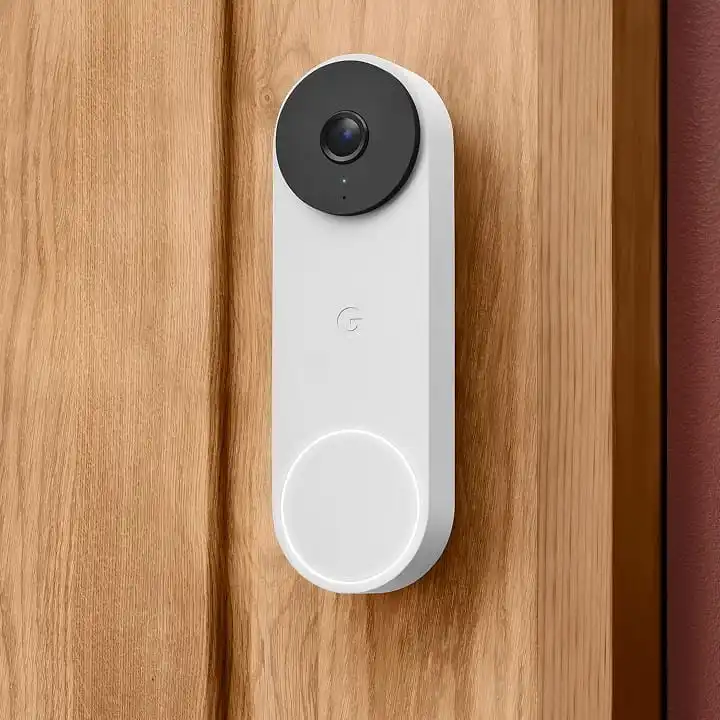
The sharpest image on this list and the best AI, with one large caveat: nearly everything people praise about this doorbell arrives on a subscription, and Nest cameras cannot store a thing locally.
- 2K HDR — Google's sharpest doorbell image yet
- Independently rated first in class for image quality by DXOMARK
- 166° field of view covers a whole porch
- Natural-language history search genuinely works
- Familiar face alerts name the visitor
- Hardwired — nothing to recharge
- Free tier still gives you live view, alerts and two-way audio
- No microSD, no local recording, no offline archive — at all
- The Gemini features require a paid plan
- Search-by-question needs the $20/month tier specifically
- Hardwired only — no battery version of this model
- Google raised subscription prices in 2025, the second rise since 2023
The hardware deserves the top spot. Google's 2025 refresh moved the whole Nest camera line to 2K HDR, and Google says independent testing by DXOMARK ranked all three new models first in their class for image quality. The 166° field of view is the widest Nest has shipped. Colour night vision is good enough to read a delivery label. As a piece of glass and silicon pointed at your door, nothing here beats it.
The storage claim is where most write-ups go wrong. You will see this doorbell credited with "6 hours of free on-device storage," and that phrasing is misleading in a way that matters. Nest cameras have no local storage of any kind — no microSD slot, no recording to a base station, nothing. The free allowance is a short window of cloud event history, which Google increased from three hours to six during the Google Home Premium transition. If your internet drops or you cancel the subscription, there is no archive sitting in your hallway. Compare that with the eufy and Tapo entries further down, where "local storage" means an actual card you can hold.
The other thing worth pricing properly is the AI. Gemini is the reason to buy this doorbell over a cheaper one, and Gemini is not free. Google's own listing states plainly that Gemini features require a Google Home Premium subscription. Familiar faces and package alerts sit on the Standard plan at $10 a month. Asking your doorbell "when did the parcel arrive on Tuesday?" — the feature every review leads with — is on the Advanced plan at $20 a month or $200 a year. Over three years that is $600 on top of the doorbell, which is worth knowing before you fall in love with the demo.
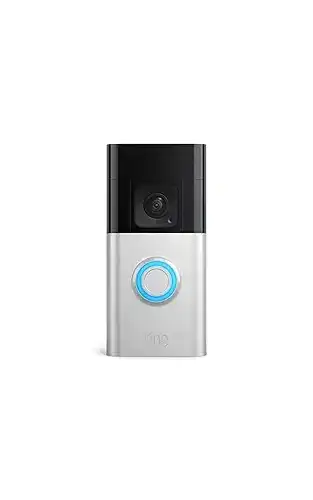
The square head-to-toe frame is the right shape for a doorbell — it sees the visitor and the parcel at their feet in one view. Installs in ten minutes on battery, or wire it and forget it.
- 1:1 frame shows the doorstep, not just the visitor's face
- Battery or wired — genuine flexibility
- Colour night vision
- 180 days of video history on a plan, the longest here
- Best-in-class Alexa integration
- Reasonable at $150
- Records nothing without a subscription
- No Google Home or Apple Home, ever
- Battery needs pulling down to recharge
- Ring's own privacy record is the worst on this page
- Now outclassed within Ring's own range
The aspect ratio is the real argument. Most cameras shoot a wide 16:9 letterbox, which is the wrong shape for a doorway — it captures your neighbour's hedge and cuts off the ground where the parcel actually is. Ring's 1:1 head-to-toe frame trades horizontal sweep for vertical reach, so a delivery on the mat and the face of the person collecting it appear in the same shot. If package theft is your reason for buying, aspect ratio matters more than megapixels.
Two things to know that were not on this page before. First, the subscription is not optional in any meaningful sense: without a Ring Protect plan the doorbell will alert you and show you a live view, but it saves nothing, so the event you actually wanted is gone. Second, Ring has since released a Battery Video Doorbell Pro that shoots what it calls Retinal 4K, so the Plus is no longer the best battery doorbell Ring makes — it is the best-value one.
The plan names have changed too, and this trips up every older article. See the subscription section for what Ring's tiers are actually called in 2026 and what each one covers.
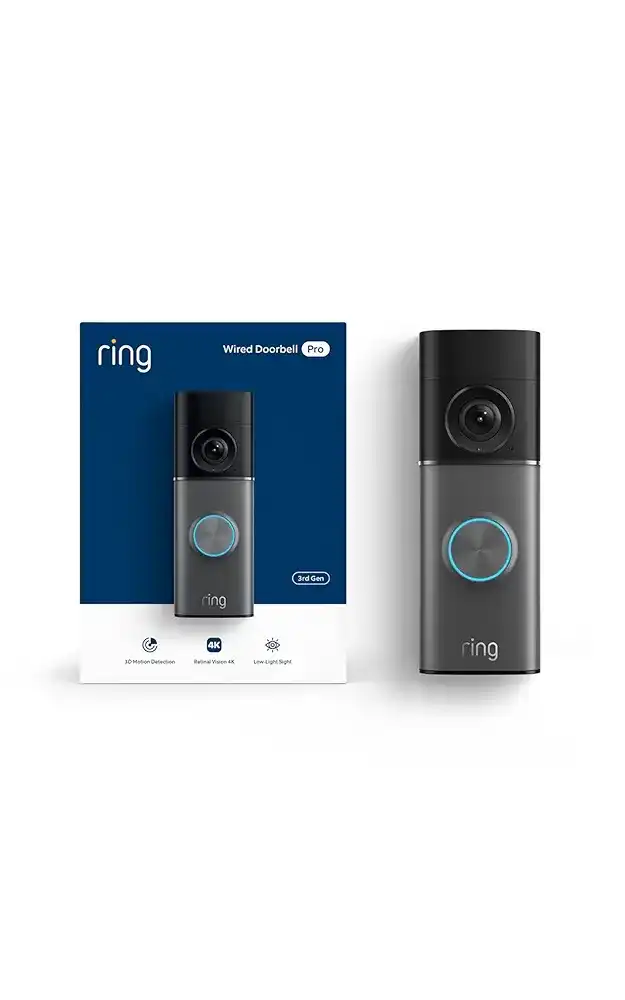
The sharpest doorbell you can buy — 2880 × 2880 with ten-times zoom and true-colour low-light video. Just make sure you buy the right one, because Ring sells two very different doorbells under almost the same name.
- Genuinely the best image quality of any doorbell here
- 10× zoom that stays legible — reads plates and labels
- True colour video in near-darkness
- Radar-based 3D Motion Detection with mapped zones
- Chime Kit Mini included, no wiring fuss
- Sleeker than the doorbell it replaces
- Needs 15–20 Mbps upload — many homes do not have it
- Shares a name with a much cheaper 1536p model
- Familiar Faces costs extra and is unavailable in three jurisdictions
- Hardwired only
- Nothing recorded without a plan
Take the name warning seriously, because this is the single easiest mistake to make in the category. Ring currently sells a Wired Doorbell Pro shooting 1536p head-to-toe with Bird's Eye View, which regularly discounts to about $130 against a $230 list. It also sells the Wired Doorbell Pro (3rd Gen), also marketed as the Wired Doorbell 4K Pro, shooting 2880 × 2880 with Low-Light Sight and 10× zoom, listing at $250 and streeting around $200. Same shelf, same brand, same three words in the name, roughly double the pixel count. Plenty of write-ups blend them — quoting the 4K specifications against the cheaper model's price — which is exactly the kind of mix that makes a review useless.
The 4K is not free of consequences. Ring recommends at least 15 Mbps of upload for the full-quality stream and suggests 20 Mbps or more is ideal. Plenty of cable and DSL homes run 5 to 10 Mbps up, in which case the doorbell will quietly downgrade its own stream and you will have paid for resolution you never see. Check your upload speed, not your download speed, before buying this one.
Familiar Faces deserves its own warning. It is not included — it belongs to Ring's Pro Intelligence add-on at roughly $5 a month, applied to a single camera, on top of a Solo or Multi plan. And it is not available in Illinois, Texas or Portland, Oregon, where biometric privacy law restricts it. Several related features, including Video Descriptions and Active Warnings, are also unavailable in Illinois. If you live in one of those places, the marketing on the box describes a doorbell you cannot fully own.
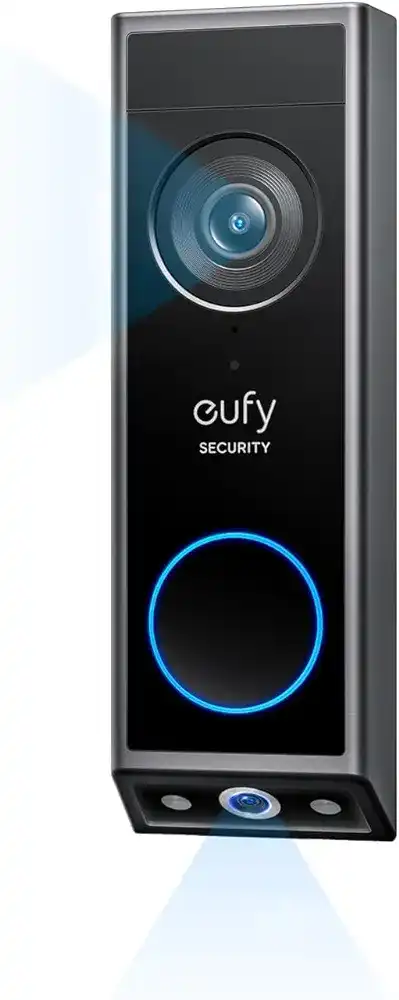
The only doorbell here with a second camera pointed straight down at your doormat. Everything records locally, nothing costs monthly — from a company with a documented history of being wrong about exactly that.
- Second camera watches the doorstep continuously
- Best package detection of anything on this list
- Local storage — footage you physically possess
- No subscription, ever
- Battery or wired
- Cheaper over three years than any Ring or Nest
- Anker was caught misrepresenting exactly this feature
- No Apple Home
- Bulkier than a single-camera doorbell
- App is less polished than Ring or Nest
The dual-camera design is the smartest engineering on this page. Every other doorbell infers a package by running AI over a single wide image and guessing whether that brown rectangle is a box. The E340 has a second lens aimed down at the mat, so it does not infer anything — it looks. It also solves the problem that a tall visitor's face and a parcel on the ground are rarely in the same part of the frame.
Now the part you need before you buy, and unlike the eufy lock we cover elsewhere, this one is directly relevant, because this is a camera. In late 2022 the security researcher Paul Moore demonstrated that eufy devices marketed under the slogan "No Clouds or Costs" were uploading name-tagged thumbnail images and facial recognition results to Amazon Web Services servers while cloud storage was switched off. The Verge reproduced it and went further, streaming footage from a eufy camera from the other side of the country with no encryption at all. Anker denied parts of it, then conceded images were uploaded for notification purposes, then admitted in a forum post it "must be more clear" about which processes were local, and finally acknowledged in early 2023 that the cameras had never been end-to-end encrypted.
Anker has since tightened things up, and a 2026-firmware eufy camera is a materially more private device than a 2022 one. But the specific promise this doorbell sells on — your video stays yours — is the exact promise the company was caught breaking. If you buy it, go into the notification settings and switch thumbnail previews to text-only, which stops images leaving the house at all. That is a one-minute change that makes the marketing true.
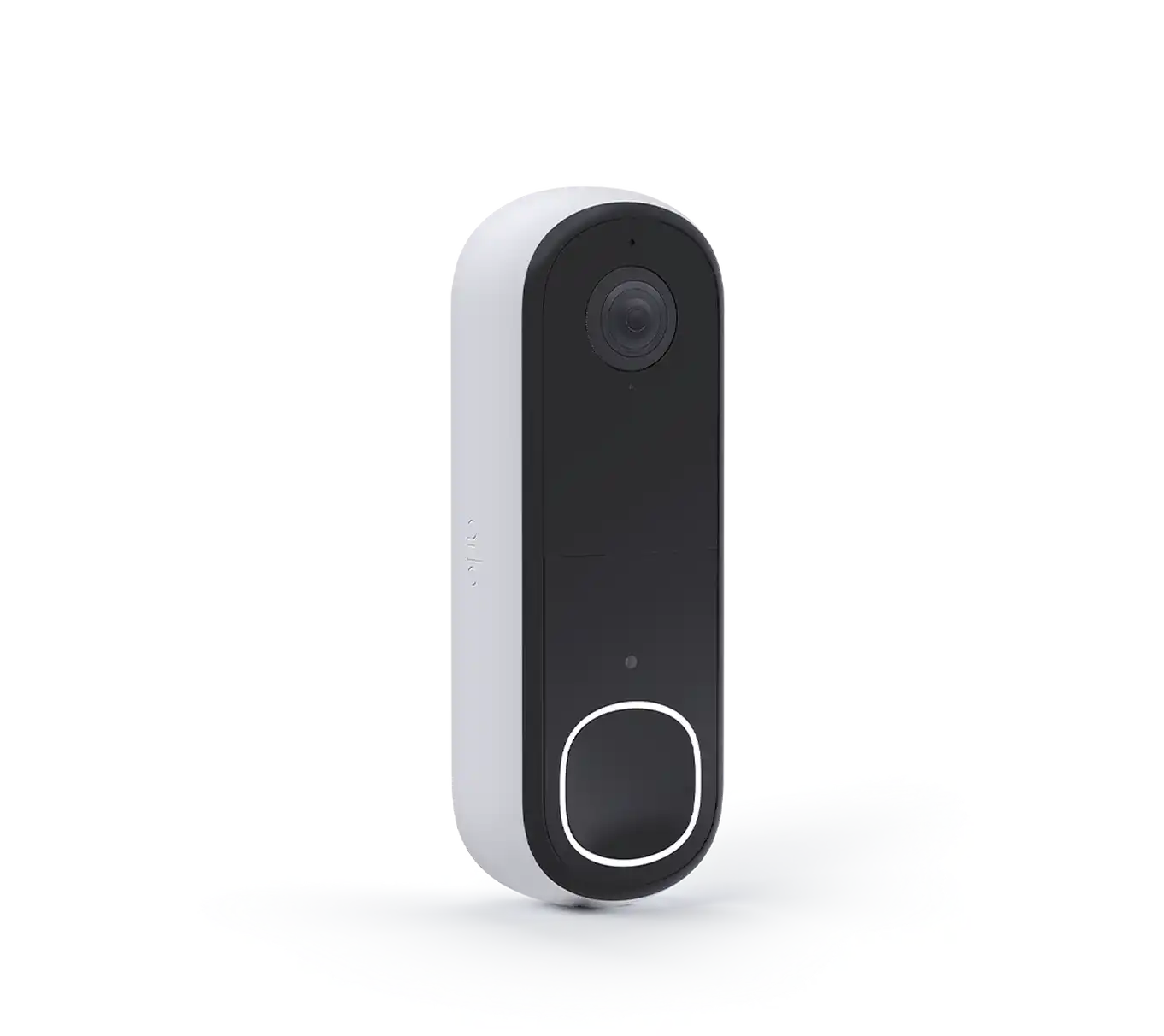
The doorbell that does not care which phone you own — Alexa, Google and, with the right setup, Apple. A square frame, 2K video and a direct-call feature that rings your phone like a call.
- Widest platform support of the mainstream brands
- Square frame catches the doorstep
- Built-in spotlight gives real colour at night
- Direct call is the best "someone is at the door" alert going
- Battery or wired
- Often the cheapest 2K doorbell here
- AI detection and recording need an Arlo Secure plan
- No local storage on the doorbell itself
- Battery life drops sharply on a busy street
- Arlo has previously cut features from older hardware
Arlo's pitch is neutrality. Ring is an Amazon product that speaks Alexa and refuses to speak Google; Nest is a Google product that does the reverse. Arlo sells to whoever turns up, which makes it the sensible choice for a mixed household or anyone who suspects they might switch ecosystems in the next five years.
The direct-call feature is underrated and genuinely changes behaviour. Most doorbells fire a push notification that competes with every other notification on your phone, so you see it four minutes later. Arlo makes it ring like an incoming call, which is impossible to ignore and means you actually answer the door to the delivery driver instead of watching a recording of them leaving.
The catch is the same one Ring has: without an Arlo Secure subscription you get alerts and a live view but no saved recordings and no person-versus-package intelligence. Budget for it, or buy one of the local-storage options below.
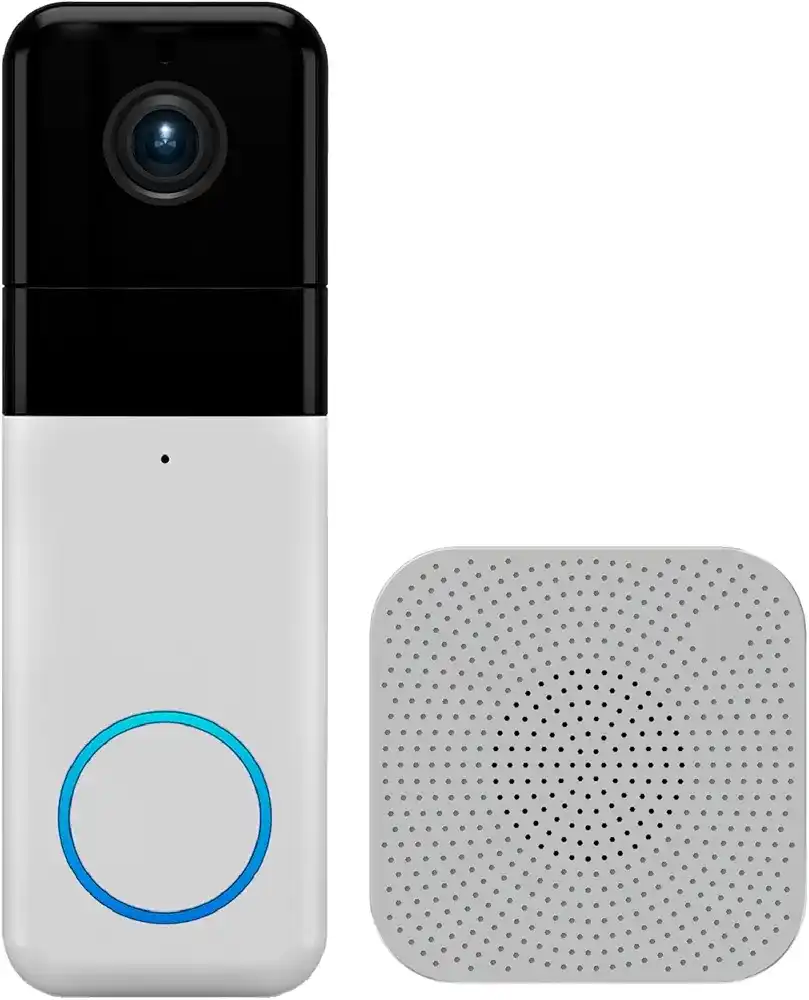
Head-to-toe framing, colour night vision and a wireless chime in the box, for less than a Ring costs in subscriptions over a year. The specs are remarkable. The company's track record is not.
- Costs less than a year of most competitors' subscriptions
- Head-to-toe framing at a budget price
- Colour night vision
- Chime in the box — no extra purchase
- Cam Plus is the cheapest plan on this page
- Pairs with Wyze locks for unlock-from-the-feed
- Wyze took nearly three years to fully patch a 2019 disclosure
- Showed roughly 13,000 users other people's camera feeds in 2024
- Cam Plus went up 50% in March 2026
- Build quality is what you would expect at the price
- No Apple Home
On pure value nothing here comes close. You get the frame shape that actually matters for parcels, colour night vision, a chime in the box, and a subscription that costs less than a coffee. For a back door, a side gate, or a first camera on a tight budget, it is an easy recommendation on the hardware alone.
The reason it is not higher is the company's history, and it is worth setting out plainly rather than gesturing at "privacy concerns." Bitdefender disclosed a set of vulnerabilities in March 2019 that Wyze did not fully patch until January 2022 — close to three years. The original Cam v1 could not be fixed at all and was retired in February 2022. Then in February 2024, roughly 13,000 Wyze users were shown thumbnails and feeds belonging to strangers after a caching library mismapped device and user identifiers, an incident that followed a similar one the previous September.
Note also that Cam Plus rose from $1.99 to $2.99 per camera in March 2026 — a 50% increase that still leaves it the cheapest plan here, but the direction of travel is the same everywhere. Our Ring vs Wyze doorbell comparison puts the two head to head.
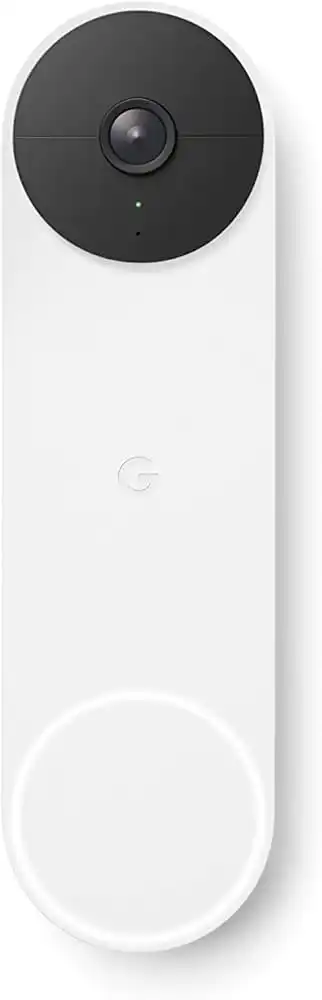
Two screws and you are done — no transformer, no chime wiring, nothing to trip a breaker over. The renter's Nest, with the same subscription maths as its wired sibling.
- Genuinely no wiring — works on any door frame
- Tall 3:4 frame catches the doorstep
- Comes off the wall when you move out
- On-device detection works without a plan
- Same Google Home ecosystem as the wired model
- Battery needs recharging every few months
- Older sensor than the 3rd-gen wired model
- No local storage — same as every Nest
- Cold weather shortens battery life noticeably
This is the doorbell for the very common situation where there is no doorbell wiring, or where the wiring exists but belongs to a landlord who would rather you did not touch it. Two screws, a rechargeable battery, done. If you do have wiring you can connect it for continuous power and skip the recharging entirely — the same unit does both.
The trade against the 3rd-gen wired model is image quality: the battery unit uses the older sensor and does not shoot the new 2K HDR. For a doorstep at conversational distance that is rarely the difference between identifying someone and not. The subscription story is identical, which means the Gemini features everyone demonstrates are a paid add-on here too.
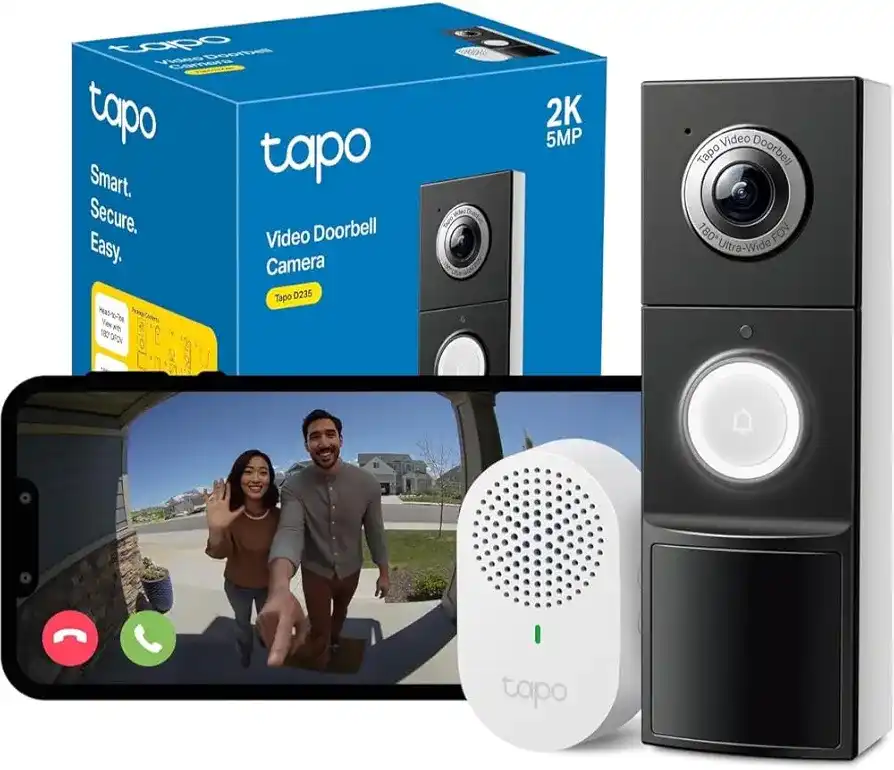
A 5-megapixel sensor, half a terabyte of local storage, and person, vehicle and package detection that costs nothing per month. The best specification-per-dollar on the page.
- 2K+ resolution for around $100
- 512GB of local storage — months of footage you own
- Person, vehicle and package detection with no plan
- Nothing recurring, ever
- Works with Alexa and Google
- Consumer Reports rates TP-Link poorly on data privacy
- Hardwired only
- Infrared night vision — no colour after dark
- No Apple Home
- Harder to find at retail than the big brands
The value case is almost absurd. A 512GB card in the slot gives you months of recorded events sitting in your own hallway, retrievable with no account, no app subscription and no company in between. Person, vehicle and package detection all run without a plan — the exact three features Ring and Google put behind a paywall. Feature for feature against the $150 Ring at number two, this is a better deal by a wide margin on paper.
The reason it sits at eight rather than two is that a doorbell is a camera pointed at your home, and Consumer Reports has rated TP-Link poorly on data privacy. That is a rating rather than a documented incident of the kind Ring, eufy and Wyze each have on their records, and we are not going to inflate it into one. But it is the relevant known fact, and if data handling is the thing you care about, a strong privacy rating is worth more than a spec sheet. If it is not the thing you care about, this is the most hardware anyone will sell you for $100.
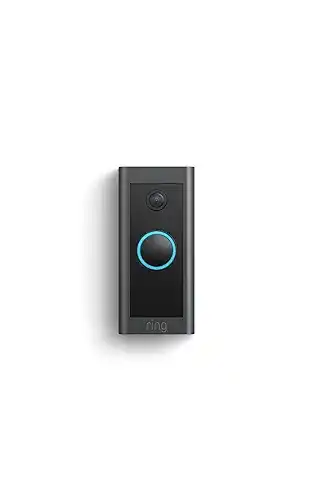
The cheapest way into Ring at $50 — small, discreet, hardwired, and honest about being basic. Just remember the subscription is what makes it record anything.
- $50 — cheapest doorbell from a major brand
- Smallest and most discreet Ring
- Custom motion zones cut false alerts
- Full Alexa integration
- Hardwired — no charging
- 1080p and a letterbox frame — misses the doorstep
- No package detection
- Infrared only at night
- The plan costs more than the doorbell within a year
- No existing-chime support without an adapter
There is an honest place for this doorbell: you want to see and speak to whoever is at the door, you already have wiring, and you do not want to think about it further. At $50 it does that.
What it does not do is the thing this whole category is sold on. The frame is a standard letterbox, so a parcel on the mat frequently falls outside it — the exact failure the head-to-toe models at numbers two, five and six were designed to fix. There is no package detection at any subscription tier. And the arithmetic is worth doing out loud: $50 for the hardware, then $4.99 a month to save any footage at all, which is roughly $180 over three years. The doorbell is the cheap part. If you are going to pay that anyway, the Battery Doorbell Plus at $150 is a substantially better camera on the same plan.
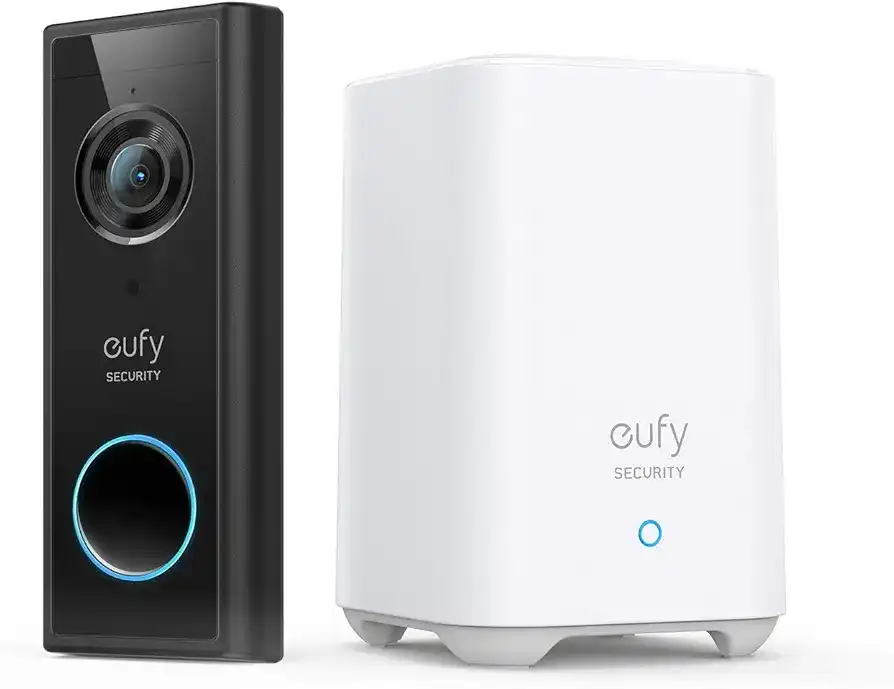
2K video and a storage box included, for a hundred dollars and nothing per month. The simplest way to own your footage outright.
- 2K plus a storage base for $100
- Nothing recurring
- Human detection included
- Battery or wired
- Footage stays in your house
- 16GB fills faster than the estimate suggests on a busy street
- Infrared night vision only
- No package-specific detection
- Same Anker privacy history as the E340
- No Apple Home
This is the cheapest honest answer to "I do not want a subscription." You get 2K video, human detection that filters out cats and headlights, and a HomeBase that keeps roughly two months of ordinary activity — eufy's estimate assumes about fifteen minutes of recording a day, so a doorbell facing a busy pavement will fill it considerably faster.
Against the E340 at number four you lose the second camera and the dedicated package view, which is a real loss if porch theft is your motivation. Against everything else on this page you gain the thing none of the cloud brands will sell you at any price: the recordings are physically in your house. The Anker privacy history in the E340 entry applies here too, and so does the fix — set notifications to text-only and no images leave the building.
The Google Nest Doorbell (3rd Gen, Wired) keeps the top spot on image quality and intelligence, but with a clearer price tag than we gave it before: the doorbell is around $140, and the features that make it special run $10 to $20 a month on top. If you will pay that, nothing else here comes close. If you will not, buy something else — a Nest without a plan is a doorbell with a very good live view and almost no memory.
For package theft specifically, the Eufy Video Doorbell Dual (E340) is still unmatched, because it points a second camera at the mat instead of guessing. For the best picture regardless of cost, the Ring Wired Doorbell Pro (3rd Gen) — the actual 4K one — provided your upload speed can carry it. And on pure value the Wyze Video Doorbell Pro at $55 does more than a $50 Ring for less money over time.
Do Video Doorbells Actually Deter Crime?
The answer you will usually get is yes, significantly. The studies do not support that, and what they actually show is more useful.
The 55% figure everyone quotes comes from a 2015 Ring pilot with the Los Angeles Police Department in the Wilshire Park neighbourhood, where burglaries fell by roughly that much over six months after Ring donated doorbells to residents. Ring later claimed a 50% reduction in two Newark neighbourhoods between April and July 2018. Both numbers come from Ring.
When outsiders looked, the picture changed. MIT Technology Review examined the Newark data in October 2018 and reported that it had not been authenticated by independent experts — and that while citywide burglaries were down nearly 30% that year, the biggest improvements were outside the Ring trial precincts. A peer-reviewed study by Dan Calacci, Jeffrey Shen and Alex Pentland at the MIT Media Lab, published in the Proceedings of the ACM on Human-Computer Interaction, built the first comprehensive map of doorbell camera use across the continental United States and found no strong evidence that video doorbells reduce property crime, and no meaningful correlation between camera density and crime rates at county or census-tract level.
An NBC News investigation of forty law enforcement agencies partnered with Ring found that only thirteen had made an arrest using Ring footage, none collected data on whether the partnership reduced crime, and only about a quarter believed the cameras deterred anything at all. One department that had partnered with Ring in April 2018 reported no arrests attributable to Ring footage at all.
The most persuasive explanation is embarrassingly simple, and researchers have made it repeatedly: a doorbell camera is nearly invisible.
Deterrence requires the offender to notice the camera before deciding to approach. A doorbell camera is a small dark lens set into a small dark rectangle beside a door, indistinguishable from a doorbell at ten paces — which is precisely the design goal. By the time someone is close enough to see it, they are already on your porch and the decision has been made.
There is also displacement. Even where a camera does turn someone away, the burglary does not evaporate; it moves down the street. A neighbourhood-level drop can be real while the national total is unchanged.
So what are you actually buying? Evidence, not deterrence. A video doorbell is an outstanding witness — it timestamps arrivals, captures faces at close range in good light, records the delivery that the courier insists was made, and gives police something concrete instead of a description. That is genuinely valuable. It is just a different product from the one the advertising describes.
Which changes what you should optimise for. If you want evidence, buy resolution, low-light performance and a frame shape that includes the doorstep. If you want deterrence, a doorbell is the wrong device — put in motion-activated lighting and a visibly bulky outdoor camera where an approaching stranger can see it from the pavement, and reinforce the door frame that will actually be attacked. For how offenders pick a house in the first place, see how burglars actually choose targets.
A camera nobody notices cannot deter anybody. It can only tell you, afterwards, exactly who you are looking for.
— NoPryZoneOne statistic worth handling carefully. You will see "119 million packages stolen last year" quoted almost everywhere. That figure comes from SafeWise's sixth annual package theft report and describes roughly 2023, so it is not current — and the wider problem is that estimates in this field vary enormously by method: the USPS Office of Inspector General put 2024 at around 58 million packages and as much as $16 billion; Security.org's survey of over 11,000 adults put it near 48 million and about $12 billion; an earlier SafeWise and Cove survey put a single year at 210 million. A spread from 48 million to 210 million is not a rounding difference, it is a disagreement about what counts. Package theft is unquestionably common — but anyone quoting a precise national figure is quoting a survey design, not a count.
What to Look for in a Video Doorbell
Video Quality and Aspect Ratio
Aspect ratio matters more than resolution and almost nobody says so. A standard 16:9 letterbox is designed for landscapes; pointed at a door it wastes half the frame on the garden and crops out the ground where a parcel sits. A 1:1 or 3:4 head-to-toe frame (Ring Battery Doorbell Plus, Arlo, Wyze, Nest Battery) trades width for height and captures the visitor and the doorstep together. On resolution, 2K is the sensible target in 2026 — enough to identify a face and read a shipping label. 1080p is workable but falls apart when you zoom. 4K is genuinely better, and genuinely demands bandwidth: Ring recommends at least 15 Mbps upload for its 4K doorbell, which is more than many home connections provide. Check your upload speed before paying for pixels you cannot transmit.
Power: Wired vs Battery
Wired doorbells run off existing low-voltage doorbell wiring, typically 16–24V AC. They never need charging, usually ring your existing indoor chime, and are the only sensible choice for a high-traffic door. Battery models install with two screws anywhere, take about ten minutes, and need recharging every few months — more often in cold weather, and much more often on a busy street, because every passing pedestrian costs you a wake-up. Several models (Ring Battery Doorbell Plus, Nest Battery, Arlo, Wyze, both eufys) do both, which is the flexible answer if you are not sure what is behind your current doorbell.
Package Detection
There are two entirely different implementations sold under one phrase. Inference — used by Ring, Nest, Arlo and Tapo — runs AI over the ordinary camera image and decides whether a rectangle is a parcel. It works well and occasionally announces that your doormat has been delivered. Dedicated hardware — the eufy E340 — points a second camera straight down at the step, so there is nothing to infer. If parcels are the reason you are buying, that difference is worth more than any other feature on the page. Note also that on Ring and Nest, package alerts require a subscription; on Tapo and eufy they are free.
Subscription vs No-Subscription
This is the largest cost in the category and the fastest-changing, so here is the state of play as of August 2026.
Ring renamed its plans on 14 January 2026: Ring Home became Ring Protect. The tiers are Solo at $4.99 a month or $49.99 a year for a single device, Multi at $9.99 or $99.99 covering every Ring device at one address, and Pro at $19.99 or $199.99 adding professional monitoring. All tiers include video event history up to 180 days and person, package and vehicle alerts. The advanced AI — Video Descriptions, Familiar Faces, Active Warnings — is a separate Pro Intelligence add-on at roughly $5 a month applied to one camera. Continuous 24/7 recording is another add-on again. If you have two Ring devices, Multi is almost always cheaper than two Solos.
Google retired Nest Aware in October 2025 and replaced it with Google Home Premium. Standard is $10 a month or $100 a year and gives 30 days of event history plus intelligent alerts. Advanced is $20 or $200 and gives 60 days of event history, ten days of continuous recording, AI event descriptions, daily Home Brief summaries and natural-language history search. Google raised these prices in 2025 — Standard from $8, Advanced from $15 — the second increase since 2023. Note that no Nest camera has local storage of any kind, so without a plan there is no archive at all.
Wyze Cam Plus went from $1.99 to $2.99 per camera in March 2026. Tapo Care is optional at about $3.49. eufy charges nothing.
eufy E340: $180 hardware + $0 = $180
Tapo TD25: $100 + $0 = $100
Wyze Pro: $55 + $108 (Cam Plus) = $163
Ring Wired $50 + Solo at $49.99/yr = $200
Ring Battery Plus $150 + Multi at $99.99/yr = $450
Nest 3rd Gen $140 + Home Premium Advanced at $200/yr = $740
The cheapest doorbell on this page is not the cheapest doorbell on this page. Over three years the $50 Ring costs more than the $180 eufy, and the $140 Nest costs more than four times the $100 Tapo. Whether that is worth it depends entirely on whether you will use the AI — but you should make that decision on purpose rather than discover it on a statement.
Smart Home Compatibility
The ecosystem locks are harder here than anywhere else in home security. Ring is an Amazon company: excellent Alexa integration, and it will never work with Google Home or Apple Home. Nest is the mirror image — Google Home first, Alexa partially, Apple not at all. Arlo, eufy and Tapo support both Alexa and Google. Apple Home support is thin across the whole category, which is worth knowing before you assume it. Because a doorbell typically outlives the phone you bought it with, the neutral brands are the safer long-term bet unless you are genuinely committed to one ecosystem.
AI Features and Where You Cannot Get Them
Facial recognition on a doorbell is regulated, and the marketing does not mention it. Ring's Familiar Faces is not available in Illinois, Texas or Portland, Oregon, and several related features including Video Descriptions, Single Event Alert, Unusual Event Alert and Active Warnings are also unavailable in Illinois. Those restrictions exist because of state biometric privacy laws — Illinois in particular has the strictest such statute in the country. If you live in one of these places, a headline feature on the box is simply switched off for you, and it will not be obvious until after you have paid.
Wired vs Battery — Installation Guide
Before you buy anything, find out what you have. Press your existing doorbell. If a chime sounds somewhere in the house, you have wiring and a transformer, and a wired doorbell is the better buy. If nothing happens, check whether there is a button at all — plenty of homes have a dead transformer rather than no wiring, which is a cheap fix for an electrician and turns a battery purchase into a wired one.
Wired installation, roughly 30 to 45 minutes. Kill the power at the breaker — doorbell circuits are low voltage but the transformer is not. Remove the old button, note which wire goes where, and check the transformer rating: most doorbells want 16–24V AC, and an old 10V transformer will produce a device that boots, connects and then browns out under load, which presents as maddeningly intermittent behaviour rather than an obvious failure. Some doorbells need a supplied resistor or a chime kit fitted at the chime box to work with mechanical chimes; the Ring 4K model includes a Chime Kit Mini for this. Restore power and set up in the app.
Battery installation, roughly 10 minutes. Charge fully first — most ship at partial charge and a low battery during setup causes failures people misdiagnose as Wi-Fi problems. Mount the bracket at about 48 inches, which frames an average adult from head to feet. Use the wedge if your door is recessed or your path approaches at an angle. Then check the field of view in the app before you screw everything down.
The mistake nearly everyone makes is Wi-Fi. Your front door is usually the furthest point in the house from the router, often through a masonry wall, and doorbells are almost universally 2.4GHz only. If your router broadcasts one merged network name for both bands, the doorbell may fail to join at all. Check signal strength at the door with your phone before you commit; a $30 mesh node solves more doorbell complaints than any firmware update ever has.
Model Numbers That Will Catch You Out
Doorbell naming is worse than lock naming, and the same trap applies: read a review of the wrong variant and you will learn things about your device that are not true.
- Ring Wired Doorbell Pro vs Wired Doorbell Pro (3rd Gen). The first is 1536p with Bird's Eye View, listing at $230 and streeting near $130. The second — also sold as Wired Doorbell 4K Pro — is 2880 × 2880 with Low-Light Sight and 10× zoom, listing at $250 and streeting near $200. If a review quotes 4K at around $130, it has mixed the two.
- Nest Doorbell wired, 2nd gen vs 3rd gen. Both are on sale. Only the 3rd gen (2025) has 2K HDR and the 166° field of view. The 2nd gen is still listed prominently and is a materially different camera.
- Ring Battery Doorbell Plus vs Battery Video Doorbell Pro (2nd Gen). The Plus is 1536p. The Pro now shoots Retinal 4K. "Plus" sounds like the upgrade and is not.
- eufy E340 vs S220. Only the E340 has the second downward camera. Both are described as having package features; only one has hardware dedicated to it.
- Ring Elite. A separate professional line with its own 24/7 recording pricing by model, from $6 to $18 a month. Not comparable to the consumer range.
Match the full model code on the box to the review you are reading. See how we pick for why we now audit at model-number level rather than brand level.
The Privacy Record
A doorbell is a camera aimed permanently at the entrance to your home and, unavoidably, at part of the public street. What the manufacturer does with that footage is a specification, not a footnote. Here is the documented record.
Ring — $5.8 million, Federal Trade Commission (FTC), May 2023. The findings included unrestricted employee and contractor access to customer video, two documented instances of staff viewing women's private recordings — one continuing for months — no multi-factor authentication until 2019, and roughly 55,000 accounts compromised between January 2019 and March 2020. Ring denied violating the law and accepted a twenty-year compliance obligation. Separately, Ring has partnered with well over a thousand police departments through its Neighbors programme, and in some city partnerships residents who received subsidised or free doorbells were required to comply with footage requests police deemed reasonably necessary.
eufy — 2022 to 2023. Marketed as "No Clouds or Costs," found uploading facial thumbnails to Amazon Web Services with cloud storage disabled; The Verge streamed footage from one across the country unencrypted. Anker's admissions came in stages, ending with the acknowledgement that the cameras had never been end-to-end encrypted.
Wyze — 2019 to 2024. A Bitdefender disclosure in March 2019 was not fully patched until January 2022. In February 2024 roughly 13,000 users were shown other people's camera feeds after a caching library mismapped device and user identifiers, following a similar incident five months earlier.
TP-Link — rated poorly on data privacy by Consumer Reports. A rating, not an incident. We are listing it because it is the relevant known fact, not because it is equivalent to the three above.
Two conclusions worth drawing. First, none of these were camera failures — every one was an account system, an access policy, a storage bucket or a caching layer. The lens was never the weak point. Second, and more usefully: the brands with no entry on this list are the ones that never had your footage in the first place. Local storage is not just cheaper. It is the only architecture where this category of failure is impossible.
Frequently Asked Questions
The evidence is much weaker than the marketing suggests. The widely quoted 55% and 50% reductions both come from Ring's own pilot programmes. MIT Technology Review found Ring's Newark data unverified by outside experts, and that citywide burglary improvements were largest outside the trial areas. A peer-reviewed MIT Media Lab study found no strong evidence that doorbell cameras reduce property crime nationally. The likeliest explanation is that a doorbell camera is too small to be noticed before someone is already at your door. Buy one as evidence, not as a deterrent.
With Ring, Nest or Arlo, effectively yes — without a plan you get live view and alerts but nothing is saved, so the event you wanted is gone. With eufy and TP-Link Tapo, no: they record to local storage you own and include detection features free. Over three years the difference is substantial. A $50 Ring plus the cheapest plan costs about $200; a $100 Tapo costs $100 and stores months of footage on a memory card.
It was retired in October 2025 and replaced by Google Home Premium. Standard costs $10 a month or $100 a year for 30 days of event history and intelligent alerts. Advanced costs $20 or $200 for 60 days of history, ten days of continuous recording, AI descriptions, daily summaries and natural-language search of your video. Google raised the prices in 2025 — Standard was $8 and Advanced was $15 — the second increase since 2023.
Ring Home was renamed Ring Protect on 14 January 2026. The tiers are Solo at $4.99 a month or $49.99 a year for one device, Multi at $9.99 or $99.99 for every Ring device at one address, and Pro at $19.99 or $199.99 with professional monitoring. Advanced AI features such as Familiar Faces and Video Descriptions are a separate Pro Intelligence add-on at about $5 a month for one camera. If you own two or more Ring devices, Multi beats two Solo plans.
Yes. Battery models including the Ring Battery Doorbell Plus, Google Nest Doorbell (Battery), Arlo, Wyze and both eufy doorbells mount with two screws and need no wiring at all, taking about ten minutes. Charge the battery fully before setup, because a low battery during pairing causes failures that look like Wi-Fi problems. Expect to recharge every few months, more often in cold weather or on a busy street.
The eufy Video Doorbell Dual (E340), because it has a second camera pointed down at the doorstep rather than inferring a parcel from a single wide image. Beyond that, prioritise aspect ratio over resolution — a 1:1 or 3:4 head-to-toe frame includes the ground where the package sits, while a standard 16:9 letterbox often crops it out entirely. On Ring and Nest, package alerts require a subscription; on eufy and Tapo they are free.
Mostly not, and this is the weakest ecosystem story in home security. Ring is an Amazon product and works with Alexa only. Nest is a Google product and works with Google Home, partially with Alexa, and not with Apple. Arlo, eufy and Tapo support Alexa and Google. If Apple Home is essential to you, check current compatibility for the specific model before buying rather than assuming — support in this category has historically been added and removed.
State biometric privacy laws. Ring's Familiar Faces is unavailable in Illinois, Texas and Portland, Oregon, and Video Descriptions, Single Event Alert, Unusual Event Alert and Active Warnings are additionally unavailable in Illinois. Illinois has the strictest biometric statute in the United States. Nothing on the packaging tells you this, so if facial recognition is your reason for choosing a particular doorbell and you live in one of those places, check availability before you buy.
More upload than most homes have. Ring recommends at least 15 Mbps upload for the full-quality stream on its 4K doorbell and suggests 20 Mbps or higher is ideal. Note that is upload, not download — many cable and DSL connections provide 5 to 10 Mbps up. The doorbell will automatically reduce quality to keep a stable connection, so a slow connection does not break it; you simply never see the resolution you paid for. Run a speed test at the door before choosing a 4K model.
For privacy and cost, clearly yes — footage on a memory card or base station in your house cannot be exposed by a company's access policy or caching bug, which is how every major incident in this category actually happened. It also costs nothing per month. The trade-offs are real though: local storage can be stolen along with everything else, has finite capacity, and generally comes with less sophisticated AI. A reasonable middle path is local storage plus offsite backup of anything important.
Your Front Door Is Your First Line of Defense
A video doorbell is the most useful camera you can own and the most overpromised device in home security. It will not stop a burglary — the research is fairly clear that a lens the size of a coin, set into a rectangle that looks like a doorbell, is not visible enough to change anyone's mind before they are already at your door. What it will do is give you an accurate, timestamped, close-range record of everyone who comes to your house, which is worth having and is not the same thing.
Buy accordingly. For the best evidence: the Nest Doorbell (3rd Gen, Wired) if you will pay for a plan, the Ring Wired Doorbell Pro (3rd Gen) if your upload speed supports 4K. For packages: the eufy E340 and its second camera. For owning your footage outright and paying nothing monthly: the Tapo TD25 or the eufy S220. For the least money that still does the job properly: the Wyze Video Doorbell Pro.
And then spend the subscription money you saved on the things that actually deter. A motion-activated floodlight visible from the pavement, a camera someone can see from thirty feet, a reinforced frame with three-inch screws in the strike plate, and a deadbolt worth the name. The doorbell tells you what happened. Those four make it less likely there is anything to watch.
Testing status. Researched, not tested. Prices for the Nest and Ring models were verified in August 2026; other hardware prices should be treated as approximate. Where a figure comes from a manufacturer rather than an independent test, we say so.
Why some figures here differ from other sites. This category reprices and renames constantly, and a great deal of published material is a year behind. Nest Aware no longer exists. Ring's tiers are not called what most articles call them. Nest cameras have no local storage at all, despite frequently being credited with it. Ring sells two very different doorbells under nearly the same name. And package-theft totals range from roughly 48 million to 210 million a year depending entirely on survey design, so any precise national figure is describing a methodology as much as a phenomenon.
Primary sources. Ring's own plans page for tier names and pricing and its 14 January 2026 change notice; Google's October 2025 announcement and Nest support pages for Google Home Premium; Google's 2025 device launch post for the Nest Doorbell 3rd gen; Ring product pages for the two Wired Doorbell Pro variants and bandwidth guidance; Calacci, Shen and Pentland in the Proceedings of the ACM on Human-Computer Interaction, MIT Technology Review's October 2018 analysis and NBC News' survey of forty agencies for deterrence; the FTC for the Ring settlement; Bitdefender for the Wyze timeline; The Verge and Anker's own statements for eufy; SafeWise, the USPS Office of Inspector General and Security.org for the package theft ranges.