ABUS 55/40: The Best Cheap Padlock You Can Actually Respect.
Solid brass where almost everything at this price is plated zinc, tolerances you can feel, and no pretending to be more lock than it is. It's the one padlock under twenty dollars we'd put on a shed without wincing — and, having bought three of them, the one that taught us how much two copies of the same lock can differ.
By Johnny T.·March 2026·10 min read
Some links on this page are affiliate links — we may earn a commission.
The verdict
8/10
The best fifteen-dollar padlock there is, and the best teacher on this list. Solid brass body, tight tolerances, clean feedback, and — in current production — real spool pins that will teach you what a false set feels like before you meet one on a lock that matters.
The thing that stalled us was a chamber sitting well off its neighbours — a short key pin from a high, shallow cut, needing noticeably more lift than the pins either side of it. Finding it is what turned a month of failure into opening the lock almost every time.
Being precise about what that is, because it would be easy to oversell: it is a property of the bitting, not of the model. Any two keyed-different locks have different cuts and therefore a different binding order — that is what a key is. Our two current units pick much the same as each other and differ only in that ordinary way. If you buy one and find it harder or easier than the internet promised, the likeliest reason is simply that your cuts are different from theirs.
Body & shackle quality9
Value for money10
Pick resistance6
Value as a practice lock10
Consistency between units5
How to read this review
This is one of the few pages on this site with hands-on tags on it. They're used sparingly and they mean exactly what they say.
TestedMy three locks, my bench, my hands. Sample size three.
DocumentedPublished specification or primary source. Linked at the bottom.
ManufacturerABUS's own claim. A claim, not a fact.
CommunityLocksport consensus. Informed opinion.
The short version
Fifteen dollars, solid brass, and the only lock at this price that is honest about what it is. Buy it for a shed, a gate or a locker — not for anything a person with tools wants badly.
Chapter 1
What Fifteen Dollars Buys
Materials, build, and what this lock is actually for
Most people buying this lock are not going to pick it, and are not especially worried about anyone else picking it either. So before any of that: what does fifteen dollars actually get you?
Solid brass, not plated zinc. You can feel the difference the moment you pick one up.
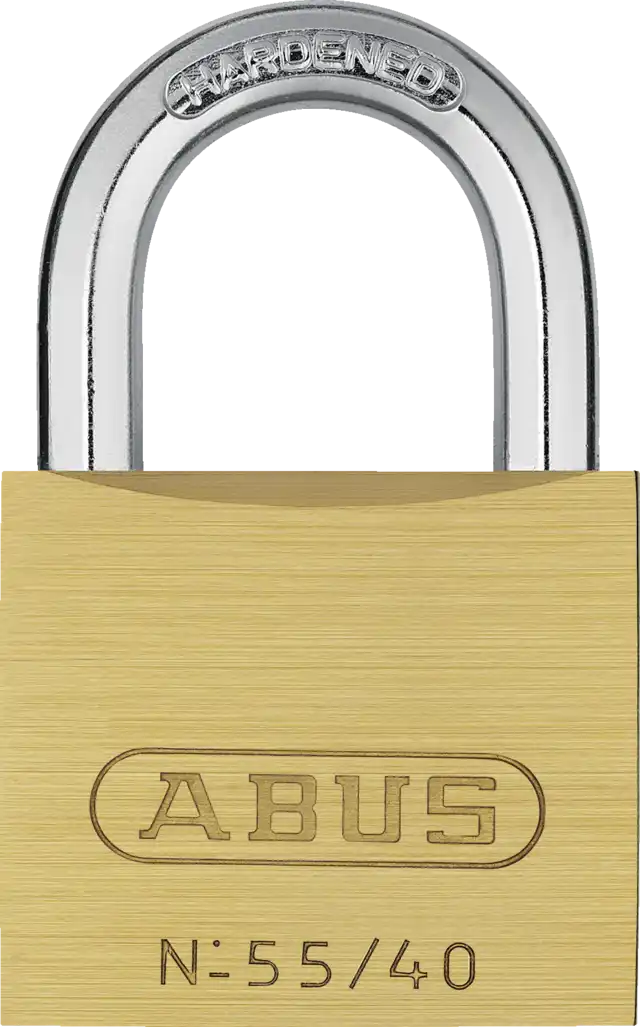
A solid brass body, not plated zinc, and you can tell the instant you pick it up.Tested That difference isn't cosmetic. Plated zinc is what almost everything at this price is made of, and it fails in two ways brass doesn't — the plating breaks down outdoors and the base metal is soft enough to deform under attack. Brass corrodes gracefully and stays dimensionally stable. It's the single biggest reason this lock is worth more than the one next to it on the peg.
The shackle is hardened steel with triple plating, and the internal components are specified as non-corrosive. Manufacturer The lock is also double-bolted — it latches on both sides of the shackle rather than one, so cutting through one leg doesn't release it. Manufacturer That's a meaningful feature at this price and it goes almost entirely unmentioned in retail listings.
It's self-locking: push the shackle down and it's locked, no key needed. Small thing, genuinely useful when you're locking a gate with your hands full.
What it's built for
ABUS lists the intended applications, and the list is honest about the tier: cables, doors, gates, cabinets, lockers, toolboxes, cellar windows, sheds, switchgear and barriers. Manufacturer That is a fair description of where this lock belongs. It is a deterrent and a delay for the things around your property that need locking but aren't worth a specialist's afternoon.
What it is not is a lock for anything a determined person with tools genuinely wants. That isn't a criticism — nothing in this size and price does that, and the ones that claim to are lying. If you're securing something valuable, the honest advice is to go up a tier and look at the closed-shackle and high-security options instead.
Weather
Better than almost anything comparable, with one caveat. The brass body handles damp and salt far better than plated zinc, and ABUS specifies the internals as corrosion-free. Manufacturer The limiting part is the shackle: it's plated steel, and in a permanently exposed outdoor fitting the plating is what will show wear first. Community For a shed or a gate that's fine for years. For something on a coast, take a look at the stainless-shackle models in the same family.
Chapter 2
Will It Actually Fit?
The question every padlock buyer has and almost no review answers
More people return a padlock because it doesn't fit than because it isn't secure. The numbers in the name don't help: the 40 in "55/40" is the body width in millimetres — it tells you nothing about the shackle, which is the part that has to go through your hasp.
So, measured properly: Documented
Dimension
Imperial
Metric
Why you care
Shackle diameter
1/4″
~6 mm
Has to pass through the hole in your hasp or chain link.
Shackle clearance (vertical)
55/64″
~22 mm
The usable opening. This is the number that decides whether it fits.
Shackle clearance (horizontal)
53/64″
~21 mm
Matters on a thick staple or a doubled-over chain.
Body width
1-1/2″
40 mm
The number in the name. Least important of the four.
Body depth
33/64″
~13 mm
Whether it sits flush in a recessed hasp.
Total height
2-23/64″
~60 mm
Clearance behind a door or inside a cabinet.
That 7/8-inch shackle clearance is the one that catches people out. It's fine for a standard hasp, a locker latch, a toolbox or a cabinet. It is not enough for a thick gate staple, a doubled chain, or most hasps on a shipping container.
If 7/8″ isn't enough, there's a version that is
ABUS make the 55/40HB63 — the same lock with a 2-1/2 inch shackle. Documented Identical body, identical cylinder, far more clearance. Almost nobody mentions it, and it's the answer to most "this didn't fit" reviews on the standard model. Measure your hasp before you order either.
Keyed alike is worth asking for
The 55/40 ships either keyed different (KD — every lock its own key) or keyed alike (KA — a batch that shares one key). Documented If you're locking a shed, a gate and a couple of toolboxes, keyed alike turns four keys into one and usually costs less per lock. Retail listings default to keyed different and rarely explain the option exists.
Two keys come with each lock. Manufacturer Have a spare cut before you need one.
Chapter 3
The Lock Is Not Your Weak Point
What actually gets attacked, and why it usually isn't the padlock
Here's the part that changes how you should spend the money, and it's the same argument we make about deadbolts and door frames: the lock is almost never the weakest component of the thing it's locking.
Walk out to your shed and look at what the padlock is attached to. Typically that's a stamped steel hasp, three or four millimetres thick, screwed into the door and frame with short wood screws — often the ones that came in the packet. The 55/40 has a quarter-inch hardened steel shackle and a solid brass body. The hasp has neither.
"A better padlock makes the shed more secure."
Only up to the point where the padlock stops being the easiest thing to defeat — and on most sheds, gates and lockers, it never was. Unscrewing a hasp, prying a staple out of soft wood, or levering the whole assembly off the door are all faster, quieter and require less skill than anything done to the lock itself. Upgrading from a Master Lock 3 to a 55/40 is worth doing. Upgrading from a 55/40 to a hundred-dollar padlock, while leaving the same hasp on the same four short screws, buys you almost nothing. Community
VerdictTrue until it isn't. Fix the mounting before you spend more on the lock.
What to do about it, in cost order:
Getting Your Money's Worth From This Lock
The lock is fine. The things around it usually aren't.
$0
Free
Look at the screws holding your hasp. If the heads are exposed when the lock is shut, the padlock is decorative — a screwdriver defeats the whole assembly.
Check the hasp covers its own fixings in the closed position. A well-designed one does. Most cheap ones don't.
Check the staple isn't loose in the wood. Wiggle it. If it moves, the lock is irrelevant.
<$15
Cheap
Replace the hasp screws with longer ones that reach framing rather than sitting in door skin. Same principle, same cost, as the door frame fix.
Where the fixings can't be hidden, use carriage bolts through the door with the nuts inside, not screws from outside.
<$40
Worth it
A concealed-fixing hasp — one where the plate covers the bolt heads once closed, and the shackle sits in a shrouded slot rather than an open loop.
A backing plate on the inside face so the bolts can't simply tear through thin timber or sheet steel.
$40+
Overkill
A closed-shackle padlock and a matching shrouded hasp, bought as a pair so the shackle is barely reachable. This is the point at which upgrading the lock starts paying again.
At that budget, look at the Diskus or a closed-shackle body rather than a bigger version of this lock.
And the one attack no padlock survives
Bolt croppers. A quarter-inch shackle is not going to defeat them, and neither is a half-inch one — the defence against cutting is geometry, not hardness. If a cropper's jaws can't get around the shackle, they can't cut it, which is why closed-shackle and disc-style bodies exist and why they look the way they do.
The 55/40's shackle is fully exposed on both sides. If somebody arriving with tools is in your threat model, this is the wrong product and no amount of brass changes that. For everything below that line — which is most sheds, gates, lockers and toolboxes — it's more lock than the thing it's protecting.
Chapter 4
Against The Alternatives
And who should buy something else
Lock
Body
Under a pick
The short version
ABUS 55/40
Solid brass, 40 mm
Five pins, spools in current production. Clean feedback that punishes sloppy tension.
Four pins — one fewer than this lock, at the same size and money. Security pinning is inconsistent and often absent. The comb attack opens it in about three seconds and requires no skill whatsoever.
Identical on the shelf, beaten by a bypass a child could perform.
No security pins at all. Tolerances loose enough that almost any upward pressure sets them. Under a second once you have any feel for it — raking, single pin picking, jigglers, a bobby pin with patience.
Not a lock. A lock-shaped object. We have never found a reason to recommend it.
Bought for shackle geometry, not pinning — far harder to get croppers onto.
Two of those deserve to be singled out, because they sit on the same peg at the same price and people buy them interchangeably. The 140D is the same size and the same money as the 55/40 with one fewer pin and a three-second bypass that needs no skill at all. The No. 3 is worse again — we opened one in under a second and it offers so little feedback that it will actively teach a beginner bad habits. Buying either instead of this lock is spending the same money to get less.
Buy it if
You want a first real lock to learn on and you're tired of clear acrylic practice locks.
You need a decent padlock for a shed, gate, locker or toolbox and you'd rather not buy something dishonest.
You want to understand what a false set feels like before you meet one somewhere it matters.
Buy something else if
Bolt croppers are in your threat model. Shackle geometry is the defence against cutting, and this lock's is small and exposed. Look at a Diskus or a closed-shackle body.
It's going somewhere hostile and outdoors permanently. Brass body is fine; the shackle is the limiting part.
You want serious manipulation resistance. Fifteen dollars does not buy that, and any page telling you otherwise is selling something.
Chapter 5
How Hard Is It To Pick?
The honest answer, from someone who spent a month failing
Everything above is what matters if you're buying a padlock. What follows is for the people who bought one to learn on — and anyone wondering how much resistance it really offers.
The honest version, because the dishonest version is everywhere: it took me somewhere around four to five weeks of daily attempts, roughly an hour most days, to open an ABUS 55/40 for the first time.Tested It felt considerably longer than that while it was happening, which is worth saying out loud, because the gap between how long something takes and how long it feels is most of why people quit.
Partway through I bought a second, convinced the first was defective. It wasn't. That second purchase is the only reason this page exists.
From the bench
I'm a yellow belt who has opened a handful of orange locks and exactly one green. That's calibration, not modesty — weigh everything below against it. A better picker will find this lock trivial and will happily show you on video.
Which is the problem. A clip of someone opening a lock in nine seconds contains almost no information for a learner. It doesn't tell you that four weeks of failing is normal, or that the thing blocking you might be one chamber the person in the video didn't happen to have.
Chapter 6
The Chamber That Stopped Me
One pin, more lift than its neighbours, and a month of my life
What eventually cracked it wasn't a new pick or better tension. It was noticing that one chamber needs appreciably more lift than the ones either side of it.Tested
The mechanism is simple once you see it. Every key pin has to be raised until its top reaches the shear line. A short key pin starts lower, so it has further to travel; a long one is already most of the way there. Key pin length is set by the cut depth on the key — a shallow, high cut pairs with a short key pin, a deep cut with a long one. So a single unusually high cut in the bitting produces a single chamber that wants far more lift than anything around it.
Which is a quiet disaster for a learner. You work chamber to chamber, calibrating against the pins you've already set — so when four set at roughly the same height and the fifth needs half again as much, your hands tell you you've finished. You haven't. You've under-set one pin and you're now hunting for a fault somewhere else entirely.
Fig. 04
Why one high cut breaks a learner's calibration
SECTION · SCHEMATIC
1At rest every stack is closed — key pin and driver are touching, and the joint between them sits below the shear line. The driver bridging that line is what stops the plug turning.
2Chamber 4's key pin is short, so its driver is correspondingly long. In current production this is the sort of chamber where a spool sits, which puts a false set on top of an under-set.
3Picking lifts each stack until its joint arrives at the shear line. Chamber 4's joint starts far lower, so it needs roughly twice the lift of its neighbours — set the other four and your hands report a finished lock.
Schematic, not a section of an actual 55/40. Pin lengths are drawn to show relative lift, not to scale, and chamber numbering is illustrative — see Chapter 3 for where the outlier actually sat on my units.
Once I knew to look for a chamber wanting more travel than the rest, the lock stopped being a wall. Not a technique, not a tool — a piece of information about the specific lock in my hand.
And that raises the obvious question, which is what the rest of this review is about: is that a fact about the ABUS 55/40, or a fact about my ABUS 55/40?
Chapter 7
Three Units, Three Locks
The bit nobody publishes, because nobody buys three of the same padlock
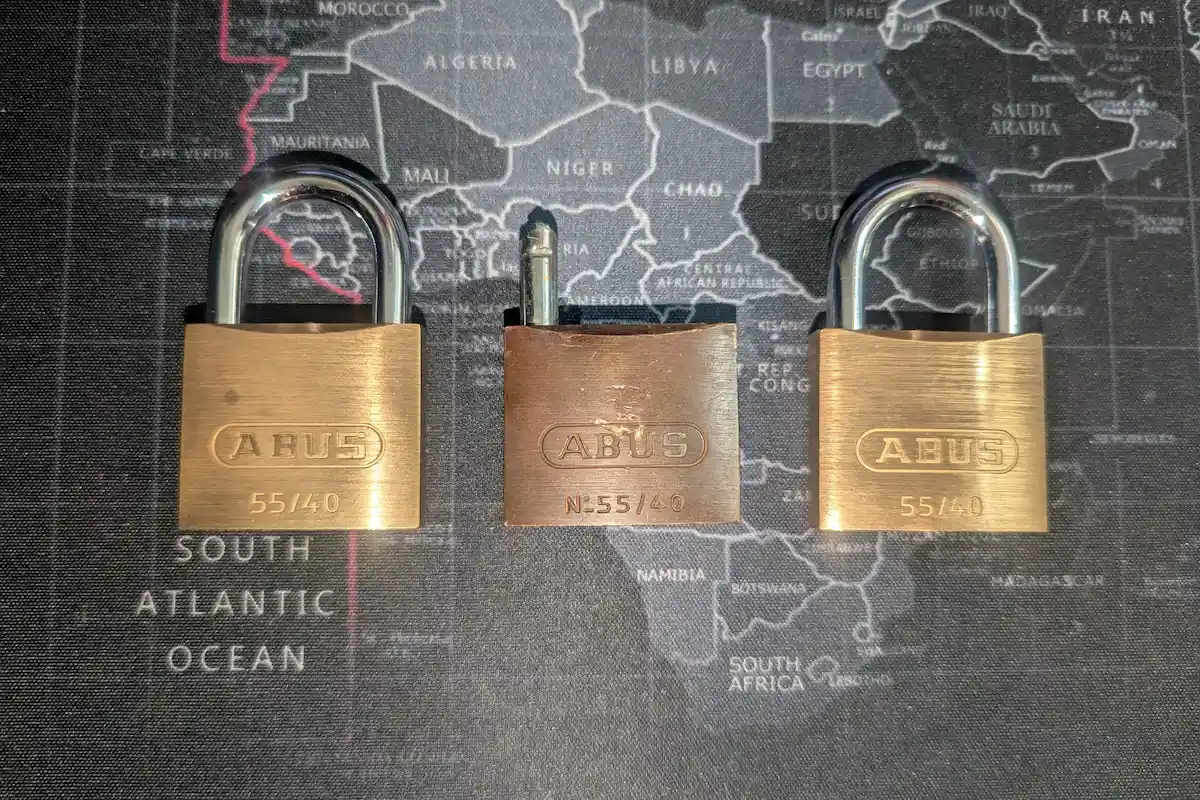
Here is what I actually have. Tested
All three. Same model, same shelf, three different locks to pick.
Tab. 01
Unit comparison — three ABUS 55/40s, same model
Unit
Security pins
Behaviour on the bench
Unit A current production
Spools — plug rotates, feels like progress, drops back.
One chamber wanting clearly more lift than its neighbours.
OUTLIER PRESENT
Unit B current production
Reads as spools, same character as A.
Picks much like A. Different cuts, so a different binding order — the ordinary difference between any two keyed-different locks.
OUTLIER PRESENT — DIFFERENT POSITION
Unit C older body
Reads more like serrated than spool. Some sessions it feels like there's no security pinning in there at all.
Doesn't present the same obstacle. A different lock to pick, wearing the same label.
NO CLEAR OUTLIER
Sample of three, one owner, no disassembly. This is a bench observation, not a teardown — I have not pulled the plugs to confirm pin lengths directly, and until I do, everything above is inference from feel.
Why this happens
None of this suggests ABUS is doing anything wrong. A mass-produced padlock is pinned to a keying schedule so units sold in the same shop don't share a key. Bitting varies deliberately, and where an extreme cut lands is a function of the code, not of quality control.
The consequence is what matters: two 55/40s off the same peg can be meaningfully different locks to pick, and the difference isn't visible from outside. Mine differ enough that I'd have given the same model quite different write-ups depending on which one I'd bought first.
What that does to every pick time you've read
Including mine. "Four to five weeks" is a claim about one learner and one specimen; "nine seconds" is a claim about one expert and one specimen. Neither is a property of the model, and both get repeated as though they were.
This is a general problem with mass-produced pin tumblers and it's badly under-acknowledged. A published opening time without a unit count, a bitting note, and a production date is not really a measurement — and almost nobody publishes those. It's the reason we'd rather build a logged dataset than quote single demonstrations — and why the head-to-head against the Master Lock 3 says how many copies of each we opened.
The finding
Difficulty on this lock is a property of the individual unit, not the model. Which means a published pick time for a 55/40 is a statement about one padlock somebody happened to own.
If you're buying this to learn on
Buy two. Not for redundancy — for calibration. The moment you have two of the same lock that behave differently, you stop attributing every failure to your own technique, which is the single most demoralising mistake a beginner makes. It's also about thirty dollars, which is less than most first pick sets.
Questions
The Ones People Actually Ask
Short answers
Will the ABUS 55/40 fit my hasp?
The usable shackle opening is 55/64″ (about 22 mm) vertically with a 1/4″ shackle. That covers a standard hasp, locker latch, toolbox or cabinet. It will not cope with a thick gate staple, a doubled chain, or most container hasps — for those, ABUS make the 55/40HB63 with a 2-1/2″ shackle. Measure the opening before you order.
Does the ABUS 55/40 have security pins?
Yes — spools, in current production. That's the consensus among people who have taken one apart, it matches what our two newer units do at the bench, and it's why the lock is recommended for learning false sets. Community Note that ABUS's own English literature says "mushroom counter pins"; that's a translation of the German Pilzkopfstifte, which their marketing uses as a blanket term for anti-pick pins across the whole range. It isn't a per-model geometry claim. Our older unit reads more like serrated, and on some sessions like very little at all.
How long does it take to pick?
There isn't a real answer, and that's the point of this review. It took me four to five weeks of daily attempts to open one for the first time. It takes an experienced picker under a minute. And two of my own units differ enough from each other that I'd give different answers depending which one you handed me.
Is it a good first lock to learn on?
It's the one I'd recommend, with one adjustment: buy two. Tight tolerances mean it gives clean feedback and won't reward sloppy tension, and the spools teach false sets properly. Two units means you can tell the difference between a hard lock and a bad day.
What picks and tension does it want?
The keyway is tighter than an American padlock of the same price, so thinner picks are easier to work with, and top-of-keyway tension leaves you more room. Beyond that, tool choice mattered far less for me than realising one chamber needed more lift than the rest.
Is it weatherproof?
Reasonably, for a fifteen-dollar lock. The brass body handles damp far better than plated zinc. The shackle is the part that will show wear first in a permanently exposed outdoor fitting.
Will it stop a determined thief?
No, and nor will anything else in this size and price bracket. It stops opportunists, it resists casual manipulation, and it's a visible signal that the owner thought about it. Against tools, shackle geometry and body size decide the outcome, and this lock is small.
Specification
Model
ABUS 55/40 brass padlock
Body
Solid brass, 1-1/2″ (40 mm) wide × 33/64″ deep — the "40" is body width, not shackle
Double-bolted, self-locking. Keyed alike or keyed different. Two keys per lock
Cylinder
Pin tumbler with spool security pins in current production Community. Distributors list five pins; at least one teardown account reports four. See sources
Keyway
Tighter than comparable American padlocks; favours thinner picks
Locksport tier
Around Yellow Belt in community ranking Community
Units owned
Three. Two current production, one older body
First open
Approx. 4–5 weeks of near-daily attempts, roughly an hour per session Tested
Now
Opens on most attempts, usually quickly Tested
Street price
Roughly $15 USD
Where to buy
ABUS 55/40 Brass Padlock
~$15 USD
If it's for learning, buy two. The second one is the control, and it will save you weeks of blaming your own hands for something that's a property of the lock.
Keyed-alike sets are available and are usually cheaper per lock — worth it if you're kitting out a shed, gate and a couple of lockers.
I spent about a month convinced I was bad at this. I was bad at this — but not for the reason I thought. The obstacle wasn't tension or pick selection or patience. It was one chamber pinned differently from its neighbours, on one particular lock, and I had no way of knowing that because everyone who writes about this lock writes about it as though there were only one of them.
There are at least three, and I own them.
Verdict — 8 / 10
The best fifteen dollars in locksport, and the strongest argument on this site that a single pick time tells you almost nothing.
Sources & Method
Everything in Chapters 1, 2 and 3 — Tested
Three ABUS 55/40 padlocks owned by the author, picked by hand over an extended period. Time to first open, the high-cut chamber that caused the delay, and the character of the security pinning are bench observations on those locks. Correction: an earlier version presented differences between units as notable unit-to-unit variation. That was overstated — two keyed-different locks necessarily have different cuts and therefore different binding orders, which is ordinary rather than a finding. The third unit is old and physically damaged, with a cut shackle, so where it behaves differently that reflects wear rather than manufacture.
Limitations, stated plainly: sample of three; one owner; no plugs pulled, so pin lengths are inferred from feel rather than measured; no controlled timing.
The lift mechanism — Community
Standard pin tumbler behaviour: a key pin must be raised until its top reaches the shear line, so a shorter key pin — paired with a shallower cut — requires more lift. This is textbook mechanism rather than a finding, and it is the explanation we reached for the bench observation above, not something we proved independently.
Correction — previous copy on this site — Corrected
Our head-to-head page previously described the outlier as "a very high cut biting — meaning the key cut at that position is deep, so the corresponding pin sits low." That is self-contradictory: a high cut is a shallow cut, which gives a short key pin needing more lift, not less. Corrected here and on that page.
Correction — time to first open — Corrected
This figure has appeared on the site as "three to four weeks" and elsewhere as "three to six weeks." On checking with the author, roughly four to five weeks is the accurate figure. Standardised across all pages in this revision.
Dimensions, double-bolting, keying options and the HB63 variant — Documented
ABUS published product data for the 55 brass series, and distributor specification listings.
ABUS 55 series
Spool pins, and why ABUS's own copy says otherwise — Community
Teardown and picking accounts consistently report spool drivers in the 55/40, and pick demonstrations describe it as a good lock for learning the feel of a spool. This matches our two current-production units.
ABUS's English product literature describes "mushroom counter pins" — a translation of the German Pilzkopfstifte, used as a generic term for anti-pick counter pins across their entire catalogue rather than as a per-model geometry specification. The same phrasing appears on their Euro cylinders, in one listing rendered by machine translation as counter-pins "in the shape of a head fungus." Treated as marketing boilerplate, not as a contradiction of the teardowns.
Pin count — open question — Unresolved
Distributor specifications list the 55/40 as a five-pin cylinder. At least one first-hand account from someone who inspected the cylinder reports four pins — three spools and one standard. We have not counted ours, and we would rather flag the disagreement than repeat a number we have not checked.
Locksport tier and general consensus — Community
LPU belt ranking places the 55/40 around Yellow. Widely held, not something we can verify independently, and belt lists change.
Body material and dimensions — Manufacturer
ABUS product specification: solid brass body, 40 mm width. Verified by hand for material feel and size, not by assay.
This is one of a small number of pages on this site carrying Tested tags, and they cover three locks — not a laboratory. The central finding here would be far stronger with thirty units than with three, and if you own several 55/40s and have noticed the same outlier behaviour, or haven't, tell us — we'd like to build this into something with a real sample size, and you'll be credited.