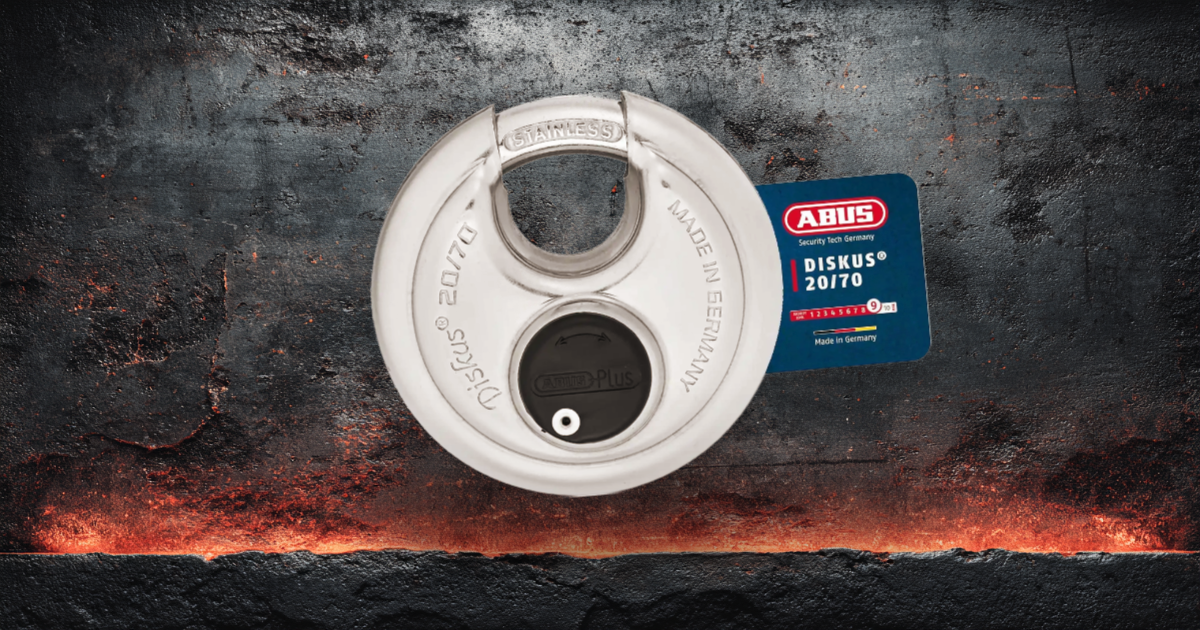
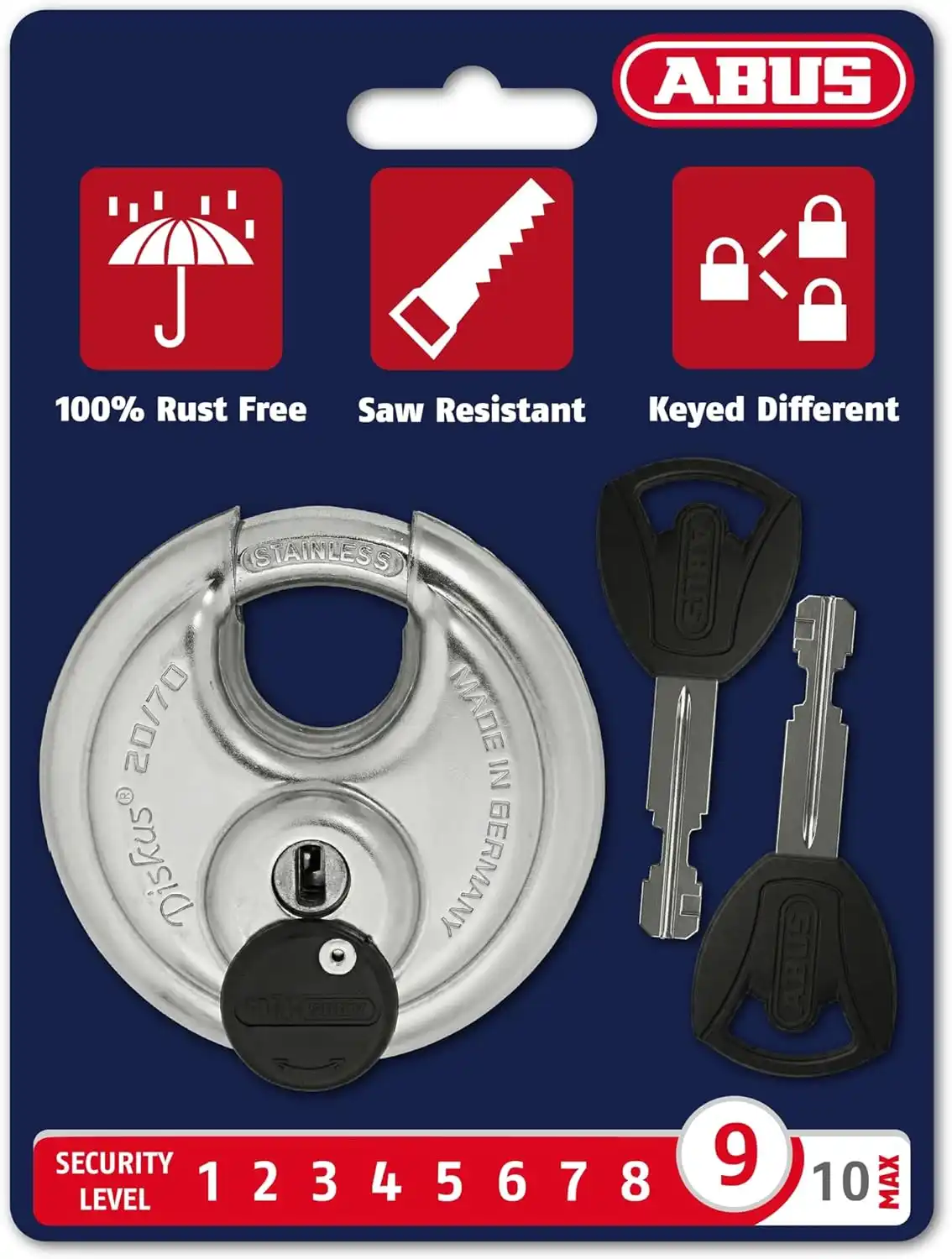
The best answer there is to bolt cutters at anything near this price. Stainless inside and out, hand-welded in Germany, almost no shackle exposed, and a disc detainer cylinder that raking, bumping and comb picks simply don't apply to. Fit it and forget it for a decade.
Two things to know rather than complain about. It isn't rekeyable, so order keyed-alike sets together. And the shackle opening is deliberately tiny — that's the security working, but measure your hasp first. Where it's genuinely the wrong buy is a shed nobody is targeting, where a fifteen-dollar brass padlock is enough lock and the money belongs in the hasp.
Cut & pry resistance10
Cylinder & pick resistance9
Corrosion resistance10
Fitment & versatility6
Value where it belongs8
How to read this review
We do not own this lock. Everything below is specification, mechanism and community consensus, and it's tagged accordingly.
TestedPhysically in hand. Nothing on this page carries this tag.
DocumentedPublished specification or primary source. Linked at the bottom.
ManufacturerABUS's own claim. A claim, not a fact.
CommunityLocksmith and locksport consensus. Informed opinion.
Almost every padlock is defeated the same way, and it isn't picking. Bolt cutters get their jaws around an exposed shackle and squeeze. Everything else — pin count, security pins, tolerances — is irrelevant to that attack.
Resistance to cutting is a function of geometry, not hardness. A thicker shackle helps only once the jaws are already on it. If they can't get on, thickness never enters the calculation. That's the entire argument for the disc shape, and it's why we make the same point in the budget roundup and again in the ABUS 55/40 review: shape beats steel.
The Diskus body is a stainless disc with the shackle buried inside its circumference. The opening left for the hasp is deliberately tiny — 17 mm vertical, 20 mm horizontal Documented — which leaves nowhere for cutter jaws, a pry bar, or a hammer to find purchase.
Two more details that follow from the shape:
- The two halves are joined by a hand-welded seam, made in Germany. Manufacturer That seam is the obvious attack — split the housing and the mechanism is exposed — and welding rather than pinning or screwing it is why splitting it isn't practical.
- Stainless steel inside and out, with a hardened alloy steel shackle. No plating to fail, no laminate seams for water to sit in.
"A disc lock is a high-security lock."
A disc lock is a high-cut-resistance lock. The two are not the same thing, and cheap disc-shaped padlocks are everywhere — the shape has been copied by nearly every manufacturer, usually without the cylinder or the welded construction that makes the original work. A copy with a four-pin cylinder in it is still a four-pin lock; it just costs more to cut off. Judge a disc lock on what's inside the disc.
VerdictThe shape is necessary, not sufficient. This particular one happens to have both.
Here's the part that surprises people who've read the rest of this site. The 20/70 doesn't have a pin tumbler cylinder. It has an ABUS Plus disc detainer cylinder — a fundamentally different mechanism. Documented
Instead of spring-loaded pin stacks that have to be lifted to a shear line, a disc detainer uses a stack of rotating discs. The key doesn't push anything up; it rotates each disc to a specific angle. When every disc is at the correct angle, a slot lines up across all of them and a sidebar drops in, freeing the core.
What that changes, practically:
- Standard picks are useless. A hook and a tension wrench act on pins. There are no pins. Opening a disc detainer requires a purpose-built disc detainer pick and a different technique entirely — a much smaller population of people own one and know how to use it. Community
- No springs means nothing to jam with dirt or ice. Combined with the fitted cylinder cover, this is a large part of why the lock survives outdoors as well as it does.
- Raking and bumping don't apply — both exploit pin stacks, which this doesn't have.
- ABUS specify drilling and pulling protection in the cylinder and around 250,000 key differs. Manufacturer
None of which makes it unopenable. Disc detainers are picked, and the good ones are picked by people with the right tool and real practice. But it removes this lock from the category most padlock attacks live in, and against an opportunist it may as well be welded shut.
Worth being precise about
ABUS market this lock as "virtually pickproof." Manufacturer That is a manufacturer's phrase and we'd not repeat it as our own. What's defensible is narrower and still impressive: it isn't vulnerable to the attacks that defeat almost every other padlock at any price, because those attacks all assume pins.
We don't own one, so nothing here is Tested. If you own a 20/70 and have opened one, or failed to, that's worth more than this whole chapter — send it over.
This is the section most Diskus reviews skip, and it's the one most likely to cost you money.
Read the clearance row twice. The Diskus has a smaller shackle opening than a fifteen-dollar brass padlock, and a shackle nearly twice as thick going through it. That is not a flaw — it is the entire security mechanism — but it means:
- It will not fit most gym and school lockers. The 10 mm shackle is simply too fat for the latch. ABUS's own smaller Diskus models use an 8 mm shackle for exactly this reason. Documented
- It will not fit a thick gate staple or a doubled chain. 17 mm of vertical opening is not much.
- It is heavy for its size — a third of a kilo — which matters on a light door or a locker latch.
- It is not rekeyable. Lose the keys and you replace the lock. If you want a padlock you can key to an existing system, that's the 83/55 Rock, not this.
Buy the hasp with the lock
ABUS make a matched hasp — the 140 series — designed so the Diskus sits inside it and the shackle is effectively unreachable. Manufacturer This matters more than it sounds. A shrouded lock on an ordinary hasp still leaves the hasp as the weakest part, and on a shed or a unit door the fixings are usually easier to defeat than the lock. Same argument as the door frame guide: the lock is rarely the weak point.
One naming thing worth knowing
The Diskus family spans several series and they are not the same lock. The 20 series is the top of the line — it's the evolution of the older 24 series, upgraded with the ABUS Plus disc cylinder and a hardened alloy shackle. Documented The 24 series still sells, still has the shape, and costs less, but it's a different cylinder. If you see a cheap "Diskus," check the series number before assuming it's this lock.
Specification
Model
ABUS Diskus 20/70, 20 series
Body
Stainless steel inside and out, 70 mm (2-3/4″) diameter × 30.5 mm deep, hand-welded seam, made in Germany
Shackle
Hardened alloy steel, 10 mm (3/8″) diameter
Clearance
17 mm (21/32″) vertical, 20 mm (25/32″) horizontal
Cylinder
ABUS Plus disc detainer with drill and pull protection; approx. 250,000 key differs Manufacturer
Rekeyable
No. Keyed different, keyed alike or master keyed to order
Supplied with
Two keys, security code card, fitted cylinder cover
Matched hasp
ABUS 140 series
ABUS made the disc padlock roughly forty years ago and the shape has been copied by nearly every manufacturer since, usually without the cylinder or the welded housing that made it work. The copies prove the idea was right; they don't replace it.
What makes the 20/70 worth its money isn't that it's hard to pick — plenty of locks are. It's that it declines to play the game most padlocks lose. There's nothing for cutters to grip, nothing for a pry bar to lever, no seam to split, no pins to rake, and no plating to corrode off. The trade is that it's heavy, expensive, permanent, and might not fit your hasp.
Verdict — 8.5 / 10
The best-shaped padlock money buys at this price, and a decade of not thinking about it. Get a tape measure out first.